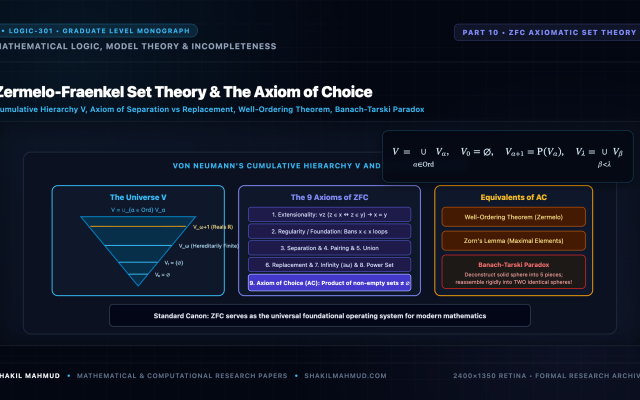
Following the collapse of naive set theory, Ernst Zermelo (1908) and Abraham Fraenkel (1922) undertook the monumental reconstruction that established the standard...
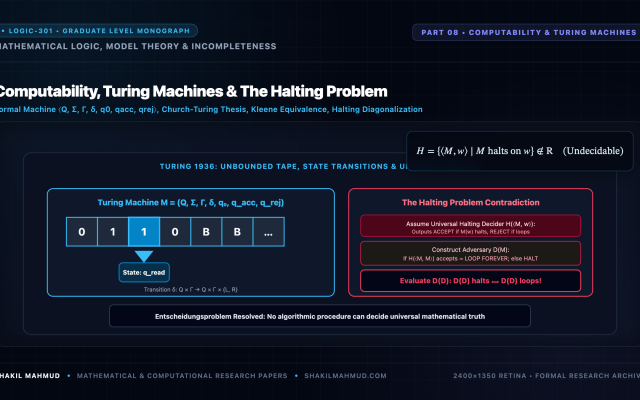
In 1936, a 24-year-old British mathematician named Alan Mathison Turing set out to resolve David Hilbert’s remaining foundational challenge: the Entscheidungsproblem (the...
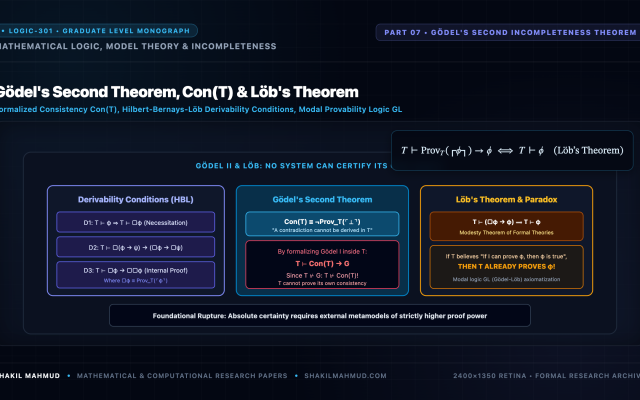
If Gödel’s First Incompleteness Theorem showed that formal systems have blind spots, his Second Incompleteness Theorem delivered the fatal blow to David...
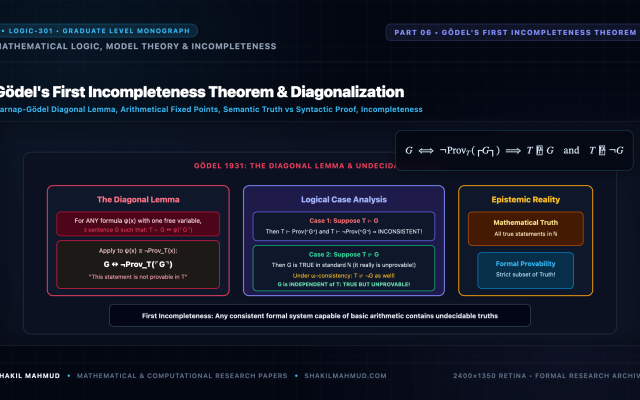
In 1931, Kurt Gödel published the paper that permanently altered human epistemology: “Über formal unentscheidbare Sätze der Principia Mathematica und verwandter Systeme...
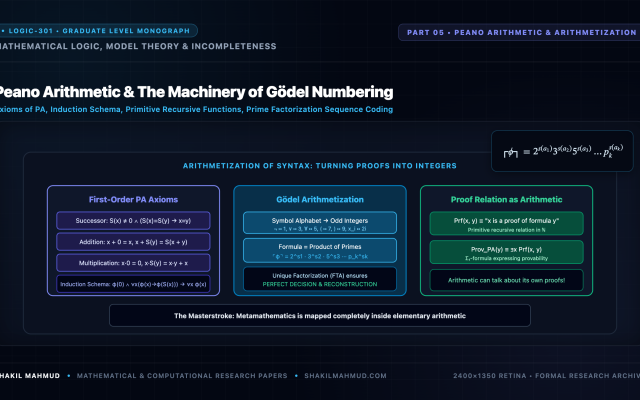
For millennia, numbers were perceived as objects to be studied, while logical deductions about those numbers were considered an external commentary belonging...
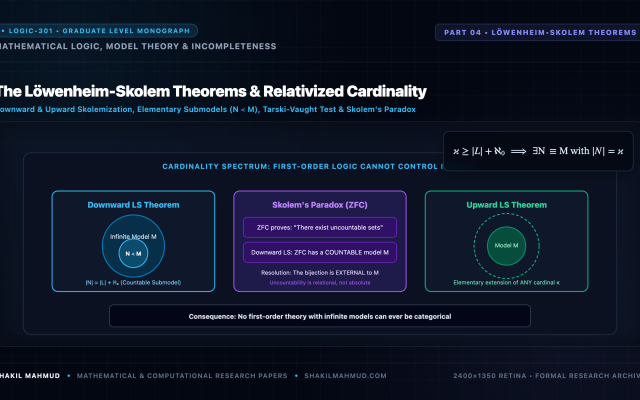
In 1915, Leopold Löwenheim proved a startling result about first-order formulas, later generalized by Thoralf Skolem in 1920: if a first-order theory...
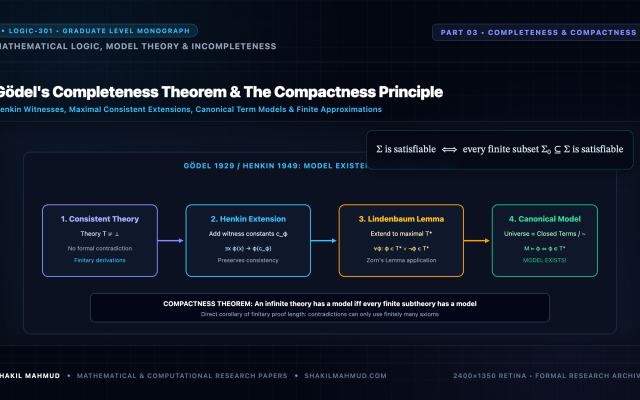
In 1929, at the age of twenty-three, Kurt Gödel published his doctoral dissertation establishing the crowning achievement of early mathematical logic: the...
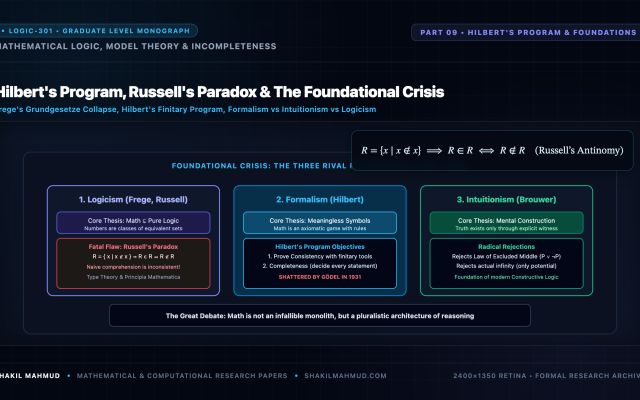
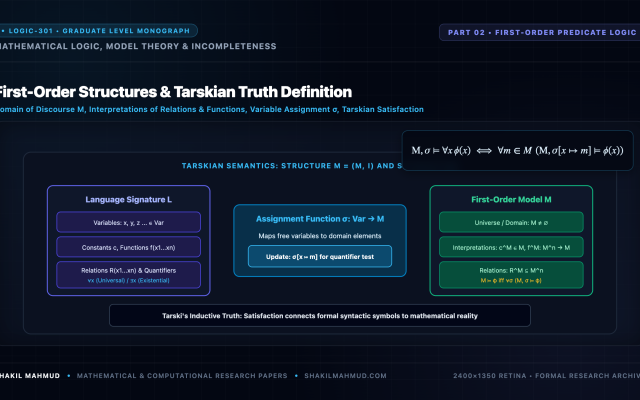
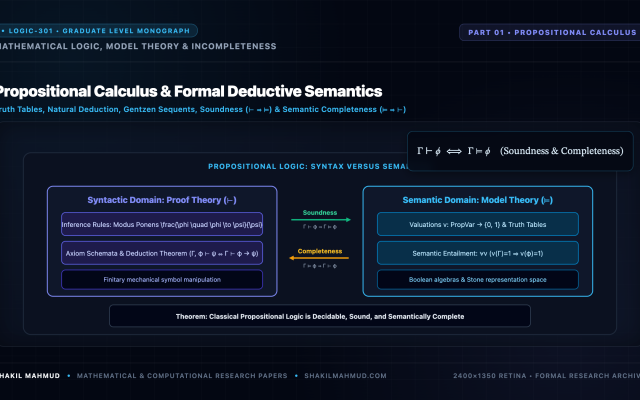
At the foundational roots of mathematical thought lies a profound dualism: the tension between syntactic deduction—the mechanical manipulation of uninterpreted typographical marks...
•4 min read
Editorial Academy
Learner Portal & Sync
Open to everyone worldwide—researchers, engineers, students, and independent scholars. Sign in with Google or your email to securely track reading progress across devices, take faculty examinations, and earn verified diplomas.
or continue with email
🎓
Enrolled Academic Curricula (43 Disciplines)
The Great Equations (MATH-101)20 Parts • Mathematical Physics & Epistemology
The Story of Physics (PHYS-101)20 Parts • Classical & Modern Theoretical Physics
The Universal Chronicle (COSM-101)20 Parts • Astrophysics & Big History Cosmology
The Evolutionary Odyssey (BIOL-101)20 Parts • Paleobiology, Genetics & Macroevolution
The Story of Consciousness (PHIL-101)20 Parts • Cognitive Neuroscience & Philosophy of Mind
The History of Computing and AI (COMP-101)20 Parts • Computer Architecture & Machine Intelligence
The History of Bengal (HIST-101)20 Parts • Regional Historiography & Geopolitical Economy
The Epic of Human Civilization (CIV-101)20 Parts • World History & Civilizational Anthropology
The Evolution of Money & Markets (ECON-101)20 Parts • Monetary History, Central Banking & Macroeconomics
The Story of Chemistry (CHEM-101)20 Parts • Molecular Sciences, Quantum Bonding & Nanotechnology
The Story of Genetics (GEN-101)20 Parts • Molecular Biology, Genomics & Synthetic Life
The History of Philosophy (PHIL-101)20 Parts • Epistemology, Classical Metaphysics & Continental Thought
Game Theory & Mechanism Design (GAME-101)20 Parts • Strategic Interaction, Mechanism Design & Algorithmic Economics
Nuclear Physics, Fusion Energy & Advanced Reactors (ENERGY-201)20 Parts • Nuclear Physics, Thermonuclear Plasmas & Reactor Engineering
Autonomous Robotics, Kinematics & Spatial Intelligence (ROBOT-201)20 Parts • Robotic Kinematics, Dynamics, SLAM & Embodied AI
Modern Cryptography, Zero-Knowledge & Post-Quantum Security (CRYPTO-301)20 Parts • Mathematical Cryptography, Complexity Theory & Zero-Knowledge Systems