Following the collapse of naive set theory, Ernst Zermelo (1908) and Abraham Fraenkel (1922) undertook the monumental reconstruction that established the standard foundation for all of modern mathematics: Zermelo-Fraenkel Set Theory with the Axiom of Choice ($text{ZFC}$). By structuring the mathematical cosmos into John von Neumann’s cumulative hierarchy $V$, $text{ZFC}$ safely houses all of analysis, algebra, and topology while warding off antinomies. Yet, its crowned jewel—the Axiom of Choice—unleashed paradoxical wonders like the Banach-Tarski Paradox.
1. The Cumulative Hierarchy $V$
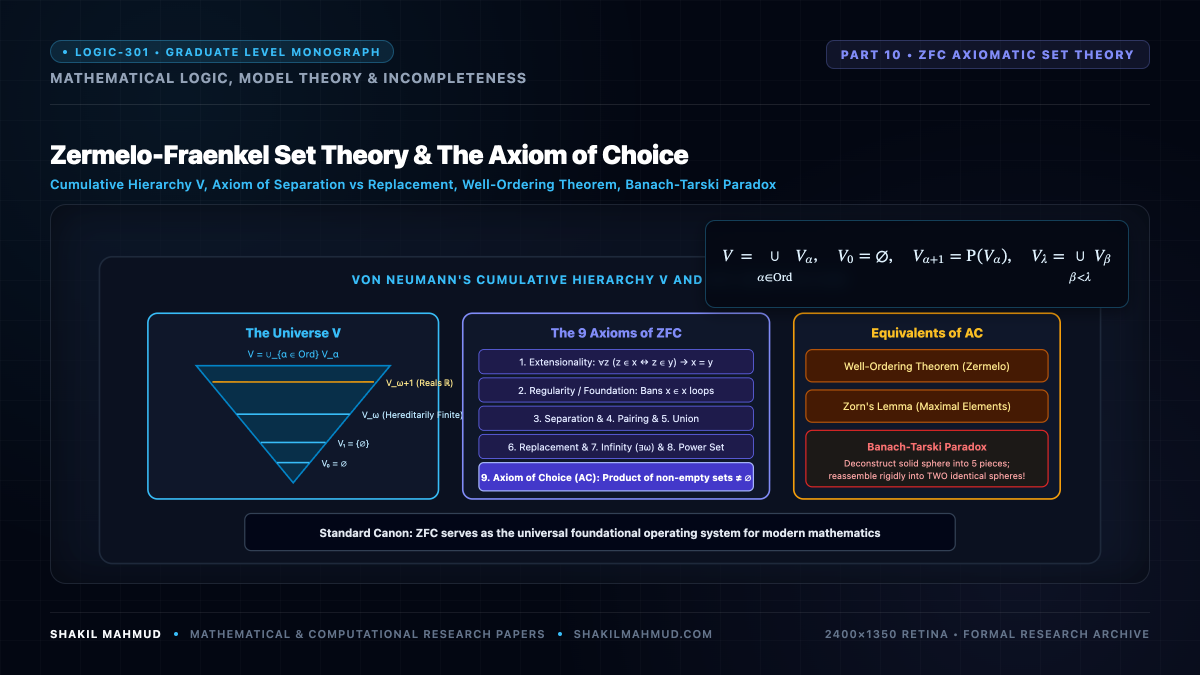
In $text{ZFC}$, every mathematical object—integers, real numbers, functions, manifolds, topological spaces—is constructed purely out of sets, starting from the empty set $emptyset$. Von Neumann organized this universe into an escalating transfinite hierarchy of stages indexed by the ordinals $text{Ord}$:
The Von Neumann Universe $V$
[
V = bigcup_{alpha in text{Ord}} V_alpha
]
- Base Stage: $V_0 = emptyset$
- Successor Stages: $V_{alpha+1} = mathcal{P}(V_alpha)$ (The power set of the previous stage)
- Limit Stages: $V_lambda = bigcup_{beta < lambda} V_beta$ for limit ordinals $lambda$
The universe unfolds in majestic transfinite tiers: $V_0$ has $0$ elements, $V_1 = {emptyset}$ has $1$ element, $V_2 = {emptyset, {emptyset}}$ has $2$ elements, $V_3$ has $4$ elements, and $V_omega$ contains all hereditarily finite sets (isomorphic to elementary arithmetic). The real numbers $mathbb{R}$ appear at $V_{omega+1}$, and higher functional analysis lives within $V_{omega+2}$.
2. The Axioms of ZFC
Formulated in the first-order language with the single membership relation $in$, $text{ZFC}$ rests upon nine fundamental axiom groups:
- Extensionality: Sets with the same elements are identical:
[
forall x forall y , (forall z (z in x leftrightarrow z in y) to x = y)
] - Regularity (Foundation): Every non-empty set $x$ has an $in$-minimal element ($x cap y = emptyset$ for some $y in x$). This prohibits infinite descending membership chains $dots in x_2 in x_1 in x_0$ and self-containing loops $x in x$.
- Separation Schema (Specification): For any formula $phi$ and set $A$, the sub-collection ${ x in A mid phi(x) }$ is a set. Crucially, sets can only be carved out of pre-existing sets, permanently blocking Russell’s paradox.
- Pairing: For any sets $a, b$, there exists ${a, b}$.
- Union: For any set of sets $mathcal{F}$, the union $bigcup mathcal{F}$ is a set.
- Replacement Schema (Fraenkel): If a class function $F$ maps elements of a set $A$ to sets, the image $F[A] = { F(x) mid x in A }$ is a legitimate set.
- Infinity: There exists an infinite set containing $emptyset$ and closed under successor ($x cup {x}$), guaranteeing the existence of $omega cong mathbb{N}$.
- Power Set: For any set $x$, the collection of all subsets $mathcal{P}(x)$ is a set.
3. The Axiom of Choice ($text{AC}$)
The ninth and most controversial pillar is the Axiom of Choice:
The Axiom of Choice
For any set $X$ of pairwise disjoint non-empty sets, there exists a choice function $f: X to bigcup X$ such that for every $A in X$, $f(A) in A$. Equivalently: the Cartesian product of any family of non-empty sets is non-empty.
Unlike constructive axioms, $text{AC}$ asserts the existence of a selection function without providing any algorithm, formula, or rule to determine which elements are selected.
4. Equivalents of Choice
The Axiom of Choice is mathematically equivalent to several cornerstones of modern mathematics:
- Zermelo’s Well-Ordering Theorem: Every set can be well-ordered (endowed with a total order where every non-empty subset has a least element).
- Zorn’s Lemma: Every partially ordered set in which every chain has an upper bound contains at least one maximal element.
- Tychonoff’s Theorem: The arbitrary product of compact topological spaces is compact.
- Basis Theorem for Vector Spaces: Every vector space (even infinite-dimensional Hilbert or Banach spaces) possesses a Hamel basis.
- Krull’s Theorem: Every non-trivial commutative ring with identity contains a maximal ideal.
5. The Banach-Tarski Paradox (1924)
The non-constructive power of $text{AC}$ produces astounding geometrical consequences. Stefan Banach and Alfred Tarski proved:
The Banach-Tarski Paradox
A solid three-dimensional unit ball $B subset mathbb{R}^3$ can be decomposed into a finite number of disjoint subsets (in fact, just five pieces!), which can then be rotated and translated rigidly to form TWO solid unit balls identical to the original!
This is not physical matter duplication; it is a profound discovery about measure theory. The five pieces constructed via the Axiom of Choice are non-measurable sets: they possess no mathematically definable volume. When rigid Euclidean rotations are applied, Lebesgue measure is undefined on the pieces, dissolving the apparent physical contradiction.