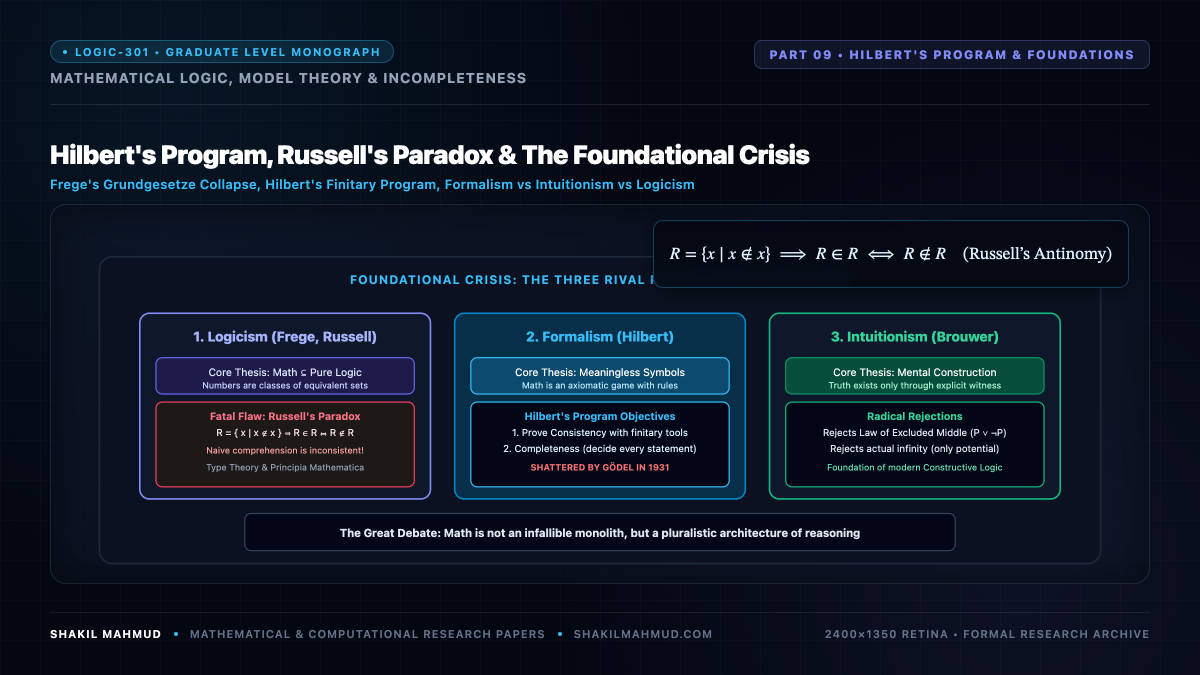
At the turn of the twentieth century, the mathematical world was shaken by a structural crisis. Gottlob Frege’s monumental attempt to derive all of arithmetic from pure logic in his Grundgesetze der Arithmetik was torpedoed on the verge of publication by a brief letter from Bertrand Russell exposing a fatal contradiction: the Russell Paradox. In response, David Hilbert launched his ambitious Finitary Formalist Program to establish once and for all the consistency, completeness, and decidability of mathematics. This historic battle among Logicism, Intuitionism, and Formalism redefined what it means for mathematics to be true.
1. Russell’s Paradox and the Death of Naive Comprehension
Frege’s system relied on the intuitive principle of Naive Comprehension (Basic Law V): for any property or formula $phi(x)$, there exists a set containing precisely those objects satisfying $phi$:
[
exists y forall x , (x in y leftrightarrow phi(x))
]
In 1901, Bertrand Russell considered the property $phi(x) equiv (x notin x)$—the class of all sets that do not contain themselves as a member. Let $R = { x mid x notin x }$. Russell asked: Does $R$ contain itself?
[
R in R iff R notin R
]
If $R in R$, then by its defining condition, $R notin R$. Conversely, if $R notin R$, then $R$ satisfies the condition, so $R in R$. A direct logical antinomy!
The paradox proved that naive set comprehension is mathematically impossible. A universal “set of all sets” cannot exist without unleashing catastrophic inconsistency across classical deduction.
2. The Tripartite War over Foundations
In the wake of Russell’s paradox, three rival philosophical camps engaged in a ferocious intellectual civil war:
1. Logicism (Gottlob Frege, Bertrand Russell, Alfred North Whitehead)
Logicism contended that mathematical truths are nothing more than tautologies of pure deductive logic. Russell and Whitehead published the gargantuan three-volume Principia Mathematica (1910–1913), attempting to rebuild mathematics on a strict hierarchy of types (the Ramified Theory of Types) to block circular self-reference. However, to construct the real numbers and arithmetic, they had to postulate non-logical axioms—the Axiom of Reducibility and the Axiom of Infinity—compromising the purity of the logicist thesis.
2. Intuitionism (L.E.J. Brouwer, Arend Heyting)
Brouwer launched a radical revolt: mathematics is not discovered in an external Platonic realm, but constructed within the human temporal intuition. Mathematical objects exist only if they can be explicitly calculated in a finite number of mental steps. Brouwer rejected actual infinity, the Bolzano-Weierstrass theorem, and the cornerstone of classical logic: the Law of Excluded Middle ($P lor neg P$). For Brouwer, a non-constructive existence proof through contradiction ($neg neg P to P$) is an empty illusion.
3. Formalism (David Hilbert)
Hilbert sought to rescue classical mathematics from Brouwer’s radical amputations without succumbing to paradox. His famous battle cry resounded across Europe: “No one shall expel us from the paradise that Cantor has created for us!”
3. Hilbert’s Program (1920–1930)
Hilbert proposed to treat all of higher mathematics as a purely mechanical game played with uninterpreted symbols on paper according to explicit syntactic rules. The program demanded three absolute objectives:
- Formalization: Express all mathematical theories (number theory, analysis, geometry, set theory) in precise axiomatic systems without semantic ambiguity.
- Finitary Consistency Proof: Prove that these systems are completely consistent ($Sigma notvdash bot$) using only finitary methods—concrete, constructive symbol manipulations so elementary that even an intuitionist like Brouwer could never dispute them.
- Completeness & Decidability: Prove that every mathematical statement expressible in the language can either be proved or disproved ($text{Completeness}$), and construct an algorithm to decide any statement ($text{Decidability / Entscheidungsproblem}$).
4. The Inevitable Collapse
In September 1930, at the Second Conference on the Epistemology of the Exact Sciences in Königsberg, a quiet 24-year-old Kurt Gödel announced his First Incompleteness Theorem. Within months, he deduced the Second Theorem:
The Fatal Blow to Hilbert’s Program
Any consistent formal theory $T$ strong enough to express elementary arithmetic cannot prove its own consistency using the methods of $T$, let alone using a weaker finitary sub-system!
Hilbert’s quest for an absolute, self-contained, finitary guarantee of mathematical consistency was mathematically impossible. Yet, far from destroying mathematics, the collapse of Hilbert’s program gave birth to mathematical logic as an autonomous discipline, establishing the modern fields of proof theory, computability, and model theory.