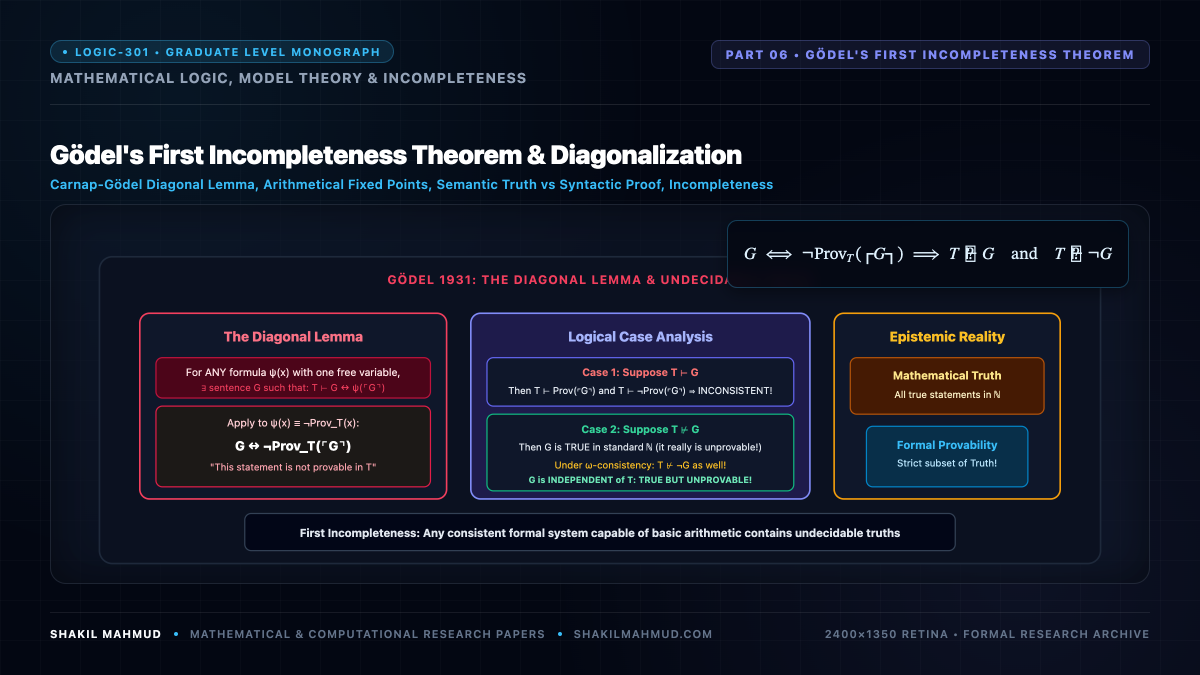
In 1931, Kurt Gödel published the paper that permanently altered human epistemology: “Über formal unentscheidbare Sätze der Principia Mathematica und verwandter Systeme I”. Armed with the machinery of arithmetization, Gödel proved the Diagonal Lemma (Fixed-Point Lemma), allowing mathematical formulas to refer directly to their own syntactic properties. The consequence was devastating: any consistent formal theory capable of doing elementary arithmetic contains true mathematical assertions that can never be proven within the system.
1. The Diagonal Lemma (The Engine of Self-Reference)
Self-reference in natural language often produces semantic paradoxes like the Liar Paradox (“This statement is false”). Gödel avoided paradox by constructing self-reference purely within syntax, using substitution of numerals:
Let $text{sub}(x, y)$ be the primitive recursive function that takes the Gödel number of a formula $psi(v)$ with one free variable $v$, and returns the Gödel number of the formula $psi(bar{y})$ where the variable $v$ is replaced by the formal numeral for $y$. Since $text{sub}$ is primitive recursive, it is represented by a formula $text{Sub}(x, y, z)$ in $text{PA}$.
The Diagonal Lemma (Carnap-Gödel Fixed Point Theorem)
Let $T$ be any theory containing basic arithmetic, and let $psi(x)$ be any formula with one free variable. Then there exists a sentence $G$ such that:
[
T vdash G leftrightarrow psi(ulcorner G urcorner)
]
Proof:
- Define the diagonalizing formula $alpha(y) equiv exists z , (text{Sub}(y, y, z) land psi(z))$. Informally, $alpha(y)$ asserts: “Substitute numeral $y$ into formula $y$, and the result satisfies $psi$.”
- Let $m = ulcorner alpha(y) urcorner$ be the Gödel number of $alpha(y)$.
- Construct the sentence $G equiv alpha(bar{m})$.
- By definition of $alpha$, $G$ is equivalent to $psi(text{sub}(bar{m}, bar{m}))$. But what is $text{sub}(m, m)$? It is the Gödel number of $alpha(bar{m})$, which is none other than $ulcorner G urcorner$!
- Therefore, $T vdash G leftrightarrow psi(ulcorner G urcorner)$. $blacksquare$
2. Construction of Gödel’s Sentence $G$
Now, let $psi(x)$ be the formula $neg text{Prov}_T(x)$, which asserts: “Formula $x$ is not provable in $T$.” Applying the Diagonal Lemma to $neg text{Prov}_T(x)$ yields a sentence $G$ such that:
[
T vdash G leftrightarrow neg text{Prov}_T(ulcorner G urcorner)
]
Informally, $G$ asserts: “I am not provable in $T$.”
3. The Incompleteness Proof
Gödel’s First Incompleteness Theorem
Let $T$ be a consistent, effectively axiomatized formal theory capable of formalizing elementary arithmetic (such as Peano Arithmetic). Then:
- $T notvdash G$ (The sentence $G$ is not provable in $T$).
- If $T$ is $omega$-consistent (or sound), then $T notvdash neg G$ (The negation of $G$ is also not provable in $T$).
- Therefore, $G$ is undecidable in $T$.
- Furthermore, $G$ is TRUE in the standard model of arithmetic $mathbb{N}$!
Part 1: Proof that $T notvdash G$
Suppose $T vdash G$.
- Since $G$ is provable, there exists a formal proof sequence $n$, so $text{Prf}_T(n, ulcorner G urcorner)$ is true.
- Because $text{Prf}_T$ is primitive recursive, $T vdash text{Prf}_T(bar{n}, ulcorner G urcorner)$.
- By existential generalization, $T vdash exists x , text{Prf}_T(x, ulcorner G urcorner)$, which means $T vdash text{Prov}_T(ulcorner G urcorner)$.
- However, by definition of $G$, $T vdash G leftrightarrow neg text{Prov}_T(ulcorner G urcorner)$. Therefore, $T vdash neg text{Prov}_T(ulcorner G urcorner)$.
- $T$ proves both $text{Prov}_T(ulcorner G urcorner)$ and $neg text{Prov}_T(ulcorner G urcorner)$, contradicting the consistency of $T$!
- Thus, if $T$ is consistent, $T notvdash G$.
Part 2: Proof that $T notvdash neg G$
Suppose $T vdash neg G$.
- By the equivalence of $G$, $T vdash text{Prov}_T(ulcorner G urcorner)$, which is $T vdash exists x , text{Prf}_T(x, ulcorner G urcorner)$.
- However, from Part 1, we know $T notvdash G$. This means for every individual integer $k in mathbb{N}$, $k$ is NOT a proof of $G$.
- Since $text{Prf}_T$ is primitive recursive, for each $k$, $T vdash neg text{Prf}_T(bar{k}, ulcorner G urcorner)$.
- If $T$ proves $exists x , text{Prf}_T(x, ulcorner G urcorner)$ while simultaneously proving $neg text{Prf}_T(bar{k}, ulcorner G urcorner)$ for every individual $k$, $T$ is $omega$-inconsistent!
- Thus, if $T$ is $omega$-consistent, $T notvdash neg G$.
4. The Chasm Between Truth and Proof
Why is $G$ true? $G$ asserts that it is unprovable. In Part 1, we mathematically proved that $G$ is indeed unprovable in $T$. Therefore, what $G$ asserts is an undeniable mathematical fact!
$G$ is a true arithmetical statement that $T$ cannot prove. In 1936, J. Barkley Rosser strengthened Gödel’s proof by substituting a modified provability predicate, eliminating the need for $omega$-consistency and requiring only simple consistency.
The philosophical consequence is absolute: Mathematical truth outstrips formal provability. No finite set of axioms, no matter how sophisticated, can ever encompass the totality of mathematical truth.