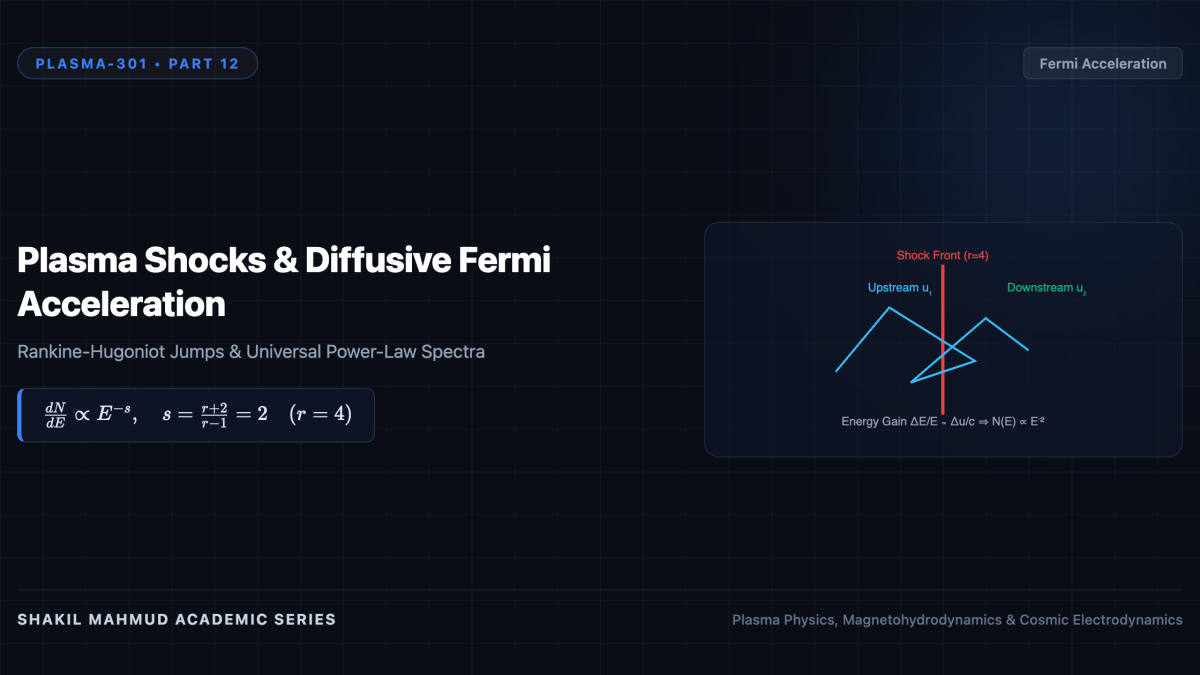
Energetic cosmic rays bombard Earth from the depths of interstellar space with energies reaching beyond (10^{20} ext{ eV})—millions of times higher than the collision energies achievable by the Large Hadron Collider. Ordinary mechanical collisions cannot produce such astronomical energies. Instead, these relativistic particles are forged in cosmic Collisionless Shocks driven by supernova remnants and active galactic nuclei via Diffusive Shock Acceleration (DSA). In this article, we derive the MHD Rankine-Hugoniot shock jump relations and the universal power-law spectrum of cosmic rays.
1. The Rankine-Hugoniot MHD Shock Jump Conditions
In a neutral gas, a shock wave dissipates supersonic directed kinetic energy into thermal heat via molecular mean-free-path collisions. In diffuse astrophysical plasmas, the Coulomb collision mean free path exceeds billions of kilometers. Shocks nevertheless form across thin layers mediated entirely by collective plasma wave instabilities (Weibel instability and ion-cyclotron wave turbulence). These are Collisionless Shocks.
Across a 1D planar shock moving in the (x)-direction in the shock-rest frame, the conservation laws of mass, momentum, energy, and magnetic flux demand continuity of fluxes across upstream (subscript 1) and downstream (subscript 2) states:
[
[
ho v_x]_1^2 = 0
]
[
left[
ho v_x^2 + P + rac{B_perp^2}{2mu_0}
ight]_1^2 = 0
]
[
left[
ho v_x mathbf{v}_perp – rac{B_x}{mu_0} mathbf{B}_perp
ight]_1^2 = 0
]
[
[B_x]_1^2 = 0, quad [v_x mathbf{B}_perp – B_x mathbf{v}_perp]_1^2 = 0
]
[
left[
ho v_x left( rac{1}{2}v^2 + rac{gamma}{gamma-1}rac{P}{
ho}
ight) + rac{v_x B_perp^2 – B_x(mathbf{v}_perp cdot mathbf{B}_perp)}{mu_0}
ight]_1^2 = 0
]
For a strong hydrodynamically dominated shock with upstream Mach number (M_1 quiv v_1/c_{s1} gg 1) in an ideal monoatomic gas ((gamma = 5/3)), the Compression Ratio (r quiv
ho_2 /
ho_1 = v_1 / v_2) simplifies to:
[
r = rac{gamma + 1}{gamma – 1 + rac{2}{M_1^2}} xrightarrow{M_1 o infty} rac{gamma + 1}{gamma – 1} = rac{5/3 + 1}{5/3 – 1} = 4
]
The downstream flow speed is precisely one-quarter of the upstream shock speed: (v_2 = v_1 / 4).
2. Kinematics of Diffusive Shock Acceleration (First-Order Fermi Acceleration)
Consider a relativistic test particle ((v approx c)) diffusing through magnetic turbulence upstream and downstream of the shock front. When crossing the shock from upstream into downstream, the particle encounters scattering centers moving toward it at relative velocity (Delta u = v_1 – v_2 = rac{3}{4}v_1). Upon scattering, it gains energy via a head-on collision. When diffusing back from downstream to upstream, it again encounters oncoming scattering centers, gaining energy on every round-trip cycle.
The fractional momentum gain per round-trip across the shock is obtained by averaging the relativistic Lorentz transformation over isotropic hemisphere pitch-angle distributions:
[
leftlangle rac{Delta p}{p}
ight
angle = rac{4}{3} rac{v_1 – v_2}{c}
]
Because the energy gain is proportional to the first power of relative shock velocity ((v_1 – v_2)/c), this mechanism is known as First-Order Fermi Acceleration (far more efficient than second-order stochastic Fermi acceleration in clouds where (Delta E/E propto (v/c)^2)).
3. Derivation of the Universal Cosmic Ray Power-Law Spectrum
Let (P_{ ext{esc}}) be the probability that a particle is swept downstream away from the shock per cycle without returning upstream. The upstream flux into the shock is (rac{1}{4} n c), while the downstream advective loss flux is (n v_2). The escape probability is therefore:
[
P_{ ext{esc}} = rac{n v_2}{rac{1}{4}n c} = rac{4 v_2}{c}
]
After (k) cycles, the particle momentum is (p_k = p_0 (1 + xi)^k), where (xi quiv rac{4}{3}rac{v_1 – v_2}{c}). The number of particles remaining after (k) cycles is (N_k = N_0 (1 – P_{ ext{esc}})^k). Taking logarithms to eliminate (k):
[
rac{ln(N/N_0)}{ln(p/p_0)} = rac{ln(1 – P_{ ext{esc}})}{ln(1 + xi)} approx -rac{P_{ ext{esc}}}{xi} = -rac{4 v_2 / c}{rac{4}{3}(v_1 – v_2)/c} = -rac{3 v_2}{v_1 – v_2} = -rac{3}{r – 1}
]
Thus, the cumulative distribution scales as (N(>p) propto p^{-3/(r-1)}). Differentiating to obtain the differential energy distribution (N(E) dE propto p^{-s} dp):
[
s = 1 + rac{3}{r – 1} = rac{r + 2}{r – 1}
]
For a strong shock with compression ratio (r = 4):
[
s = rac{4 + 2}{4 – 1} = 2.0 quad implies quad N(E) propto E^{-2.0}
]
This remarkable result is independent of plasma microphysics, magnetic field strength, or particle species: diffusive shock acceleration at strong collisionless shocks universally generates an (E^{-2}) power-law injection spectrum. As cosmic rays diffuse through the Milky Way’s galactic magnetic halo, energy-dependent propagation leakage (( au_{ ext{esc}}(E) propto E^{-0.6})) softens this spectrum to the observed (E^{-2.6}) to (E^{-2.7}) flux measured by Earth-based observatories up to the Knee at (10^{15} ext{ eV}).