Before there were stars, atoms, or even the passage of time itself, the universe existed as an unimaginable physical state: an unbroken symmetry where space, matter, and the fundamental forces of reality were compressed into a single quantum continuum. Within the first septillionth of a second, a violent exponential expansion of spacetime—cosmic inflation—stretched microscopic quantum ripples into the vast cosmic web that now cradles two trillion galaxies.
The Boundary of Knowledge: What Actually Happened at t = 0?
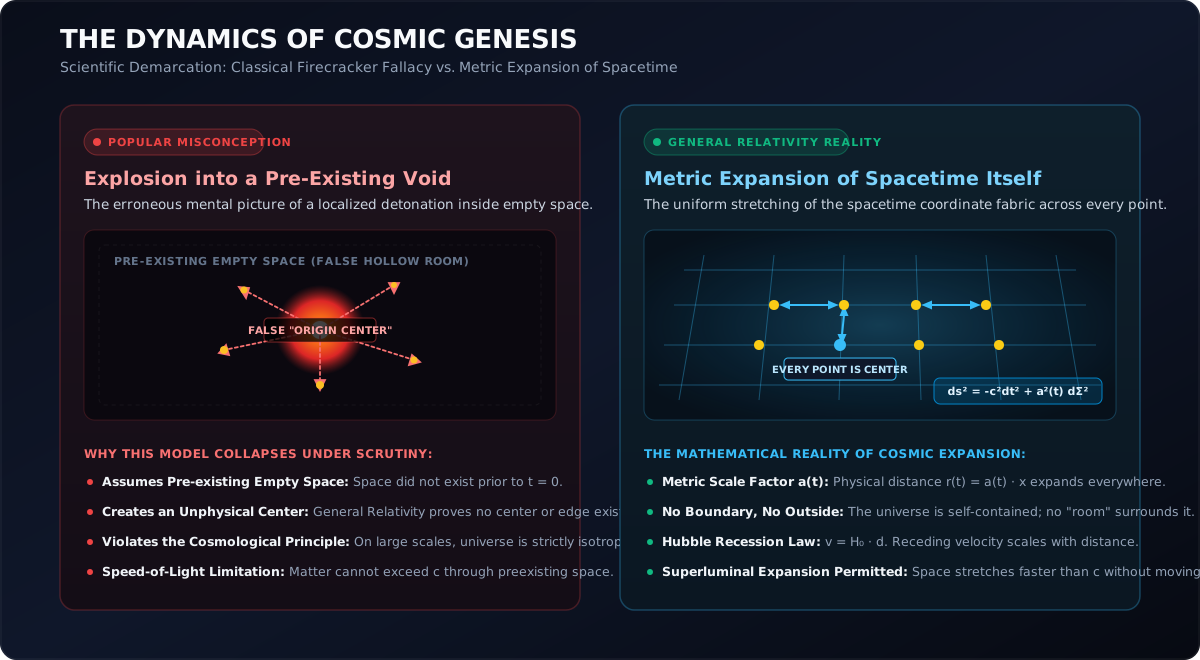
Popular representations of the Big Bang invariably imagine a firecracker exploding inside an empty black room. A blinding point of light flashes, debris hurtles outwards, and planets coalesce within the void. This mental model is profoundly incorrect in two fundamental ways: first, the Big Bang was not an explosion of matter through space, but the rapid, metric expansion of space itself; second, there was no pre-existing “outside” room into which the universe could expand.
In classical General Relativity, working backward through the Friedmann-Lemaître-Robertson-Walker (FLRW) metric leads to a mathematical singularity at t = 0. At this boundary, the scale factor of the universe a(t) → 0, causing energy density, spacetime curvature, and temperature to diverge toward infinity:
In 1970, Roger Penrose and Stephen Hawking demonstrated mathematically that if General Relativity holds true and energy satisfies reasonable positivity conditions (the strong energy condition), an initial gravitational singularity was physically inevitable. However, physicists do not interpret this infinite density as an actual physical event, but rather as the precise point where Albert Einstein’s classical theory breaks down and must surrender to quantum mechanics.
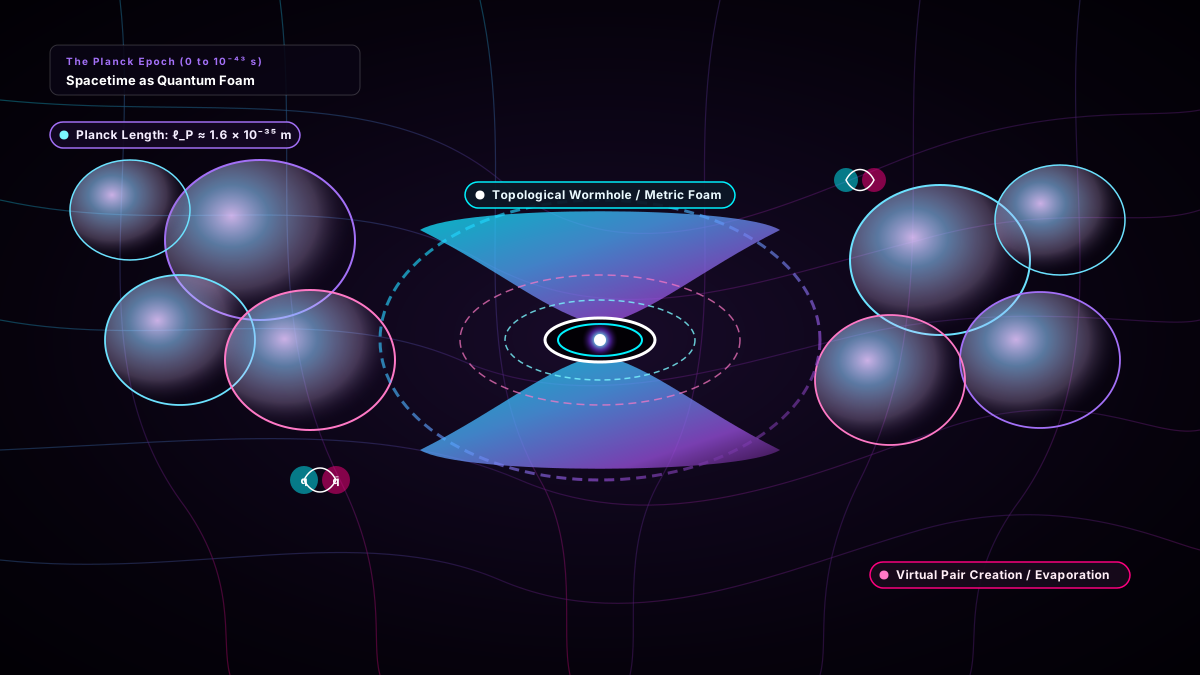
The Planck Epoch (0 to 10⁻⁴³ seconds): Spacetime as Quantum Foam
To understand the earliest reachable frontier of physics, we must encounter the fundamental constants of nature: Planck’s reduced constant ℏ (the currency of quantum mechanics), Newton’s gravitational constant G (the curvature of gravity), and the speed of light c (the maximum velocity of information). Combining these three constants yields the natural scales of the universe at which classical descriptions of geometry cease to function:
- Planck Time (t_P): √(ℏG/c⁵) ≈ 5.391 × 10⁻⁴⁴ seconds
- Planck Length (l_P): √(ℏG/c³) ≈ 1.616 × 10⁻³⁵ meters
- Planck Energy (E_P): √(ℏc⁵/G) ≈ 1.22 × 10¹⁹ GeV ≈ 1.956 × 10⁹ Joules
- Planck Density (ρ_P): c⁵/(ℏG²) ≈ 5.155 × 10⁹⁶ kg/m³
During the Planck Epoch, the energy of individual particles and gravitational curvature were so extreme that the de Broglie wavelength of any particle was smaller than its own event horizon. At this scale, spacetime was not the smooth, continuous fabric described by Einstein. Instead, as John Archibald Wheeler famously formulated, spacetime was a violent, boiling quantum foam—a chaotic topological froth where wormholes, microscopic black holes, and temporal geometries flickered into and out of existence faster than light could traverse a proton.
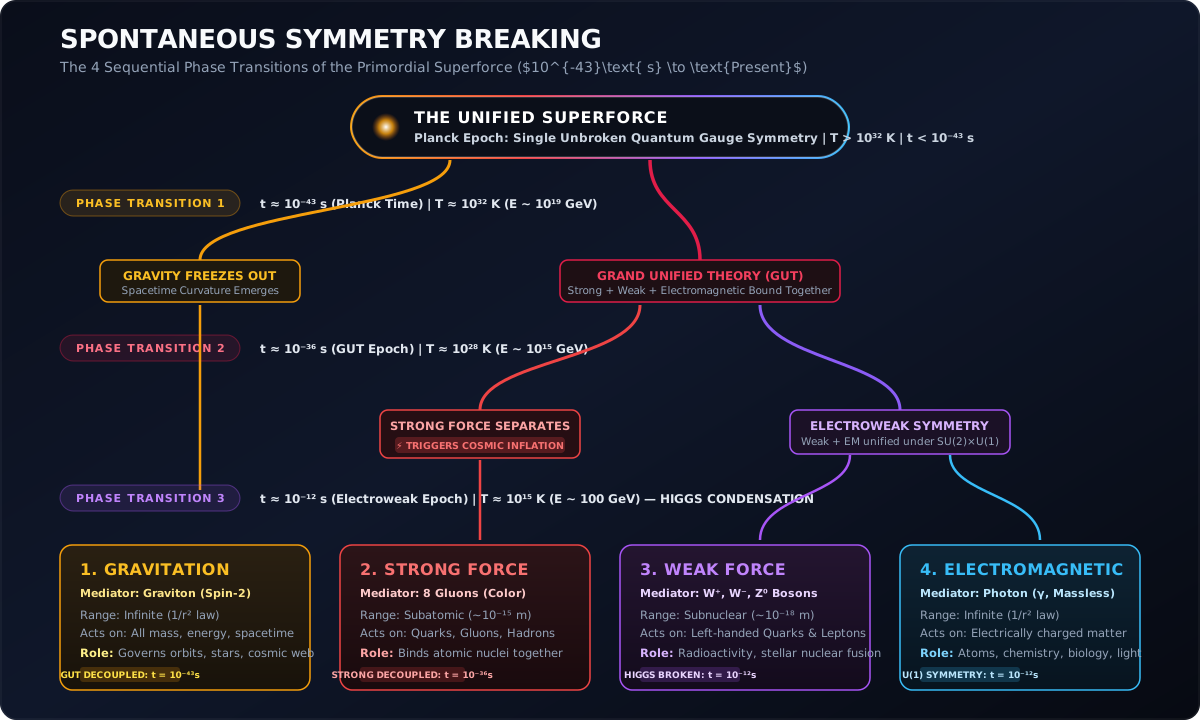
At these blistering temperatures (T ≈ 10^{32} Kelvin), all four fundamental forces of nature—Gravity, the Strong Nuclear Force, the Weak Nuclear Force, and Electromagnetism—were unified into a single, perfectly symmetric superforce. There was no distinction between matter and radiation, between a quark and an electron, or even between “here” and “there.”
Spontaneous Symmetry Breaking: The Fracturing of the Superforce
As the nascent spacetime expanded, its energy density fell below the Planck threshold at t ≈ 10^{-43} s. This cooling triggered the first great phase transition in cosmic history: gravitational decoupling. Gravity froze out from the unified superforce, becoming a distinct geometric interaction described by curved spacetime.
The remaining three forces remained bound together under what particle physicists term the Grand Unified Theory (GUT) epoch. For a fleeting interval between 10-43 s and 10-36 s, the universe was governed by a GUT gauge group (such as SU(5) or SO(10)). Gauge bosons known as X and Y bosons mediated transitions directly between leptons and quarks, allowing baryonic matter to fluctuate without conservation of baryon number.
When the temperature plunged past T ≈ 10^{28} K (~ 10¹⁵ GeV), the strong nuclear force broke away from the electroweak force. Much like water abruptly crystallizing into rigid ice when cooling past zero degrees Celsius, the Higgs-like scalar fields governing grand unification experienced spontaneous symmetry breaking. This phase transition did not occur smoothly across the entire universe—it left the universe supercooled in a high-energy false vacuum state, setting the stage for the most astonishing event in cosmic history.
The Three Fatal Flaws of the Standard Big Bang Model
By the late 1970s, the classic Big Bang theory was universally accepted following the 1965 discovery of the Cosmic Microwave Background (CMB) by Arno Penzias and Robert Wilson. Yet, as theoretical cosmologists interrogated the equations, three catastrophic paradoxes emerged that threatened to dismantle the entire paradigm:
1. The Horizon Problem (Thermal Equilibrium Without Communication)
When we point radio telescopes at opposite sides of the observable night sky, we are measuring CMB photons that were emitted 13.8 billion years ago from regions separated by roughly 28 billion light-years today. Under standard decelerating FLRW expansion, these two regions were separated by tens of millions of light-years at recombination (t = 380,000 years), while their maximum causal horizon (the distance light could have traveled since t = 0) was only 380,000 light-years. They could never have exchanged a single photon, shared energy, or equalized temperatures. Yet, satellite measurements (COBE, WMAP, Planck) show their temperatures match to within 1 part in 100,000 (2.7255 ± K). How could two regions that never touched be in such immaculate thermal equilibrium?
2. The Flatness Problem (Fine-Tuning of Ω)
The curvature of our universe is dictated by the cosmic density parameter Ω = ρ / ρ_c, where ρ_c is the critical density required for a spatially flat universe (k = 0). In standard general relativity, any deviation from Ω = 1 is unstable and grows exponentially with time: if Ω had been 1.000000000000001 at the Planck epoch, the universe would have recollapsed in a Big Crunch within microseconds; if it had been 0.999999999999999, the universe would have expanded so aggressively that atoms would never have coalesced into stars. Modern observational data demonstrates that today, 13.8 billion years later, Ω = 1.00 ± 0.002. For Ω to remain this close to flat today, it had to be tuned to Ω = 1 ± 10⁻⁶⁰ at the Planck time—an unscientific miracle of fine-tuning.
3. The Relic Magnetic Monopole Problem
Grand Unified Theories predict that during the spontaneous symmetry breaking of the GUT force, topological defects in the Higgs field should have condensed in immense quantities. The most prominent of these are stable, supermassive magnetic monopoles (m ~ 10^{16} GeV). Had standard cosmology occurred, these monopoles would have saturated the universe, dominating its mass density and collapsing the geometry trillions of years ago. Yet, decades of ultrasensitive detectors have detected zero confirmed magnetic monopoles.
The Miracle of Cosmic Inflation: Alan Guth’s Exponential Expansion
In December 1979, a 32-year-old postdoctoral researcher at SLAC named Alan Guth realized that these three existential paradoxes could be resolved simultaneously by a single mechanism: what if, for an imperceptible fraction of a second, the universe underwent an exponential super-expansion driven by negative vacuum pressure?
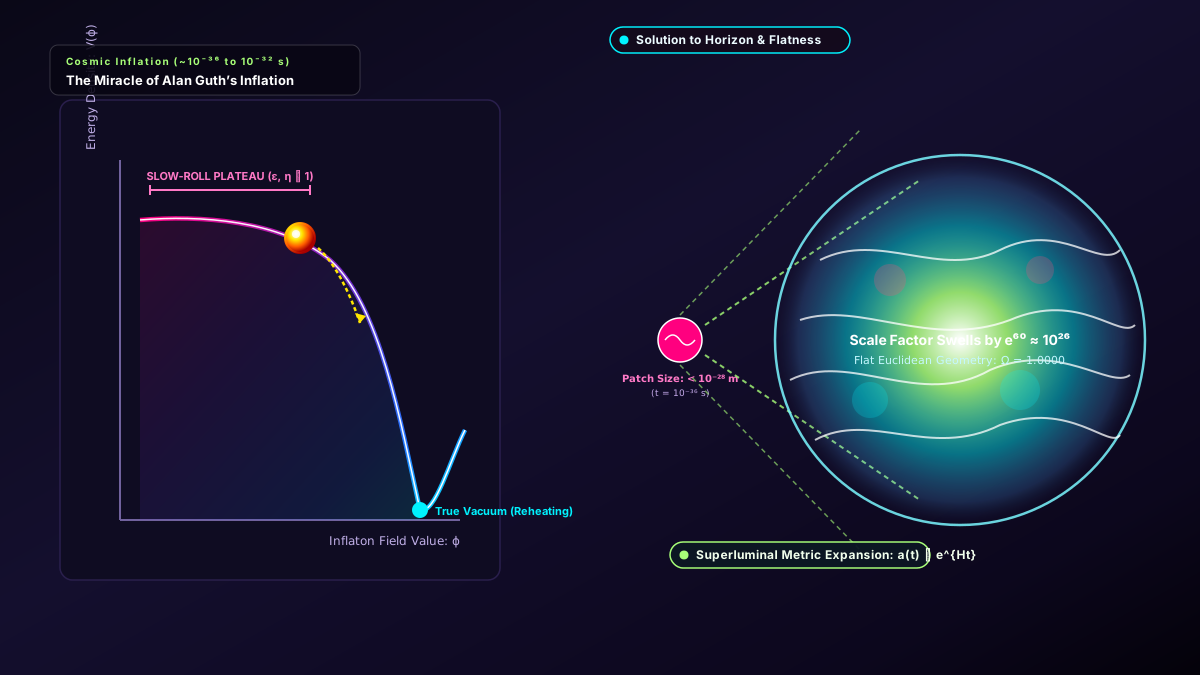
Guth postulated that during the GUT phase transition, the universe became trapped in a “false vacuum”—a local minimum of an unknown scalar potential field, designated the Inflaton Field (φ). According to the stress-energy tensor of general relativity, a scalar field dominated by its potential energy V(φ) exhibits a peculiar property: its pressure is equal to the negative of its energy density:
$$P = -\rho c^2$$
In Einstein’s second Friedmann acceleration equation:
$$\ddot{a} = -\frac{4\pi G}{3}\left(\rho + \frac{3P}{c^2}\right)a$$
Substituting P = -ρ c² flips the sign inside the parentheses from positive to negative:
$$\ddot{a} = +\frac{8\pi G}{3}\rho a$$
Rather than slowing down due to gravitational attraction, spacetime experiences unbridled gravitational repulsion!
Between t ≈ 10^{-36} seconds and t ≈ 10^{-32} seconds, the scale factor a(t) did not expand linearly or polynomially. It grew exponentially according to de Sitter spacetime geometry:
$$a(t) = a_0 \exp\left(H_{\text{inf}} \cdot t\right)$$
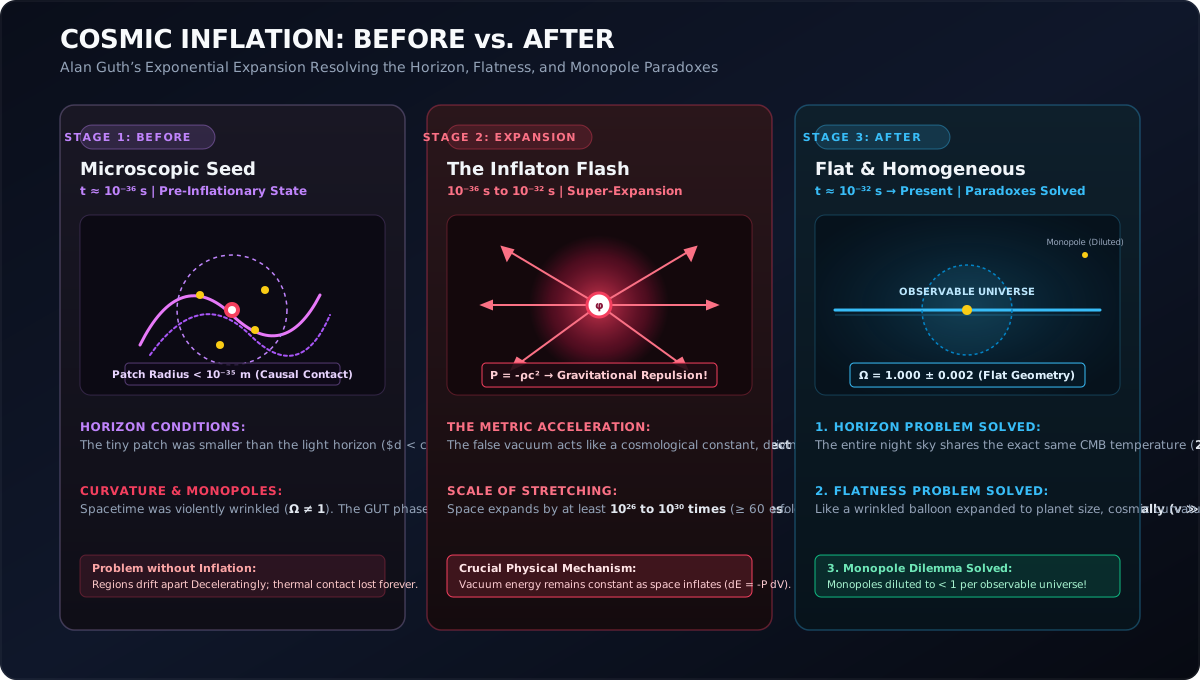
During this unimaginably brief interval of 10-32 seconds, spacetime expanded by a factor of at least 1026 to 1030 (equivalent to roughly 60 e-folds of expansion, N = ln(a_f / a_i) ≥ 60). A volume smaller than a single subatomic proton was stretched to the size of a marble in less time than it takes light to cross an atomic nucleus. The consequences of this runaway expansion completely resolved the cosmological crises:
- Horizon Problem Solved: The entire observable universe today originated from a microscopic patch that had ample time to achieve complete thermal equilibrium before inflation began. Inflation then tore this tiny, equilibrated region apart, propelling points far beyond the speed of light away from one another.
- Flatness Problem Solved: Just as blowing up a wrinkled balloon to planetary proportions makes its surface appear completely flat to an ant walking upon it, exponential expansion stretched the curvature of spacetime so thoroughly that Ω was driven irresistibly toward 1.000000.
- Monopole Problem Solved: Any topological defects or heavy monopoles created prior to inflation were diluted across an unfathomable expanse of empty volume, leaving at most one monopole in many observable universes.
The Cosmic Rosetta Stone: How Quantum Fluctuations Became Galaxies
The most breathtaking triumph of inflationary theory—clarified by Andrei Linde, Andreas Albrecht, Paul Steinhardt, and Viatcheslav Mukhanov—is that it explains where galaxies, stars, and human beings came from.
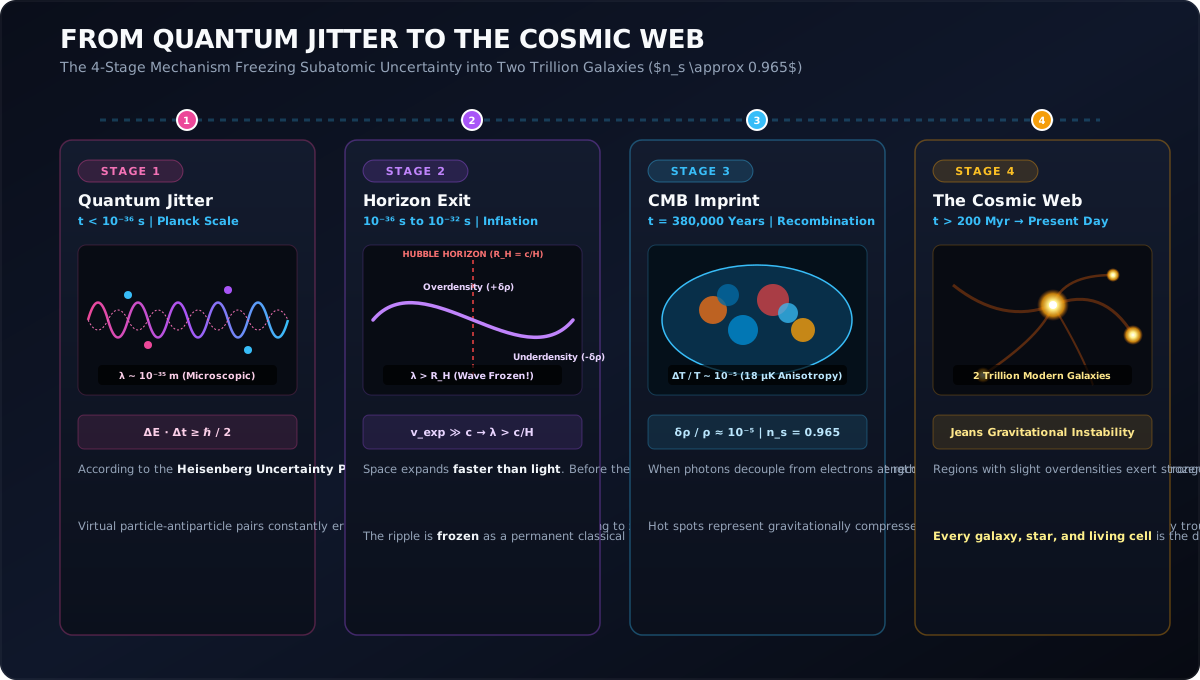
Heisenberg’s Uncertainty Principle ($$\Delta E \cdot \Delta t \ge \frac{\hbar}{2}$$) dictates that on subatomic scales, the vacuum can never be completely inert. Particles and fields must constantly fluctuate. Under normal circumstances, these microscopic quantum fluctuations appear and annihilate in fractions of a zeptosecond, averaging out to zero.
During cosmic inflation, however, the expansion rate of spacetime was far faster than the speed of light. Before a quantum ripple in the inflaton field could fluctuate back into nonexistence, spacetime stretched the crests and troughs of the wave beyond the cosmic event horizon. The quantum fluctuation was “frozen” into classical reality as a permanent overdensity or underdensity in the metric of space.
These frozen quantum ripples produced a nearly scale-invariant spectrum of primordial density perturbations (n_s ≈ 0.965, precisely measured by the Planck space observatory). Hundreds of millions of years later, regions that were merely 0.001\% denser than their surroundings exerted greater gravitational pull, drawing in surrounding hydrogen gas to build the first stars, galaxies, and galaxy clusters. Every structure in the cosmos today is the macroscopic fossil of a primordial quantum fluctuation.
Reheating: The Ignition of the Hot Big Bang
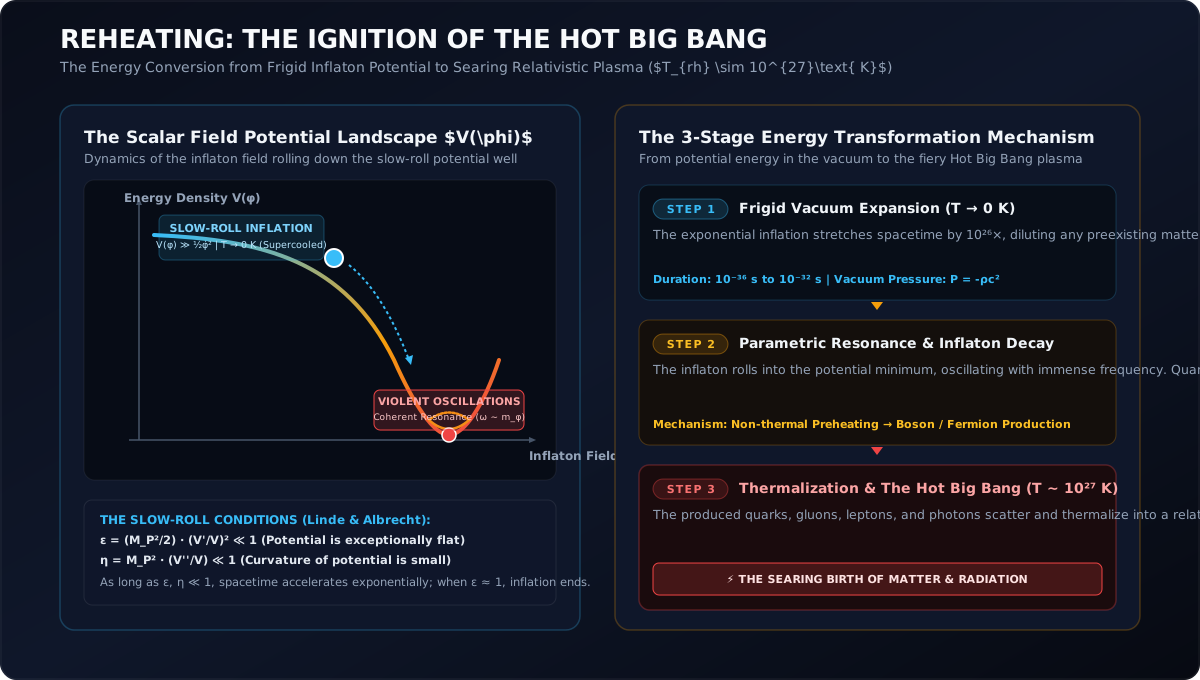
While inflation solved the paradoxes of cosmology, it presented a formidable new problem: exponential expansion stretched the universe into a state of absolute, frigid emptiness. Any pre-existing matter or radiation was diluted to zero density; the temperature dropped to absolute zero (T → K). How did the universe become the blistering, high-energy cauldron of the Hot Big Bang?
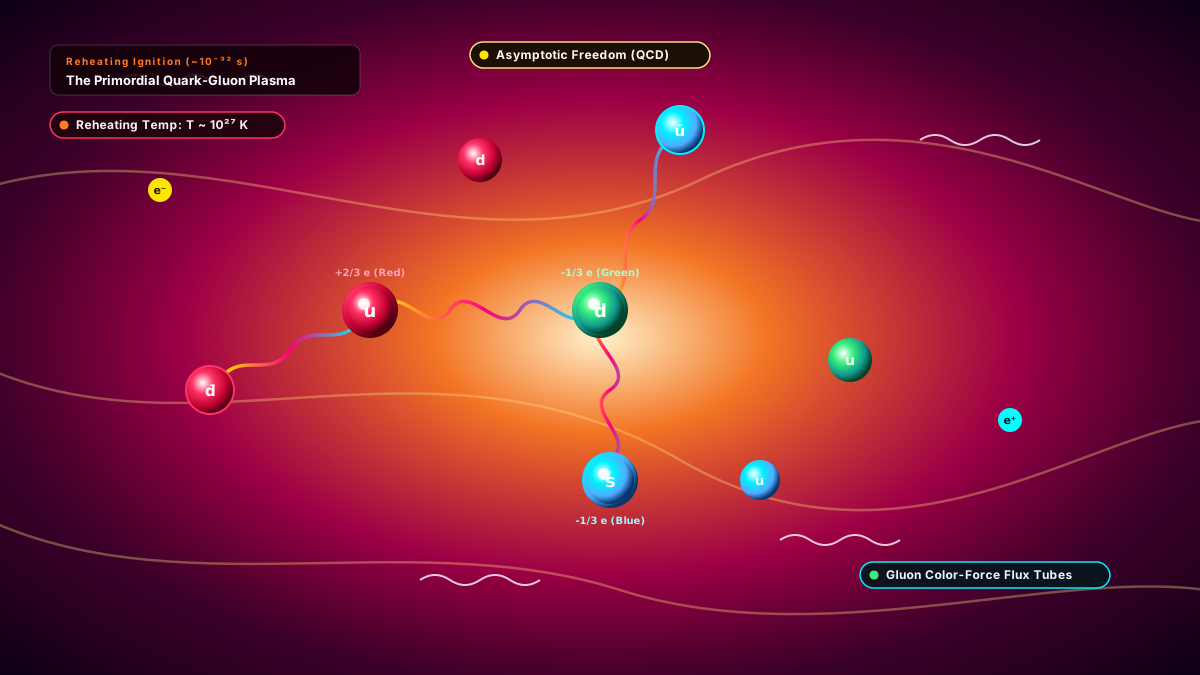
The answer is Reheating. As the inflaton field reached the bottom of its potential well (V(φ) → 0), it began oscillating violently around the minimum. Through parametric resonance and quantum field decay, the enormous potential energy stored in the false vacuum coupled to the Standard Model fields (gluons, quarks, leptons, gauge bosons). In a fraction of a second, the universe was inundated with a searing, relativistic thermal bath at temperatures exceeding T_{rh} ~ 10^{27} Kelvin.
Inflation ended. The scalar field vanished into a memory of cosmic expansion. And the true Hot Big Bang—the fiery, plasma-dominated era of particle physics—was officially ignited.
Chronology of Cosmic Genesis: The First Split-Second
| Epoch | Time Elapsed (t) | Temperature (K) | Energy Scale (GeV) | Dominant Physical Phenomena |
|---|---|---|---|---|
| Planck Epoch | 0 to 10^{-43} s | > 10^{32} K | 1019 GeV | Unified superforce; spacetime behaves as chaotic quantum foam; classical GR breaks down. |
| GUT Epoch | 10^{-43} to 10^{-36} s | 10^{32} to 10^{28} K | 1015 GeV | Gravity decouples; Strong and Electroweak forces unified; X and Y gauge bosons dominate. |
| Electroweak Symmetry Breaking & Inflation | 10^{-36} to 10^{-32} s | Supercooled to < 10^{22} K | 10¹⁴ to 10¹² GeV | Inflaton field rolls down potential; exponential de Sitter expansion (a ∝ e^{Ht}); space stretches ≥ 10^{26}×; quantum ripples frozen as cosmic seeds. |
| Reheating Epoch | 10^{-32} to 10^{-12} s | Reheated to 1027 K | 10¹² to 10^3 GeV | Inflaton decays into Standard Model quarks, leptons, and gauge bosons; Hot Big Bang thermal bath ignited. |
Philosophical Epilogue: A Universe from Absolute Nothing?
In 1973, physicist Edward P. Tryon published a seminal paper in Nature titled simply: “Is the Universe a Vacuum Fluctuation?” Tryon proposed that our universe is a zero-energy system: the positive energy locked within all mass (E = mc^2) and thermal radiation is precisely balanced and canceled out by the negative gravitational potential energy of cosmic curvature (U = -GMm/r).
As Alan Guth famously summarized, “The universe is the ultimate free lunch.” In the light of modern inflationary cosmology, the cosmos did not require a vast stockpile of matter and energy to be deposited at the beginning. It required only a tiny volume of empty space containing a quantum scalar field in a false vacuum state. The laws of quantum mechanics and general relativity did the rest.
In Part 2 of The Universal Chronicle, we will step out of the inflationary vacuum and plunge into the blinding furnace of the first minutes: The Crucible of Matter — Quark-Gluon Plasma, Baryogenesis, and the Creation of the First Atoms.
Academic Citations & Foundational Literature
- Guth, A. H. (1981). “Inflationary universe: A possible solution to the horizon and flatness problems.” Physical Review D, 23(2), 347–356. doi:10.1103/PhysRevD.23.347.
- Linde, A. D. (1982). “A new inflationary universe scenario: A possible solution of the horizon, flatness, homogeneity, isotropy and primordial monopole problems.” Physics Letters B, 108(6), 389–393. doi:10.1016/0370-2693(82)91219-9.
- Hawking, S. W., & Penrose, R. (1970). “The singularities of gravitational collapse and cosmology.” Proceedings of the Royal Society of London. A. Mathematical and Physical Sciences, 314(1519), 529–548. doi:10.1098/rspa.1970.0021.
- Planck Collaboration (Akrami, Y., et al.) (2020). “Planck 2018 results. X. Constraints on inflation.” Astronomy & Astrophysics, 641, A10. doi:10.1051/0004-6361/201833887.
- Mukhanov, V. F., & Chibisov, G. V. (1981). “Quantum fluctuations and a nonsingular universe.” JETP Letters, 33(10), 532–535.
- Tryon, E. P. (1973). “Is the Universe a Vacuum Fluctuation?” Nature, 246, 396–397. doi:10.1038/246396a0.
- Weinberg, S. (2008). Cosmology. Oxford University Press. ISBN: 978-0198526827.
- Kolb, E. W., & Turner, M. S. (1990). The Early Universe. Frontiers in Physics, Addison-Wesley. ISBN: 978-0201626742.