With the power to write genetic code comes profound civilizational responsibility. Synthetic biology possesses the dual-use capacity to cure intractable diseases and de-carbonize industry, but equally poses catastrophic existential risks: accidental environmental release of engineered superbugs, laboratory synthesis of eradicated pandemic pathogens, or weaponized biosecurity threats. In this capstone treatise of SYNTH-201, we derive the multi-layered biosafety safeguards that ensure synthetic life remains contained: synthetic auxotrophy, passcoded kill switches, and the genetic firewalls of Xenobiology.
1. Dual-Use Governance and DNA Synthesis Screening
In 2002, Eckard Wimmer chemically synthesized infectious poliovirus from scratch using mail-order oligonucleotides; in 2017, Canadian researchers synthesized horsepox (a close relative of smallpox). These milestones proved that eradication of viral diseases can no longer rely on physical sample containment: as long as a pathogen’s sequence is stored in a digital database, it can be resurrected.
To safeguard against Dual-Use Research of Concern (DURC), international gene synthesis providers adhere to Automated Sequence Screening Protocols:
[
ext{Order Request } mathbf{S} xrightarrow{ ext{BLAST / HMMer Search}} ext{Harmful Pathogen Select Agent Database} xrightarrow{ ext{Match Score } ge heta} ext{Flag Order & Verify Identity}
]
Orders matching regulated viral glycoproteins, bacterial toxins, or bioregulators trigger mandatory government identity verification and institutional biosafety clearances.
2. Multi-Layered Biocontainment and Synthetic Auxotrophy
Physical containment (BSL-3/BSL-4 negative-pressure laboratories and HEPA filters) is the first line of defense. However, for industrial biomanufacturing and environmental bioremediation, engineered organisms must be equipped with Intrinsic Genetic Biocontainment:
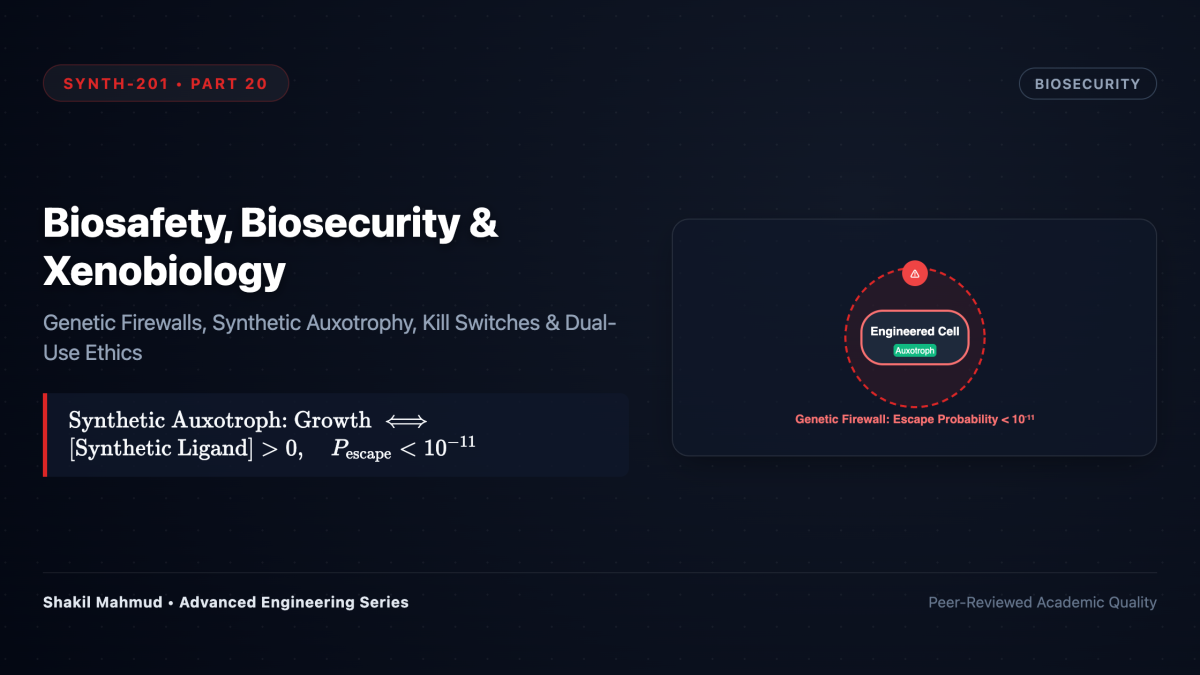
- Synthetic Auxotrophy: In 2015, George Church’s laboratory redesigned essential metabolic enzymes to depend strictly on a synthetic non-canonical amino acid—such as (L)-4,4′-biphenylalanine (BipA)—that does not exist anywhere in nature. In the presence of BipA, the synthetic enzyme folds stably. In natural environments lacking BipA, the enzyme misfolds, causing cell lysis. The escape frequency across (10^{11}) cells is strictly zero:
[
P_{ ext{escape}} < 10^{-11}
] - Multi-Input Deadman and Passcode Kill Switches: Genetic circuits designed with dual-redundant toxin-antitoxin systems (e.g., Barnase/Barstar or EcoRI/Methylase). The cell continuously requires a specific environmental chemical “passcode” (e.g., anhydrotetracycline [aTc] or arabinose) to transcribe the antitoxin. If the microbe escapes the bioreactor into wastewater or soil, the antitoxin degrades, unleashing the toxin to shear the genomic DNA into fragments.
3. Xenobiology and Unnatural Base Pairs: The Ultimate Genetic Firewall
Even if an engineered microbe cannot survive in nature, horizontal gene transfer (HGT) via conjugative plasmids, bacteriophages, or natural transformation could transmit synthetic circuits to wild soil and human gut bacteria. Xenobiology builds an impenetrable biological firewall by altering the fundamental chemical alphabet of life.
Floyd Romesberg’s laboratory at Scripps synthesized the first viable Unnatural Base Pair (UBP)—denoted d5SICS : dNaM or dTPT3 : dNaM. These synthetic nucleotides do not pair via hydrogen bonding; instead, they pair via hydrophobic packing and shape complementarity:
[
ext{Synthetic DNA Alphabet: } quad { ext{A}, ext{T}, ext{C}, ext{G}, mathbf{X}, mathbf{Y}}
]
In an engineered semi-synthetic organism, DNA polymerases replicate the 6-letter genome with over (99.9%) fidelity. However, natural polymerases cannot read or replicate the unnatural bases (mathbf{X}) and (mathbf{Y}). Furthermore, natural organisms lack the nucleoside triphosphate transporters required to import synthetic bases from the environment. This represents an absolute Genetic Firewall: synthetic genetic programs written in an expanded alphabet cannot be read, copied, or horizontally transferred to any natural organism on Earth, ensuring that synthetic biology’s living machines serve humanity safely across future generations.