By the mid-1920s, the early quantum theory was an awkward hybrid of classical Newtonian mechanics patched with arbitrary quantum rules. Between 1923 and 1927, a furious theoretical revolution exploded across Europe: Louis de Broglie proposed wave-particle duality for matter, Erwin Schrödinger developed the wave mechanics of the $Psi$ function, Max Born uncovered the probabilistic ontology of reality, and Werner Heisenberg codified the fundamental limits of measurement in the Uncertainty Principle.
De Broglie’s Matter Waves: Symmetry in Nature
In his 1924 doctoral thesis at the Sorbonne, French aristocrat Louis de Broglie asked a daring aesthetic question: if electromagnetic radiation—long understood as waves—can exhibit particle behavior (photons), why shouldn’t material particles like electrons also exhibit wave behavior? Combining Einstein’s $E = mc^2 = hnu$ and $p = frac{h}{lambda}$, de Broglie proposed the fundamental wavelength of any matter particle:
$$lambda = frac{h}{p} = frac{h}{mv}$$
In 1927, Clinton Davisson and Lester Germer at Bell Labs in New York, and George Paget Thomson in Aberdeen, confirmed de Broglie’s hypothesis experimentally: firing electrons at nickel crystals produced unmistakable wave interference fringes, establishing the wave-particle duality of all matter.
Schrödinger’s Wave Equation
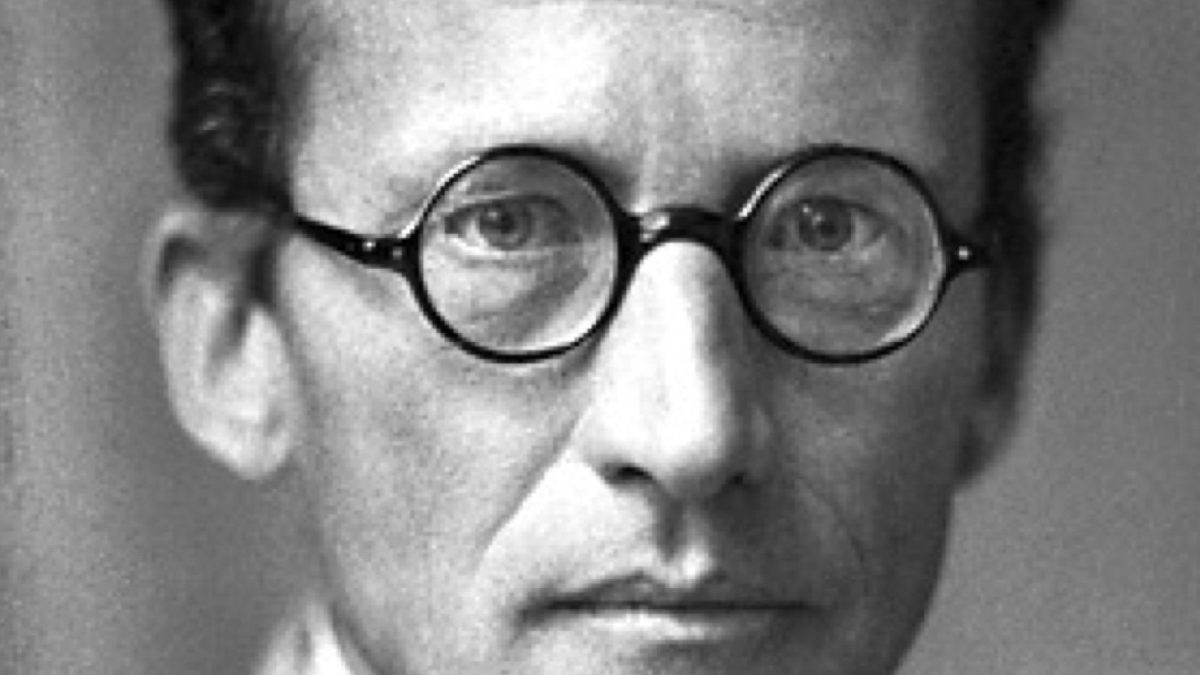
Inspired by de Broglie’s thesis, Austrian physicist Erwin Schrödinger sought the master differential wave equation that governs matter waves. During a retreat in the Swiss Alps in the winter of 1925–1926, Schrödinger formulated his non-relativistic wave equation:
$$ihbar frac{partial Psi(mathbf{r}, t)}{partial t} = hat{H} Psi(mathbf{r}, t) = left[ -frac{hbar^2}{2m} nabla^2 + V(mathbf{r}, t) right] Psi(mathbf{r}, t)$$
Applied to the hydrogen atom, the boundary conditions of this continuous wave equation naturally generated Bohr’s quantized energy levels, quantum numbers ($n, l, m$), and the three-dimensional shapes of atomic orbitals ($s, p, d, f$) without imposing artificial postulates.
Born’s Probability Density: The Death of Determinism
Schrödinger initially hoped that $Psi$ represented a continuous physical smeared-out electron charge density. But in 1926, Max Born revealed the true, unsettling meaning of the wavefunction: $Psi$ itself is not physically observable; rather, its squared modulus represents the probability density of finding the particle at coordinates $(mathbf{r}, t)$:
$$P(mathbf{r}, t) = |Psi(mathbf{r}, t)|^2 = Psi^* Psi$$
Classical determinism was dead. Nature at its core does not possess predetermined trajectories; it calculates with probability amplitudes.
Heisenberg’s Uncertainty Principle
Working parallelly in matrix mechanics, twenty-five-year-old Werner Heisenberg in 1927 uncovered a profound algebraic truth: position $hat{x}$ and momentum $hat{p}$ operators do not commute:
$$[hat{x}, hat{p}] = hat{x}hat{p} – hat{p}hat{x} = ihbar$$
Because the order of measurement matters, no physical system can possess simultaneously definite values of position and momentum. The product of their standard deviations has an irreducible quantum minimum:
$$Delta x Delta p ge frac{hbar}{2}$$
Similarly, energy and time satisfy an analogous uncertainty relation:
$$Delta E Delta t ge frac{hbar}{2}$$
The Uncertainty Principle is not an artifact of clumsy measuring apparatuses; it is an intrinsic structural property of the universe. The classical clockwork cosmos had dissolved into a majestic fog of quantum probabilities.