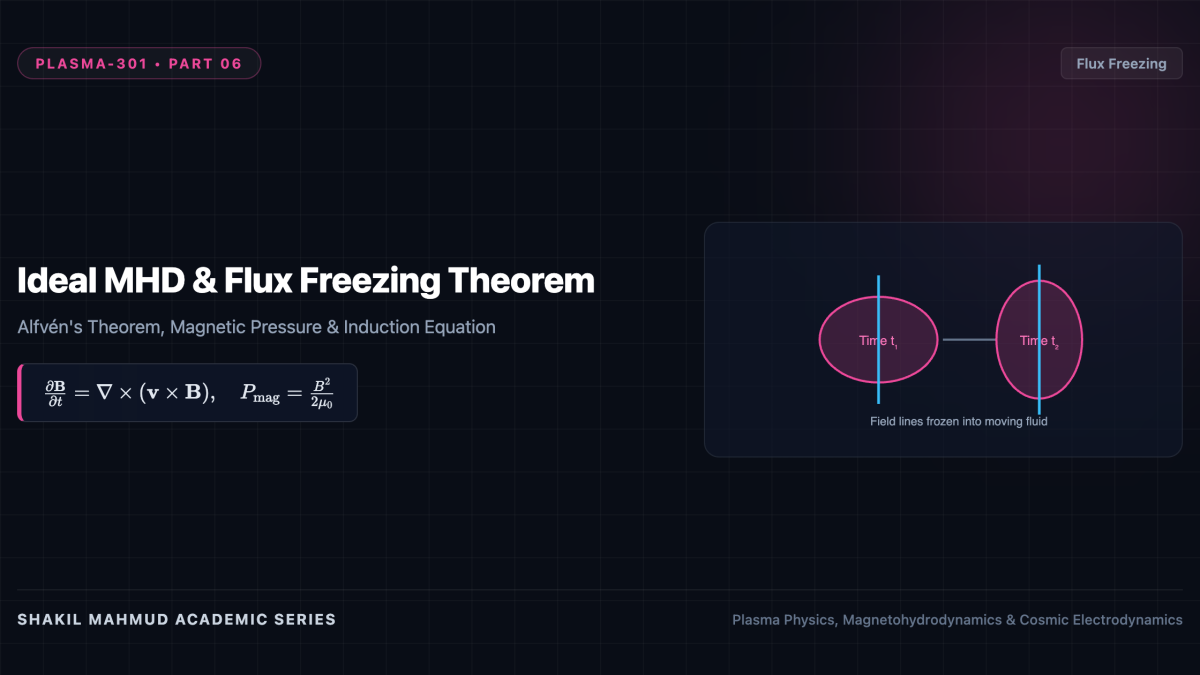
When spatial scales are vastly larger than the ion gyroradius and temporal variations are far slower than the ion cyclotron period, plasma behavior collapses from the microscopic 6D kinetic description into a single conducting fluid. This regime is Magnetohydrodynamics (MHD). In this treatise, we systematically take moments of the Vlasov equation to derive the two-fluid equations, establish the Generalized Ohm’s Law, and obtain the cornerstone of cosmic electrodynamics: the MHD Induction Equation.
1. The Two-Fluid Moments and Generalized Ohm’s Law
Taking velocity moments (int mathbf{v}^n (dots) d^3v) of the Vlasov equation for species (s in {e, i}) produces the fluid conservation laws for density (n_s), mean velocity (mathbf{u}_s), and pressure tensor (mathbb{P}_s):
[
rac{partial
ho_m}{partial t} +
abla cdot (
ho_m mathbf{v}) = 0
]
[
ho_m left( rac{partial mathbf{v}}{partial t} + mathbf{v} cdot
abla mathbf{v}
ight) = –
abla P + mathbf{J} imes mathbf{B}
]
where (
ho_m approx m_i n), (mathbf{v} approx mathbf{u}_i), (P = P_e + P_i), and (mathbf{J} = e n (mathbf{u}_i – mathbf{u}_e)) is the electric current density. Subtracting the electron momentum equation from the ion momentum equation yields the Generalized Ohm’s Law:
[
mathbf{E} + mathbf{v} imes mathbf{B} = ta mathbf{J} + rac{1}{e n} mathbf{J} imes mathbf{B} – rac{1}{e n}
abla P_e + rac{m_e}{e^2 n} rac{partial mathbf{J}}{partial t}
]
Each term on the right-hand side represents distinct physics:
- (ta mathbf{J}): Classical Spitzer resistivity due to Coulomb collisions.
- (rac{1}{en}mathbf{J} imesmathbf{B}): The Hall Term, dominant on spatial scales below the ion inertial length (d_i = c/omega_{pi}).
- (rac{1}{en}
abla P_e): The Biermann Battery Term, capable of generating seed magnetic fields from non-collinear density and temperature gradients ((
abla n_e imes
abla T_e
eq 0)). - (rac{m_e}{e^2 n}partial_t mathbf{J}): Electron inertial lag on high frequencies.
2. Derivation of the MHD Induction Equation
In standard resistive MHD, high-frequency terms, electron inertia, and the Hall effect are neglected. Ohm’s law reduces to (mathbf{E} = -mathbf{v} imes mathbf{B} + ta mathbf{J}). Substituting this into Faraday’s law of induction:
[
rac{partial mathbf{B}}{partial t} = –
abla imes mathbf{E} =
abla imes (mathbf{v} imes mathbf{B}) –
abla imes (ta mathbf{J})
]
Using Ampère’s law in the quasi-magnetostatic limit (neglecting displacement current (arepsilon_0 partial_t mathbf{E} ll mathbf{J})): (mathbf{J} = rac{1}{mu_0}
abla imes mathbf{B}). For uniform magnetic diffusivity (ta_m quiv ta / mu_0), vector identities give (
abla imes (
abla imes mathbf{B}) =
abla(
abla cdot mathbf{B}) –
abla^2 mathbf{B} = –
abla^2 mathbf{B}). Thus, we arrive at the celebrated MHD Induction Equation:
[
rac{partial mathbf{B}}{partial t} =
abla imes (mathbf{v} imes mathbf{B}) + ta_m
abla^2 mathbf{B}
]
3. The Magnetic Reynolds Number and Regimes
The behavior of magnetic fields in conducting fluids is governed by the ratio of convective flux advection to resistive diffusion, parameterized by the dimensionless Magnetic Reynolds Number ((R_m)):
[
R_m quiv rac{|
abla imes (mathbf{v} imes mathbf{B})|}{|ta_m
abla^2 mathbf{B}|} sim rac{v_0 B_0 / L_0}{ta_m B_0 / L_0^2} = rac{v_0 L_0}{ta_m} = mu_0 sigma v_0 L_0
]
This dimensionless ratio cleanly separates two cosmic regimes:
- Diffusion-Dominated ((R_m ll 1)): Magnetic fields diffuse through the fluid on a characteristic resistive timescale ( au_{ ext{diff}} = mu_0 sigma L_0^2), decaying into thermal Joule heat. Found in laboratory liquid metals and planetary cores.
- Advection-Dominated / Ideal MHD ((R_m gg 1)): In astrophysical environments (stellar atmospheres, accretion disks, galactic clusters), enormous length scales (L_0) make (R_m sim 10^8 – 10^{20}). Resistive diffusion is completely negligible, locking magnetic field lines directly into the fluid flow.