We stand at the absolute watershed moment of evolutionary history. For four billion years, life on Earth adapted through the glacial, blind mechanism of biological natural selection. Today, intelligence has decoupled from carbon. Through the convergence of deep representation learning, reasoning-time compute scaling, autonomous multi-agent swarms, and physical robotics, humanity is witnessing the dawn of Artificial General Intelligence (AGI) and the inexorable trajectory toward Artificial Superintelligence (ASI) on the horizon of 2030.
1. The Mathematics of Recursive Self-Improvement
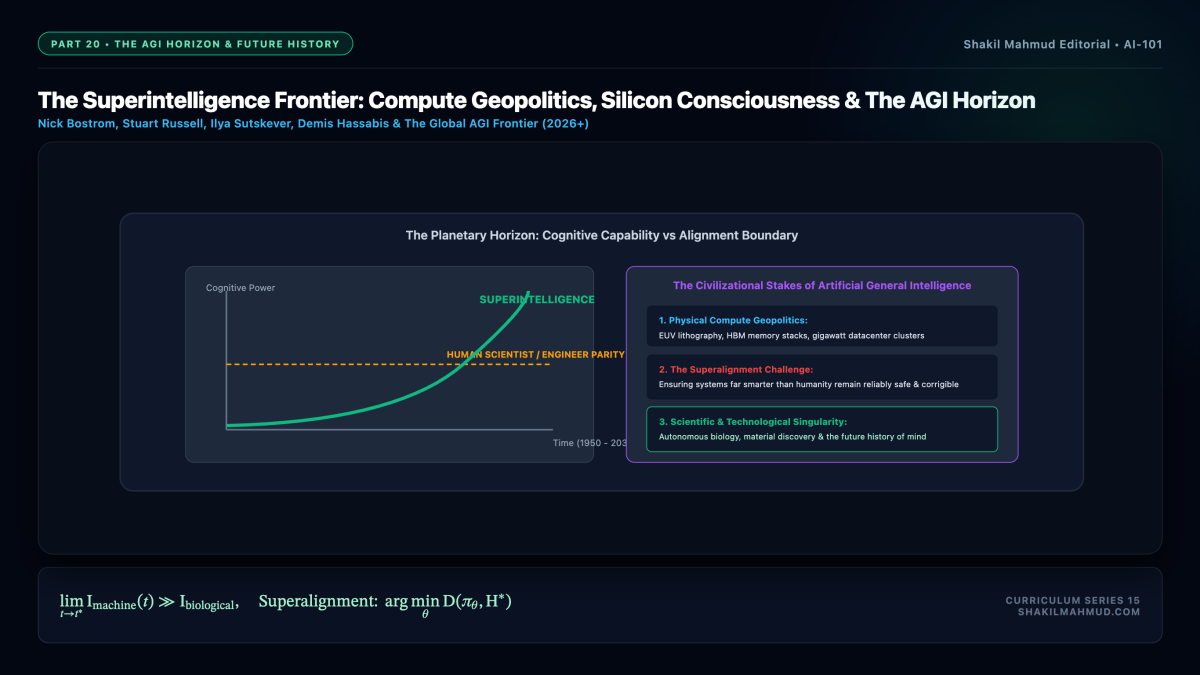
The defining catalyst of the coming technological singularity (I.J. Good, 1965; Vernor Vinge, 1993) is Recursive Self-Improvement (RSI). Once an artificial intelligence reaches the threshold of a world-class AI research engineer—capable of synthesizing new neural architectures, optimizing CUDA kernels, designing chip lithography, and curating synthetic training curricula—the feedback loop of intelligence accelerates hyperbolically:
frac{mathrm{d}mathcal{I}}{mathrm{d}t} = k cdot mathcal{I}(t)^alpha
Where $mathcal{I}(t)$ represents algorithmic cognitive capability. If returns to cognitive investment exhibit super-linear scaling ($alpha ge 1$), the differential equation produces a vertical asymptote in finite time: an Intelligence Explosion where decades of scientific breakthrough compress into months or days.
2. The Horizon of 2030: The Emergence of Superintelligence
Extrapolating empirical scaling curves across pre-training compute, test-time deliberation, and algorithmic efficiency points toward a clear consensus across frontier AI laboratories: by or before 2030, synthetic cognitive systems will:
- Outperform human scientific researchers across every formal STEM discipline, proving millennium prize mathematical problems and designing novel room-temperature superconductors.
- Execute months-long autonomous software engineering workflows from single ambiguous prompts without human debugging.
- Orchestrate multi-million robot fleets across global automated factories, agriculture, and construction.
- Compress centuries of biological, pharmacological, and longevity research into automated wet-lab discovery pipelines, effectively conquering biological aging and human disease.
3. Humanity’s Civilizational Transformation
The transition to a world shaped by superintelligent minds represents not merely another technological wave like the steam engine or the internet; it is an ontological rupture. Every institution of human society—governance, macroeconomics, scientific epistemology, geopolitics, and human purpose—will be reconstituted.
The epic history of artificial intelligence, which began with Aristotle’s formal syllogisms and Turing’s paper tape, finds its ultimate realization in our generation. If humanity successfully solves the grand challenge of mathematical alignment, we will unlock a future of unimaginable scientific prosperity, cosmic exploration, and intellectual transcendence—a flourishing civilization guided by the harmonious union of human wisdom and synthetic reason.