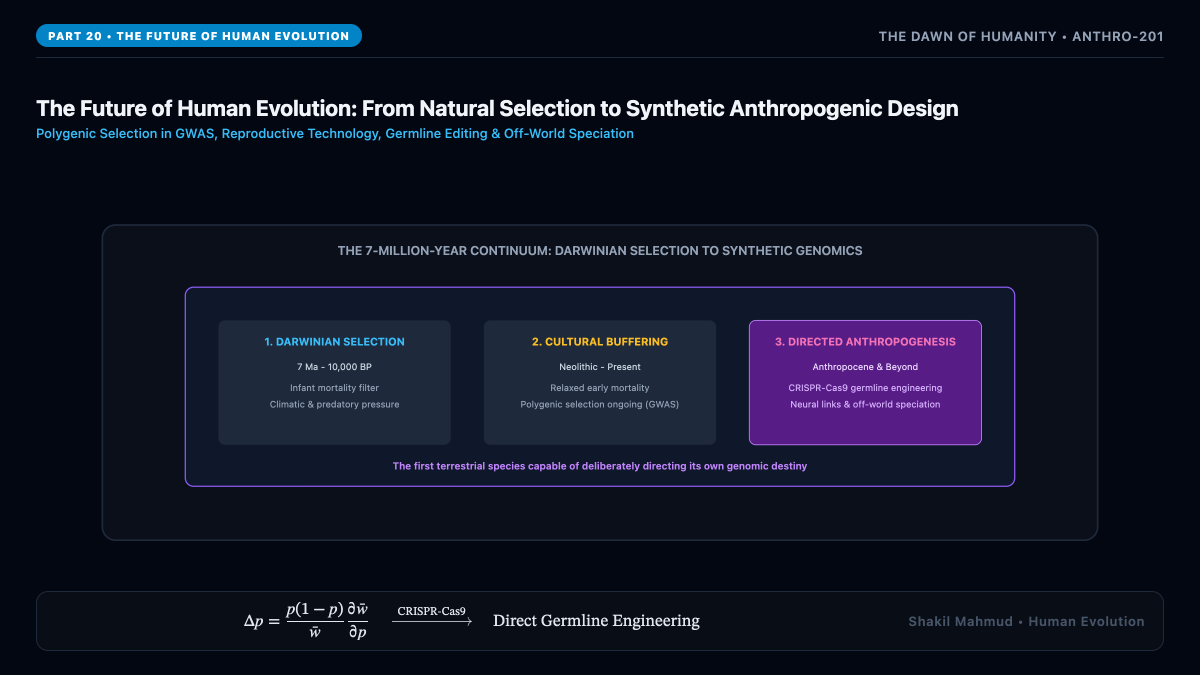
Seven million years after a population of Miocene hominoids parted ways with the ancestors of chimpanzees, the lineage that produced Sahelanthropus, Australopithecus, and Homo erectus has arrived at an unprecedented threshold. For nearly four billion years, terrestrial life was shaped exclusively by the unguided mechanisms of Darwinian natural selection, mutation, and genetic drift. Today, Homo sapiens stands as the first species in the history of the biosphere capable of intentionally reading, rewriting, and directing its own evolutionary genome.
1. Is Human Evolution Stalled? Contemporary Selection in Modern Populations
A common intellectual trope asserts that modern medicine and advanced social buffering have “stopped” natural selection by reducing infant mortality to negligible levels ($< 0.5%$ in developed nations). This is an evolutionary misunderstanding. Natural selection does not require brutal juvenile mortality; it requires only differential reproductive fitness—variation in the number of surviving offspring that reach reproductive age:
$$w_i = frac{text{Offspring}_i}{bar{text{Offspring}}}$$
Using massive population biobanks (such as the UK Biobank comprising $500,000$ sequenced individuals), modern Genome-Wide Association Studies (GWAS) and selection coefficient estimators (such as Singleton Density Score, SDS) demonstrate that human genomes continue to experience polygenic selection:
- Delayed Reproductive Age: Weak polygenic selection favoring alleles associated with delayed age at first birth and extended reproductive lifespan.
- Cardiovascular and Metabolic Tuning: Continuing selection on coronary artery disease risk alleles, body mass index (BMI), and lipid metabolism under post-industrial caloric abundance.
- Relaxed Purifying Selection: With $> 98%$ of newborns surviving to adulthood, slightly deleterious mutations that would have been purged in the Pleistocene now accumulate in the human gene pool, increasing genetic load while simultaneously vastly expanding phenotypic variation.
2. The Transition to Directed Anthropogenic Evolution
While contemporary Darwinian selection operates at generational timescales, technological interventions are poised to overtake biological evolution by orders of magnitude. Humanity is transitioning from passive recipients of natural selection to active designers of its own germline:
| Technological Frontier | Biological Mechanism | Evolutionary Implication |
|---|---|---|
| CRISPR-Cas9 & Base/Prime Editing | Targeted double-strand breaks or direct enzymatic transition ($C to T, A to G$) without DNA cleavage. | Permanent, heritable eradication of monogenic Mendelian diseases (Huntington’s, cystic fibrosis, sickle cell) from the human germline. |
| Pre-Implantation Polygenic Embryo Selection (PGT-P) | Genotyping in vitro embryos using genome-wide polygenic risk scores ($PRS = sum beta_i X_i$). | Directional skewing of cognitive, physiological, and longevity traits across generations. |
| Synthetic Genomics & Epigenetic Reprogramming | De novo chemical synthesis of artificial human chromosomes (HACs) and Yamanaka factor rejuvenation. | Decoupling human cellular longevity from the evolutionary constraints of antagonistic pleiotropy. |
3. Off-World Speciation: The Cosmic Horizon
If humanity expands beyond the cradle of Earth to establish permanent, self-sustaining colonies on the Moon, Mars, and beyond, cladogenesis—the branching of our lineage into new species—will inevitably reignite:
- Hypogravity Biomechanics: Mars possesses merely $38%$ of Earth’s gravity ($0.38g$), while the Moon has $0.16g$. Sustained generations under low gravity will induce dramatic skeletal remodeling: severe bone mineral density demineralization, elongation of the vertebral column, reduction in cardiovascular left-ventricular muscle mass, and altered cephalic fluid pressures.
- Cosmic Radiation Pressure: Outside Earth’s protective magnetosphere and thick atmosphere, ionizing galactic cosmic rays (GCRs) and solar particle events (SPEs) will elevate germline mutation rates ($mu$) by orders of magnitude, necessitating synthetic genomic enhancements such as radiation-resistant radiotrophic genes (e.g., engineered tardigrade Dsup proteins).
- Complete Reproductive Isolation: Interplanetary distances and decades of independent cultural and biological development will impose absolute reproductive barriers ($F_{ST} to 1.0$), culminating in the ultimate speciation: Homo martiensis.
4. The 7-Million-Year Continuum
From the moment a late Miocene ape first balanced precariously on two hindlegs in an African forest, to Lucy at Hadar, to Turkana Boy running down prey across the savannah, to the symbolic artists of Blombos Cave, to the sequencing of ancient Neanderthal genomes, and into the coming era of synthetic biology, human evolution is not an event with a definitive end. It is an unbroken, dynamic continuum. We are not the final chapter of human evolution; we are merely the opening sentence of an extraordinary, self-authored cosmic saga.