A widespread public misconception holds that human evolution halted when our ancestors settled into agricultural villages and buffered themselves with civilization, medicine, and technology. In reality, the exact opposite occurred. The Holocene transition from Paleolithic foraging to Neolithic agriculture sparked an unprecedented acceleration of natural selection. By radically altering human diet, population density, UV exposure, and pathogen regimes, agriculture unleashed the strongest selective sweeps documented in the human genome.
1. The Molecular Signature of a Hard Selective Sweep
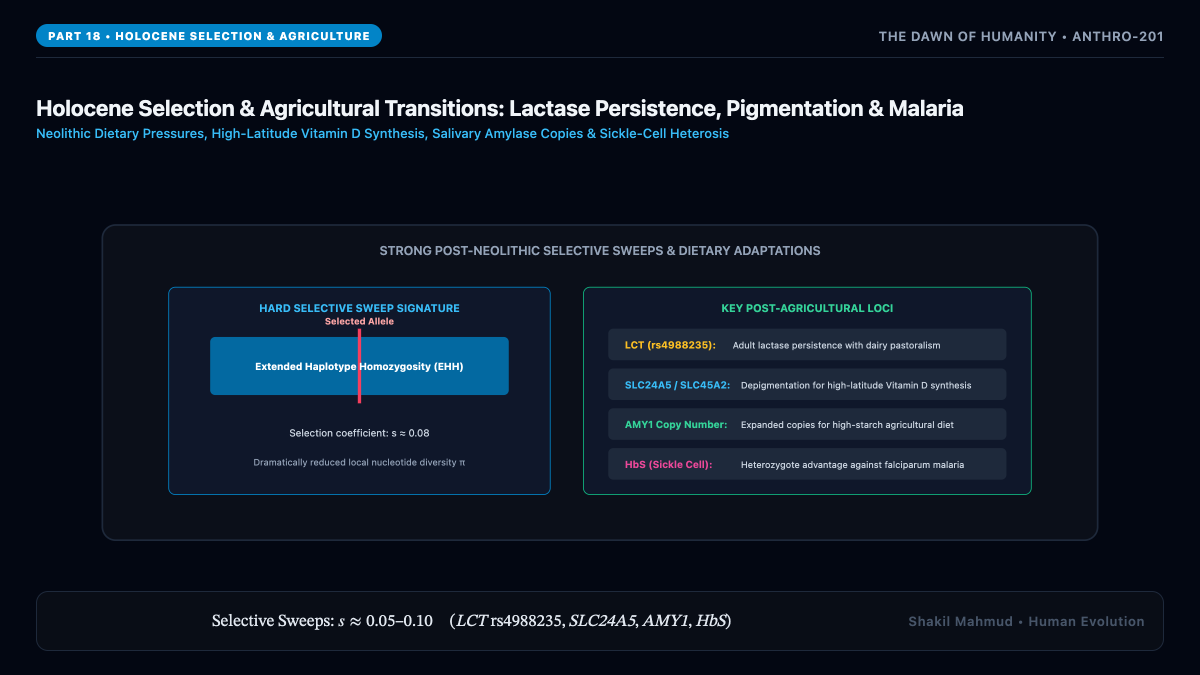
When a de novo beneficial mutation or rare standing variant confers a massive fitness advantage under new environmental conditions, natural selection drives its frequency from near zero to high prevalence faster than meiotic recombination can break it down. This produces a selective sweep:
- Extended Haplotype Homozygosity (EHH): The neutral alleles surrounding the favored mutation hitchhike along with it, creating an extraordinarily long, unbroken chromosomal block spanning hundreds of thousands of base pairs.
- Local Nucleotide Diversity Depression: Genetic diversity ($pi$) drops to near zero in the immediate vicinity of the locus.
The rate of change in allele frequency $p$ per generation under selection coefficient $s$ is governed by the classical population genetic differential equation:
$$Delta p = frac{s p(1 – p) [p h + (1 – p)(1 – h)]}{1 + s p [2p h + (1 – p)(1 – h)]}$$
Where $h$ represents the dominance coefficient. In the Holocene, several loci experienced astonishing selection coefficients of $s approx 0.05text{–}0.10$—some of the highest selective pressures measured across all sexually reproducing organisms.
2. The Dairy Revolution: Lactase Persistence (LCT / MCM6)
In all ancestral mammals and the vast majority of living adult humans, the intestinal enzyme lactase-phlorizin hydrolase (which cleaves milk lactose into glucose and galactose) is transcriptionally downregulated after weaning. Consuming raw animal milk as an adult causes severe diarrhea, dehydration, and nutrient malabsorption.
Following the domestication of cattle in the Fertile Crescent and pastoralist expansions $sim 8,000text{ BP}$:
- In European pastoralists, a single regulatory mutation located $13,910$ base pairs upstream of the lactase gene (in intron 13 of the adjacent MCM6 gene, designated rs4988235 or $-13910text{*}T$) enhanced transcription factor binding, causing lifelong lactase persistence.
- In African pastoralists (Maasai, Fulani, Tutsi), entirely independent convergent mutations (such as $-14010text{*}C$ and $-13915text{*}G$) evolved, demonstrating classic biocultural convergent evolution.
Milk provided uncontaminated fluid, protein, fat, and calcium during seasonal famines, conferring an enormous selective advantage ($s approx 0.08text{–}0.10$) that swept lactase persistence to $> 90%$ in northern Europe and pastoralist Africa.
3. High-Latitude Depigmentation & Vitamin D Synthesis
In equatorial Africa, dark eumelanin-rich skin protected folate (vitamin $B_9$) in blood capillaries from photolysis by high ultraviolet (UV) radiation ($UVB$). However, when agriculturalists migrated to high-latitude Europe and Eurasia, low ambient UVB paired with cereal diets (devoid of marine vitamin D) triggered lethal rickets and pelvic deformities in women of reproductive age.
To survive at high latitudes, natural selection favored mutations in the melanin synthesis pathway that stripped eumelanin from keratinocytes to permit cutaneous synthesis of vitamin $D_3$:
- SLC24A5 (Ala111Thr / rs1426654): A potassium-dependent sodium-calcium exchanger. The derived $A$ allele swept across West Eurasia $sim 8,000text{ years ago}$, explaining $> 30%$ of skin reflectance differences between Africans and Europeans.
- SLC45A2 and HERC2/OCA2: Further lightened pigmentation and produced blue eye coloration in northern latitudes.
4. Pathogen Selection: The Malaria Defense Mechanisms
Neolithic land clearance for agriculture created stagnant sunlit pools ideal for the breeding of Anopheles mosquitoes, bringing deadly falciparum malaria into intense contact with dense human villages. In response, natural selection favored severe mutations in red blood cell architecture:
- Sickle-Cell Hemoglobin (HbS): A missense mutation in the $eta$-globin gene (Glu6Val). Under balancing selection (heterozygote advantage):
$$text{Fitness Ordering: } w_{AS} > w_{AA} > w_{SS}$$
Heterozygotes ($AS$) are resistant to cerebral malaria with minimal sickling, maintaining the lethal sickle-cell allele in malaria-endemic zones despite high mortality in homozygotes ($SS$). - Thalassemias and G6PD Deficiency: Cellular structural defects that halt intra-erythrocytic parasite replication.