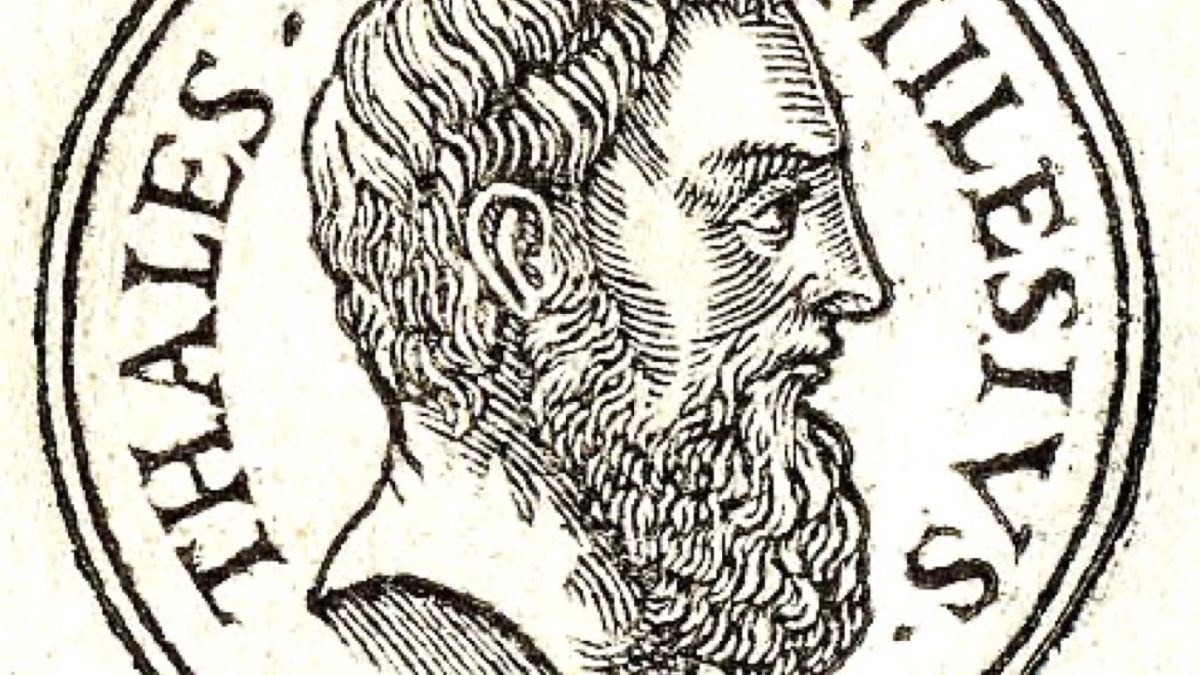
In the bustling Aegean port of Miletus during the early sixth century BCE, human consciousness crossed an irreversible intellectual threshold. For millennia, civilizations across the fertile river valleys of Egypt and Mesopotamia had explained the mechanics of the cosmos through dramatic theological narratives: storms were the wrath of Enlil, earthquakes the restlessness of Poseidon, and the annual flooding of rivers the gift of benevolent deities. In Miletus, a prosperous mercantile hub connecting East and West, an inquisitive geometer and engineer named Thales proposed a radical question that dismissed divine intervention entirely: What is the cosmos made of, and by what immanent natural laws does it govern itself?
The Rupture: From Mythos to Logos
The birth of Western philosophy is not merely a chronicle of clever men inventing abstract theories; it is a structural revolution in human epistemology known as the transition from mythos to logos. While mythopoeic thought relies on poetic genealogy, sacred authority, and emotional resonance, naturalistic inquiry demands observable evidence, critical debate, and logical coherence. Thales asserted that the underlying reality—the arche (ἀρχή), or foundational material principle—of all existing things is Water (hydor).
“The most difficult thing in life is to know yourself. The easiest is to give advice to others.” — Thales of Miletus
To modern ears conditioned by subatomic physics and the periodic table, claiming that everything is water sounds quaintly simplistic. But the philosophical genius of Thales lay not in his chemical choice, but in the monistic premise underlying it: beneath the bewildering multiplicity of sensory appearances lies a single, unified, rational substance that transforms across solid, liquid, and gaseous states without losing its essential identity. For the first time in recorded history, an explanation of the world was offered that invited public criticism, verification, and empirical refutation rather than unquestioning ritual obedience.
Epistemic Milestone: The Milesian Triad
The Milesian school unfolded across three generations of master and student, establishing the foundational methodologies of Western science:
- Thales (c. 624–548 BCE): Postulated Water as the material arche, deduced solar eclipses, and proved abstract geometric theorems through deductive proof.
- Anaximander (c. 610–546 BCE): Realized that no specific empirical element could account for opposing qualities (wet vs. dry, hot vs. cold) and proposed the Apeiron (the Boundless/Infinite).
- Anaximenes (c. 586–526 BCE): Proposed Air (aer), introducing quantitative mechanisms of rarefaction and condensation to explain qualitative change.
Anaximander and the Invention of the Infinite (Apeiron)
Thales’ student Anaximander took the abstraction of the arche to a breathtaking philosophical altitude. He observed that if water were the sole cosmic foundation, fire would be extinguished; nature consists of primordial opposites perpetually contending against one another. Therefore, the source of all things cannot itself be any single observable substance. It must be something indefinite, boundless, and eternal: the Apeiron (ἄπειρον).
Anaximander described a cosmic cycle of eternal justice: entities arise out of the Apeiron, separate into opposing qualities, and eventually dissolve back into the boundless to make restitution for their injustice of overreaching. Furthermore, Anaximander formulated the first evolutionary hypothesis, arguing that human beings must have originated inside the bellies of fish-like marine creatures because human infants are uniquely helpless and could never have survived primordial conditions unassisted.
The Architecture of Cosmic Law
In the Milesian dawn, we witness the birth of what Albert Einstein later celebrated as “the eternal mystery of the world: its comprehensibility.” By seeking reasons within nature rather than outside it, Thales, Anaximander, and Anaximenes replaced magical superstition with rational inquiry, setting into motion the two-and-a-half-millennium odyssey of philosophy, mathematics, and natural science.