For centuries, human societies divided our species into discrete, hierarchical biological “races”, assuming that geographic continental groups represented ancient, genetically coherent lineages demarcated by immutable biological boundaries. In 1972, evolutionary geneticist Richard Lewontin published a landmark quantitative study that revolutionized human biology. Applying Wright’s fixation index to empirical genetic data, Lewontin demonstrated that the biological concept of race is a statistical and biological illusion.
1. Wright’s Fixation Index ($F_{ST}$) and Hierarchical Diversity Partitioning
To mathematically quantify how genetic variation is partitioned across structured populations, Sewall Wright formulated the fixation index ($F_{ST}$). Across any polymorphic locus with allele frequencies $p_i$ across subpopulations, $F_{ST}$ measures the reduction in heterozygosity expected from random mating within subpopulations relative to the total metapopulation:
$$F_{ST} = frac{text{Var}(p)}{bar{p}(1 – bar{p})} = frac{H_T – H_S}{H_T}$$
Where $H_S$ is the average expected heterozygosity within local subpopulations, and $H_T$ is the total expected heterozygosity across the pooled metapopulation.
In classical zoology, two geographic populations are recognized as distinct biological subspecies (races) only if their genetic differentiation exceeds a recognized threshold:
$$F_{ST}^{text{subspecies}} ge 0.25text{ to } 0.30$$
For example, continental subspecies of coyotes, wolves, and chimpanzees systematically exhibit $F_{ST}$ values between $0.30text{ and }0.45$, indicating substantial genetic divergence and long-term evolutionary isolation.
2. Lewontin’s 1972 Landmark Apportionment: The 85% Reality
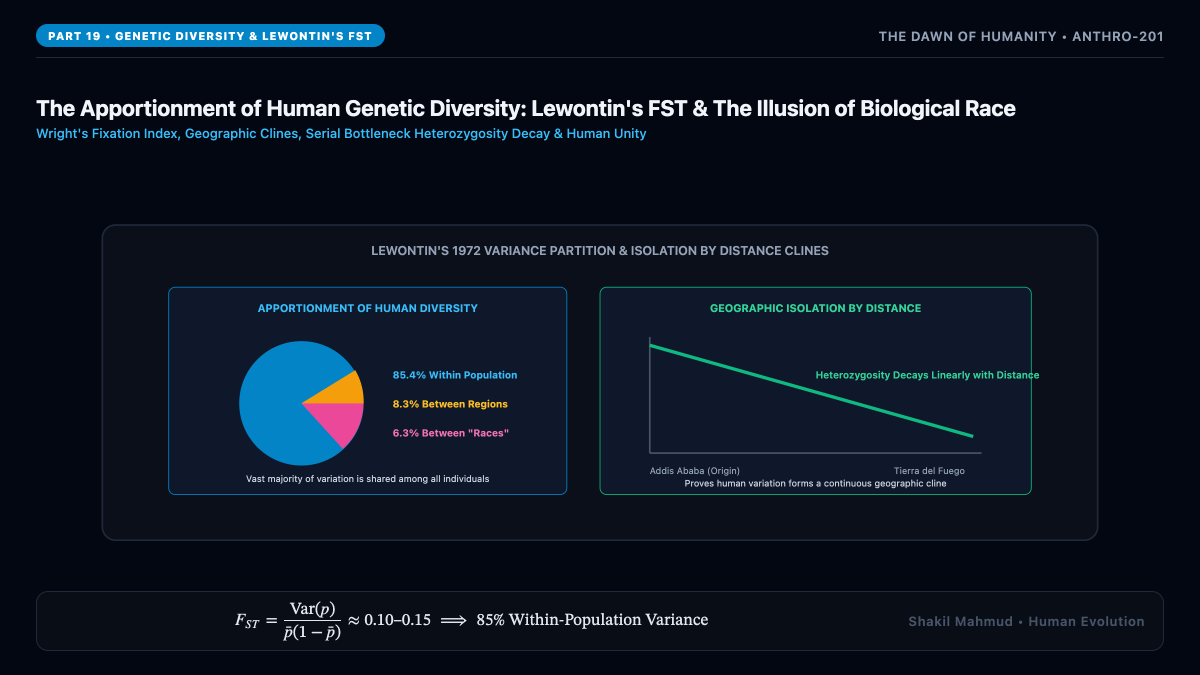
In his seminal paper, “The Apportionment of Human Diversity” (1972), Richard Lewontin analyzed allelic variation across $17$ polymorphic protein and blood group loci (such as ABO, Rh, and haptoglobins) spanning dozens of populations across seven major geographic regions. Using Shannon information entropy ($H$), Lewontin decomposed total human genetic variation into three hierarchical components:
$$H_{text{total}} = H_{text{within local populations}} + H_{text{between populations within regions}} + H_{text{between continental regions}}$$
| Hierarchical Partition Level | Proportion of Total Human Genetic Diversity | Biological Interpretation |
|---|---|---|
| Within Any Single Local Population | $85.4%$ | The vast majority of human genetic variation is present within any single local tribe, village, or town. |
| Between Populations on the Same Continent | $8.3%$ | Minor regional divergence between neighboring geographic groups (e.g., French vs German, or Yoruba vs Bantu). |
| Between Continental Geographic Groups (“Races”) | $6.3%$ | Only a vanishingly small fraction of variation separates continental populations. |
Subsequent modern whole-genome resequencing projects (such as the 1000 Genomes Project and Simons Genome Diversity Project) across millions of single nucleotide polymorphisms (SNPs) have confirmed Lewontin’s exact findings: global autosomal $F_{ST}$ across humans is merely:
$$F_{ST}^{text{human}} approx 0.10text{ to } 0.15$$
This means that if a catastrophic apocalypse wiped out every human population on Earth except for a single local indigenous village in New Guinea or a single town in West Africa, over $85%$ of all human genetic diversity would survive intact.
3. Geographic Clines vs Discrete Clusters: Isolation by Distance
Why do continental “racial” typologies appear intuitive to lay observers? The answer lies in the human brain’s cognitive tendency to categorize continuous gradients into discrete buckets.
Human genetic variation is structured as continuous geographic clines governed by the principle of Isolation by Distance (IBD):
$$d_{text{genetic}} propto log(d_{text{geographic}})$$
Genetic distance between two indigenous populations increases smoothly and monotonically with the geographic walking distance separating them. There are no sharp genetic cliffs or discrete genetic boundaries at continental borders. Traits such as skin pigmentation, hair texture, and facial bone structure vary gradually across geography in response to latitudinal UV gradients and climatic selection.
4. The Serial Founder Effect Out of Africa
Furthermore, human genetic diversity mirrors our recent evolutionary history. As modern humans expanded out of Africa, each successive stepping-stone colonization event involved a subset of the previous population—a serial founder bottleneck.
Consequently, genetic diversity (expected heterozygosity $H_e$) and phenotypic cranial variance decay linearly as a function of migratory distance from East Africa:
$$H_e = H_0 – beta cdot d_{text{migratory distance}}$$
Sub-Saharan African populations harbor the highest genetic diversity, the shortest linkage disequilibrium blocks, and the deepest ancestral lineages on Earth. All non-African populations represent a recently derived, genetically depleted subset of African variation. Population genetics has permanently dismantled biological racism: humanity is a young, deeply interconnected, biologically unified evolutionary family.