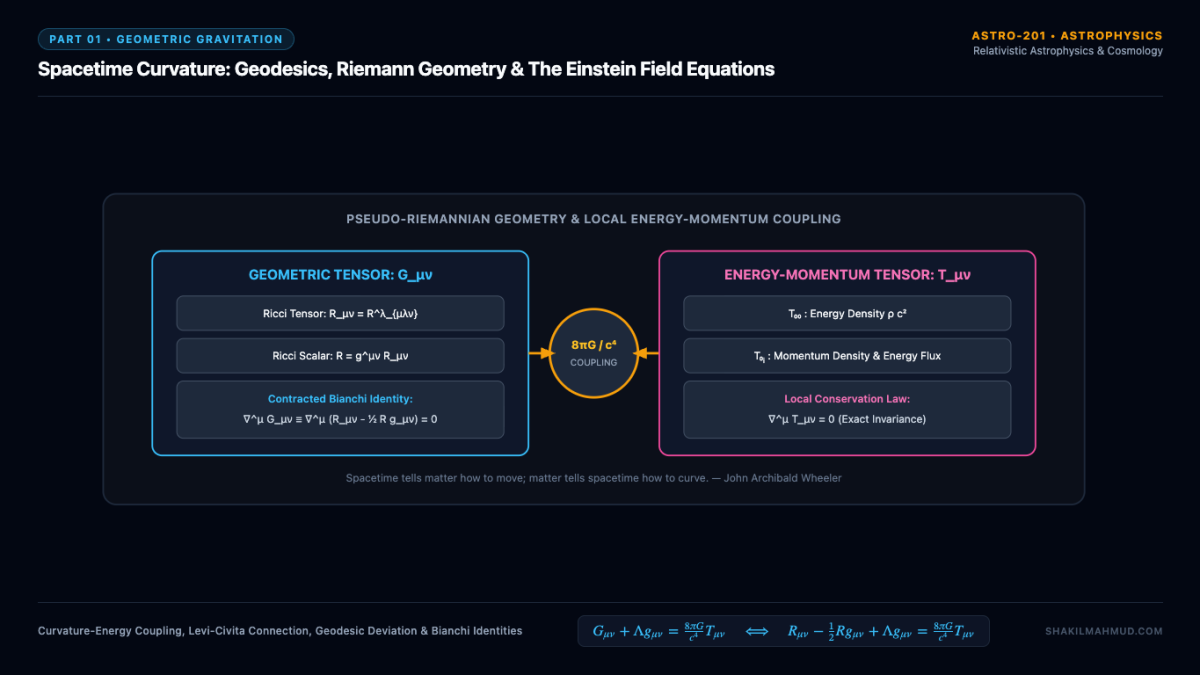
Gravitation is not an invisible Newtonian force acting instantaneously across empty Euclidean space; it is the dynamical manifestation of curved Pseudo-Riemannian Spacetime Geometry. As formulated by Albert Einstein in 1915, freely falling test bodies follow straight paths—Geodesics—through a four-dimensional metric manifold whose curvature is continuously shaped by the local distribution of matter, momentum, and stress.
1. The Metric Tensor & Spacetime Invariant Interval
The geometry of a 4-dimensional Lorentzian manifold $(mathcal{M}, g_{munu})$ with signature $(-, +, +, +)$ is governed by the infinitesimal spacetime line element:
ds^2 = g_{munu} dx^mu dx^nu
Where $g_{munu}$ is the symmetric metric tensor ($g_{munu} = g_{numu}$). The metric tensor performs two foundational geometric functions:
- It establishes the inner product of four-vectors: $u cdot v = g_{munu} u^mu v^nu$.
- It establishes the causal light-cone structure separating timelike ($ds^2 0$) physical intervals.
2. Covariant Derivatives & The Levi-Civita Connection
Because coordinate basis vectors vary across curved spacetime, standard partial derivatives $partial_mu$ fail to transform as tensors. The torsion-free, metric-compatible Covariant Derivative $nabla_mu$ is defined via the Christoffel symbols of the second kind (the Levi-Civita connection):
nabla_mu V^nu = partial_mu V^nu + Gamma^nu_{mulambda} V^lambda
Gamma^sigma_{munu} = frac{1}{2} g^{sigmalambda} left( partial_mu g_{nulambda} + partial_nu g_{mulambda} – partial_lambda g_{munu} right)
Metric compatibility guarantees that the metric tensor is covariantly constant: $nabla_sigma g_{munu} equiv 0$.
3. Geodesic Motion & The Equivalence Principle
According to the Weak Equivalence Principle, the trajectory of an uncharged test particle in a gravitational field is independent of its internal mass and composition. In curved spacetime, this motion is represented by the Geodesic Equation:
frac{d^2 x^mu}{dlambda^2} + Gamma^mu_{alphabeta} frac{dx^alpha}{dlambda} frac{dx^beta}{dlambda} = 0
Where $lambda$ is an affine parameter (proper time $tau$ for timelike observers). Tidal gravitational acceleration is not determined by the connection itself, but by the Riemann curvature tensor through the Geodesic Deviation Equation:
frac{D^2 xi^mu}{Dtau^2} = R^mu_{;nualphabeta} u^nu u^alpha xi^beta
4. The Riemann Curvature Tensor & The Einstein Field Equations
The failure of covariant derivatives to commute on arbitrary vectors measures the intrinsic curvature of spacetime:
[nabla_mu, nabla_nu] V^rho = R^rho_{;sigmamunu} V^sigma
By contracting the Riemann tensor, we obtain the symmetric rank-2 Ricci Tensor $R_{munu} = R^lambda_{;mulambdanu}$ and the scalar curvature $R = g^{munu} R_{munu}$. Coupling geometry to physical matter yields the celebrated Einstein Field Equations:
G_{munu} + Lambda g_{munu} = frac{8pi G}{c^4} T_{munu}
Where the Einstein tensor $G_{munu} = R_{munu} – frac{1}{2} R g_{munu}$ satisfies the contracted Bianchi identity $nabla^mu G_{munu} equiv 0$, guaranteeing the exact local conservation of matter and energy ($nabla^mu T_{munu} = 0$).




