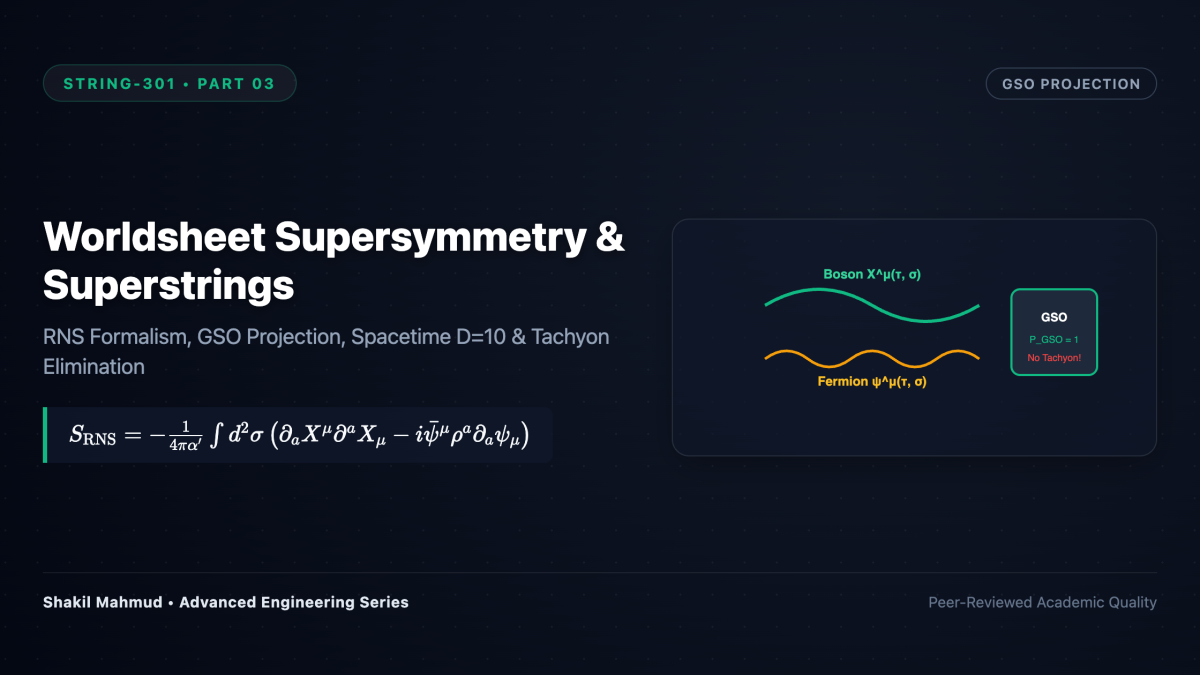
Despite its mathematical beauty, the 26-dimensional bosonic string suffers from two fatal physical flaws: its spectrum contains a catastrophic imaginary-mass tachyon ((M^2 < 0)), and it contains zero fermions, rendering it incapable of describing quarks, leptons, or matter. In 1971, Pierre Ramond, André Neveu, and John Schwarz introduced Worldsheet Supersymmetry, pairing bosonic coordinates with two-dimensional Majorana fermions. The resulting Superstring Theory eliminates the tachyon via the GSO projection, reduces the critical dimension to (D = 10), and achieves full spacetime supersymmetry.
1. The Ramond-Neveu-Schwarz (RNS) Action
In the RNS formalism, each bosonic embedding coordinate (X^mu( au, sigma)) is partnered with a two-component Majorana spinor (psi^mu = begin{pmatrix} psi_-^mu psi_+^mu nd{pmatrix}). In conformal gauge, the RNS action is:
[
S_{ ext{RNS}} = -rac{1}{4pialpha’} int d^2sigma left( partial_a X^mu partial^a X_mu – i bar{psi}^mu
ho^a partial_a psi_mu
ight)
]
where (
ho^a) are 2D Dirac matrices satisfying ({
ho^a,
ho^b} = 2ta^{ab}). The action is invariant under the global (mathcal{N}=1) 2D supersymmetry transformation:
[
delta X^mu = bar{psilon} psi^mu, quad delta psi^mu = -i
ho^a partial_a X^mu psilon
]
The boundary variation of the fermionic action requires (left[ psi_-^mu deltapsi_-^mu – psi_+^mu deltapsi_+^mu
ight]_0^pi = 0). For open strings, setting (psi_+^mu(0) = psi_-^mu(0)) leaves two distinct boundary choices at (sigma = pi):
- Ramond (R) Boundary Condition (Periodic): (psi_+^mu(pi) = +psi_-^mu(pi)). The Fourier mode expansion contains integer modes (d_n^mu) ((n in mathbb{Z})). The zero-mode algebra ({d_0^mu, d_0^
u} = ta^{mu
u}) forms the (D)-dimensional Dirac gamma matrix Clifford algebra, producing Spacetime Fermions. - Neveu-Schwarz (NS) Boundary Condition (Anti-Periodic): (psi_+^mu(pi) = -psi_-^mu(pi)). The modes are half-integers (b_r^mu) ((r in mathbb{Z} + 1/2)). The ground state is non-degenerate, producing Spacetime Bosons.
2. Super-Virasoro Algebra and the Critical Dimension (D = 10)
The conserved currents of 2D superconformal symmetry are the stress-energy tensor (T(z)) and the supercurrent (G(z)). Their Fourier modes define the Super-Virasoro Algebra:
[
[L_m, L_n] = (m – n)L_{m+n} + rac{c}{12}(m^3 – m)delta_{m+n, 0}
]
[
{G_r, G_s} = 2 L_{r+s} + rac{c}{3}left(r^2 – rac{1}{4}
ight)delta_{r+s, 0}
]
For each super-multiplet ((X^mu, psi^mu)), the bosons contribute (c_B = 1) and the fermions contribute (c_F = 1/2), yielding total matter central charge (c_{ ext{matter}} = rac{3}{2}D). The super-reparametrization ghosts ((b, c)) and ((beta, gamma)) contribute (c_{ ext{ghost}} = -26 + 11 = -15). Anomaly cancellation demands:
[
c_{ ext{total}} = rac{3}{2}D – 15 = 0 quad implies quad D = 10
]
Superstring theory lives naturally in ten spacetime dimensions.
3. The GSO Projection and Tachyon Elimination
In the NS sector, normal ordering Casimir energy yields intercept (a_{ ext{NS}} = 1/2). The ground state is a tachyon with (M^2 = -rac{1}{2alpha’}). In 1976, Ferdinando Gliozzi, Joël Scherk, and David Olive resolved this with the GSO Projection.
Defining the worldsheet fermion number operator (F), the GSO projection acts as a quantum parity filter, keeping only states with positive GSO parity:
[
P_{ ext{GSO}} = rac{1 + (-1)^F}{2}
]
- NS Sector: Ground state (|0
angle_{ ext{NS}}) has ((-1)^F = -1) and is strictly projected out! The tachyon is completely eliminated. The new ground state is the massless vector gauge boson (psi_{-1/2}^mu |0
angle_{ ext{NS}}) with (8) physical transverse states. - R Sector: Ground state is a 10D Majorana-Weyl spinor of definite spacetime chirality with (8) physical fermionic degrees of freedom.
At every mass level (M^2 = n/alpha’), the number of bosonic states exactly equals the number of fermionic states: (N_B(n) = N_F(n)). Spacetime supersymmetry ((mathcal{N}=1)) is realized, yielding a stable, tachyon-free quantum theory unifying matter and force.