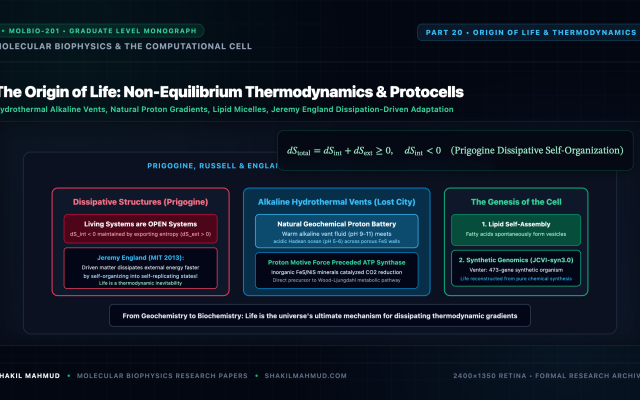
What is life? In 1944, Erwin Schrödinger asked this foundational question in his landmark lecture, proposing that living organisms survive and maintain...
For over a century, molecular biology advanced through extreme reductionism: isolating individual genes, crystallizing single proteins, and characterizing isolated metabolic reactions. In...
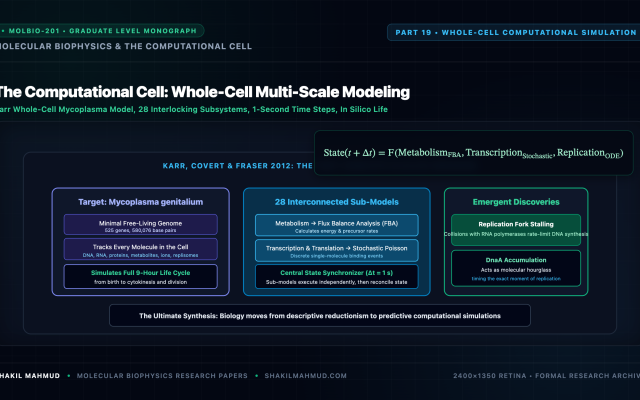
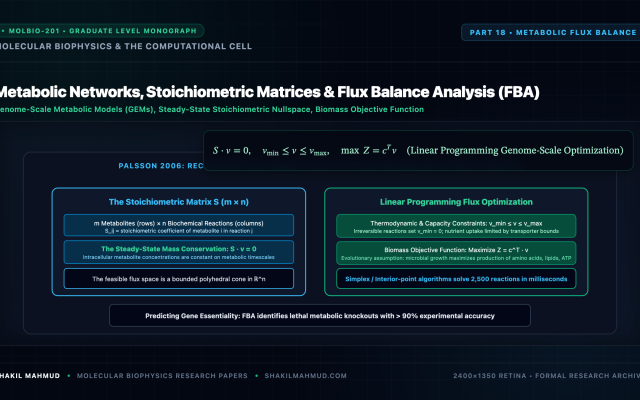
A complete cellular organism coordinates thousands of simultaneous metabolic reactions exchanging matter and energy with its environment. Because exact in vivo kinetic...
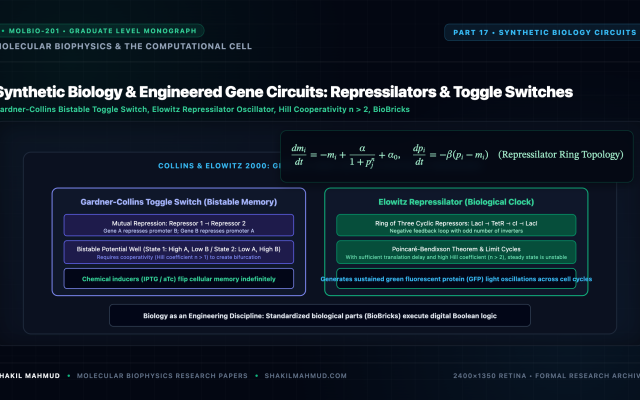
In the year 2000, molecular biology crossed a monumental threshold: the transition from descriptive observational reductionism to generative engineering synthesis. By treating...
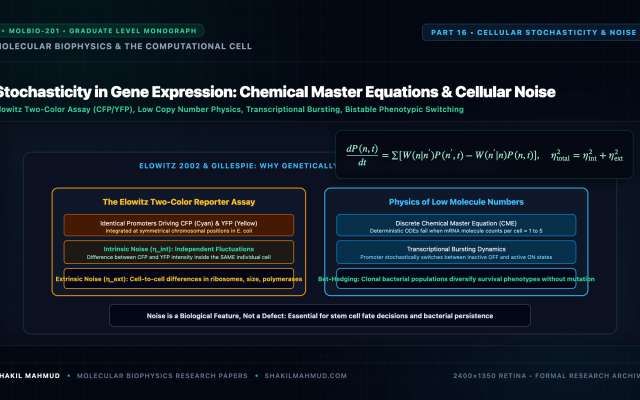
In macroscopic test tubes, chemical reactions appear smooth and deterministic, governed by the continuous law of mass action. Inside a microscopic single...
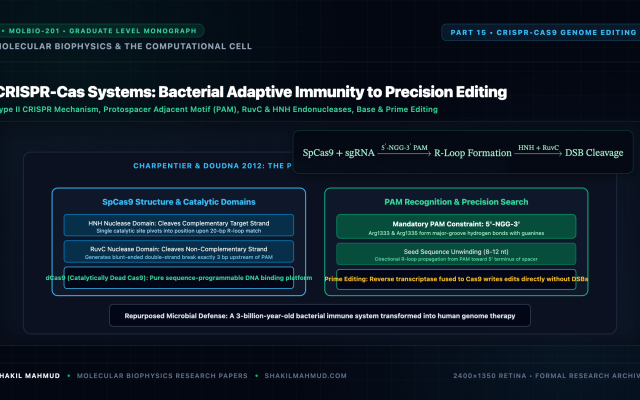
Originating as an ancient prokaryotic RNA-guided adaptive immune system against bacteriophage predation, the CRISPR-Cas9 complex has been re-engineered into the defining biotechnology...
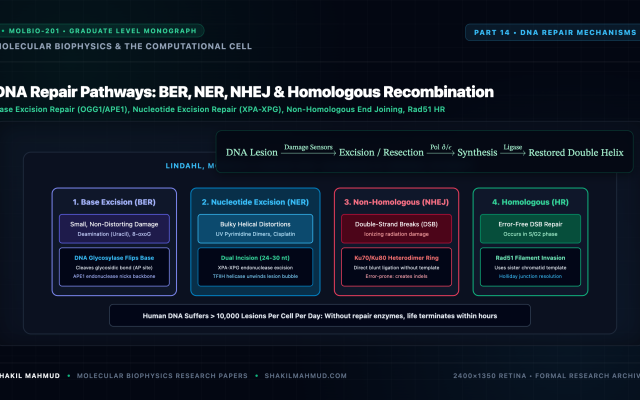
DNA is not chemically inert. Every single human cell experiences approximately $10,000text{–}100,000$ molecular lesions per day caused by endogenous oxidative free radicals...
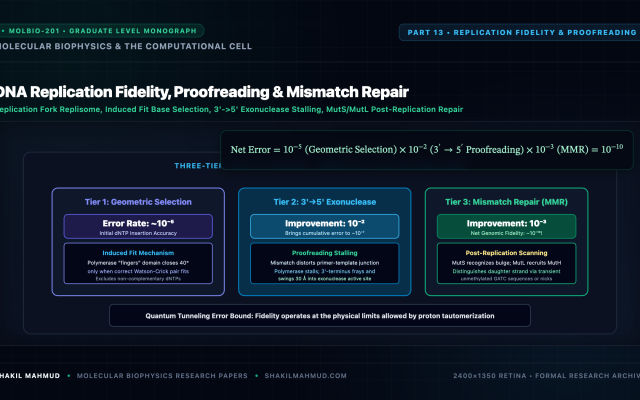
The human genome comprises $3.2 times 10^9$ base pairs. During somatic cell division, this massive molecular archive must be duplicated with near-miraculous...
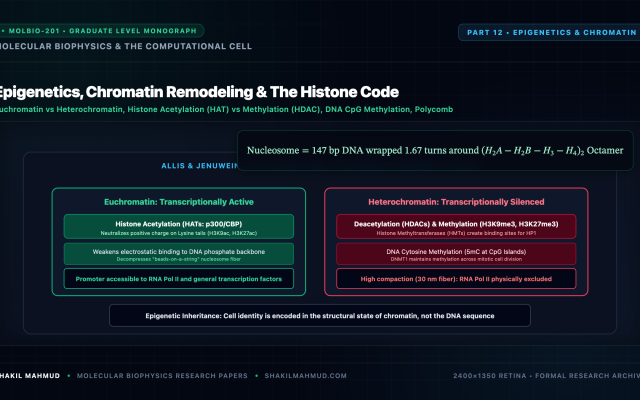
If the linear DNA sequence is the static hardware of the living cell, Epigenetics represents the dynamic operating system. Within eukaryotic nuclei,...
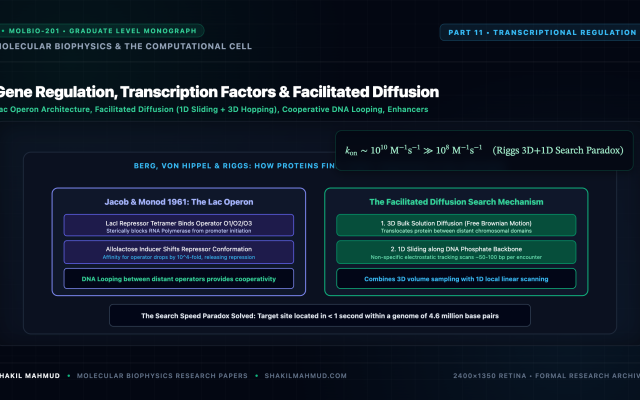
How does a sequence-specific transcription factor locate its unique 20-base-pair target site among the 4.6 million base pairs of the bacterial genome...
•3 min read
Editorial Academy
Learner Portal & Sync
Open to everyone worldwide—researchers, engineers, students, and independent scholars. Sign in with Google or your email to securely track reading progress across devices, take faculty examinations, and earn verified diplomas.
or continue with email
🎓
Enrolled Academic Curricula (43 Disciplines)
The Great Equations (MATH-101)20 Parts • Mathematical Physics & Epistemology
The Story of Physics (PHYS-101)20 Parts • Classical & Modern Theoretical Physics
The Universal Chronicle (COSM-101)20 Parts • Astrophysics & Big History Cosmology
The Evolutionary Odyssey (BIOL-101)20 Parts • Paleobiology, Genetics & Macroevolution
The Story of Consciousness (PHIL-101)20 Parts • Cognitive Neuroscience & Philosophy of Mind
The History of Computing and AI (COMP-101)20 Parts • Computer Architecture & Machine Intelligence
The History of Bengal (HIST-101)20 Parts • Regional Historiography & Geopolitical Economy
The Epic of Human Civilization (CIV-101)20 Parts • World History & Civilizational Anthropology
The Evolution of Money & Markets (ECON-101)20 Parts • Monetary History, Central Banking & Macroeconomics
The Story of Chemistry (CHEM-101)20 Parts • Molecular Sciences, Quantum Bonding & Nanotechnology
The Story of Genetics (GEN-101)20 Parts • Molecular Biology, Genomics & Synthetic Life
The History of Philosophy (PHIL-101)20 Parts • Epistemology, Classical Metaphysics & Continental Thought
Game Theory & Mechanism Design (GAME-101)20 Parts • Strategic Interaction, Mechanism Design & Algorithmic Economics
Nuclear Physics, Fusion Energy & Advanced Reactors (ENERGY-201)20 Parts • Nuclear Physics, Thermonuclear Plasmas & Reactor Engineering
Autonomous Robotics, Kinematics & Spatial Intelligence (ROBOT-201)20 Parts • Robotic Kinematics, Dynamics, SLAM & Embodied AI
Modern Cryptography, Zero-Knowledge & Post-Quantum Security (CRYPTO-301)20 Parts • Mathematical Cryptography, Complexity Theory & Zero-Knowledge Systems