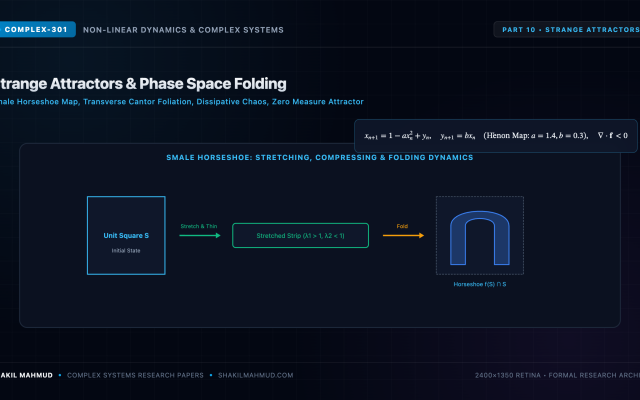
How can a dynamical system sustain continuous exponential divergence of nearby trajectories forever while remaining confined inside a strictly bounded region of...
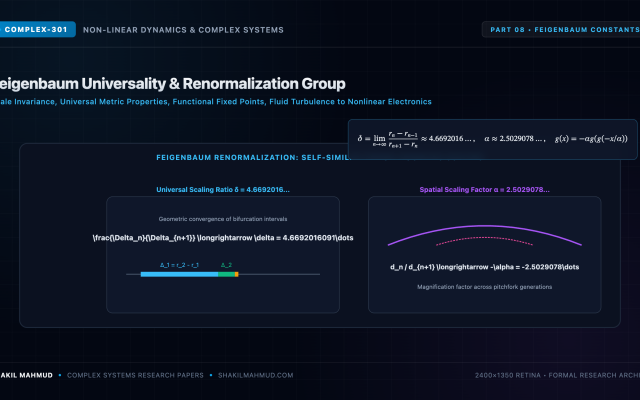
In 1978, theoretical physicist Mitchell Feigenbaum discovered a mathematical truth as fundamental and unexpected as Planck’s constant or the speed of light:...
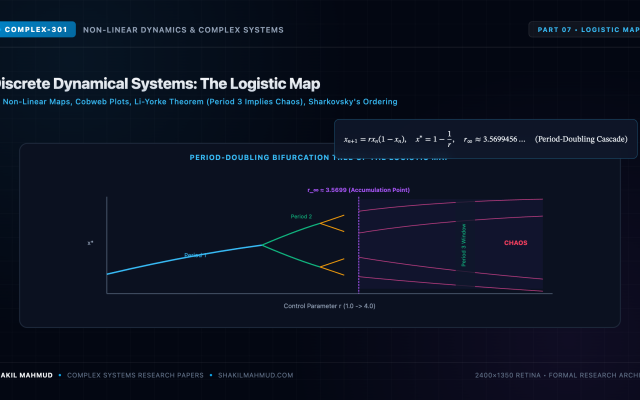
While continuous differential equations require at least three dimensions to exhibit chaos, discrete difference equations can generate boundless chaotic complexity in a...
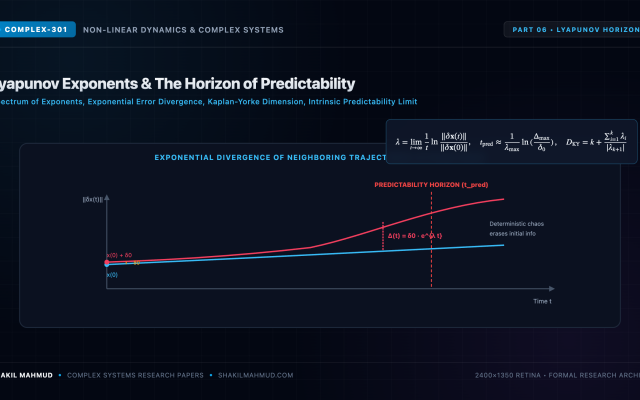
How do we mathematically quantify “chaos”? Qualitative assertions of unpredictability are made rigorous by the spectrum of Lyapunov Exponents—the asymptotic rates of...
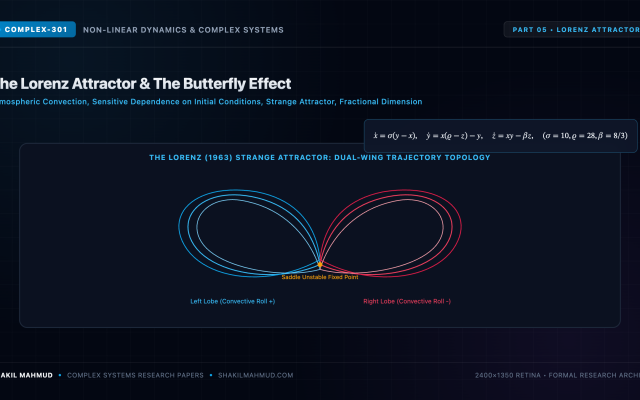
In 1963, meteorologist Edward Lorenz published a paper in the Journal of the Atmospheric Sciences titled “Deterministic Nonperiodic Flow.” In twelve humble...
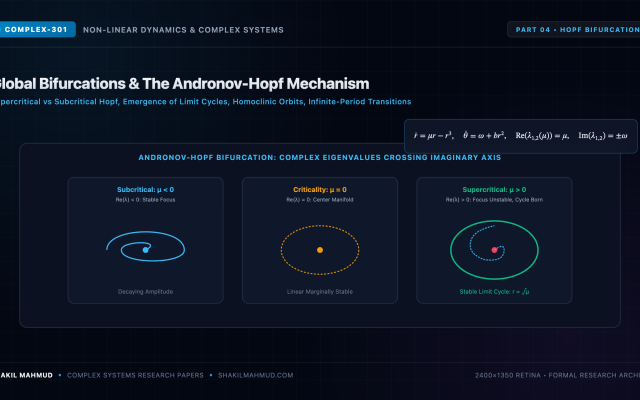
How are rhythms born out of silence? In physical systems ranging from the chemical clock of the Belousov-Zhabotinsky reaction to aeroelastic flutter...
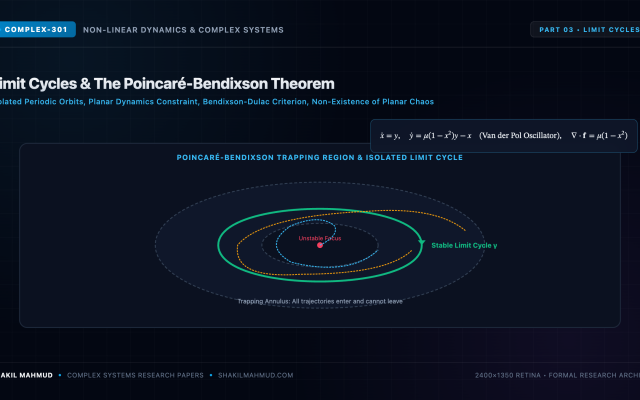
Linear systems can oscillate, but their periodic orbits form continuous neutral families whose amplitude depends entirely on initial conditions (like a frictionless...
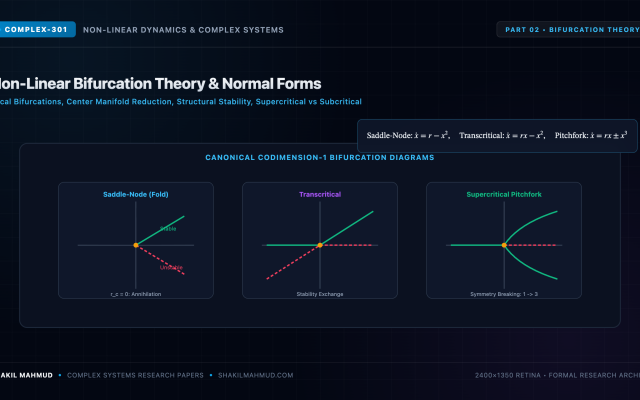
A dynamical system is rarely rigid; its governing equations depend on physical parameters—temperatures, flow velocities, chemical affinities, voltages. As a parameter smoothly...
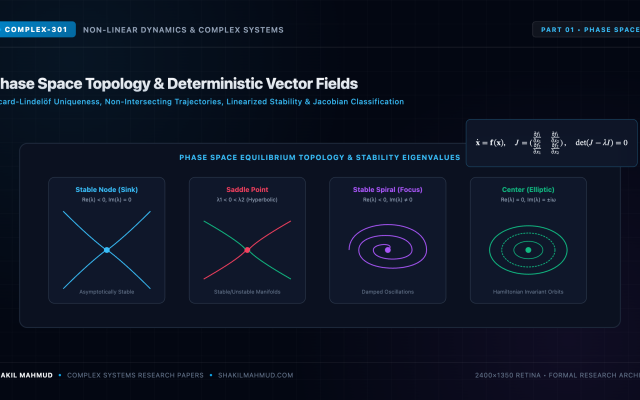
At the foundation of modern non-linear dynamics lies a geometric conceptual revolution inaugurated by Henri Poincaré: instead of seeking unattainable closed-form analytical...
•4 min read
Editorial Academy
Learner Portal & Sync
Open to everyone worldwide—researchers, engineers, students, and independent scholars. Sign in with Google or your email to securely track reading progress across devices, take faculty examinations, and earn verified diplomas.
or continue with email
🎓
Enrolled Academic Curricula (43 Disciplines)
The Great Equations (MATH-101)20 Parts • Mathematical Physics & Epistemology
The Story of Physics (PHYS-101)20 Parts • Classical & Modern Theoretical Physics
The Universal Chronicle (COSM-101)20 Parts • Astrophysics & Big History Cosmology
The Evolutionary Odyssey (BIOL-101)20 Parts • Paleobiology, Genetics & Macroevolution
The Story of Consciousness (PHIL-101)20 Parts • Cognitive Neuroscience & Philosophy of Mind
The History of Computing and AI (COMP-101)20 Parts • Computer Architecture & Machine Intelligence
The History of Bengal (HIST-101)20 Parts • Regional Historiography & Geopolitical Economy
The Epic of Human Civilization (CIV-101)20 Parts • World History & Civilizational Anthropology
The Evolution of Money & Markets (ECON-101)20 Parts • Monetary History, Central Banking & Macroeconomics
The Story of Chemistry (CHEM-101)20 Parts • Molecular Sciences, Quantum Bonding & Nanotechnology
The Story of Genetics (GEN-101)20 Parts • Molecular Biology, Genomics & Synthetic Life
The History of Philosophy (PHIL-101)20 Parts • Epistemology, Classical Metaphysics & Continental Thought
Game Theory & Mechanism Design (GAME-101)20 Parts • Strategic Interaction, Mechanism Design & Algorithmic Economics
Nuclear Physics, Fusion Energy & Advanced Reactors (ENERGY-201)20 Parts • Nuclear Physics, Thermonuclear Plasmas & Reactor Engineering
Autonomous Robotics, Kinematics & Spatial Intelligence (ROBOT-201)20 Parts • Robotic Kinematics, Dynamics, SLAM & Embodied AI
Modern Cryptography, Zero-Knowledge & Post-Quantum Security (CRYPTO-301)20 Parts • Mathematical Cryptography, Complexity Theory & Zero-Knowledge Systems