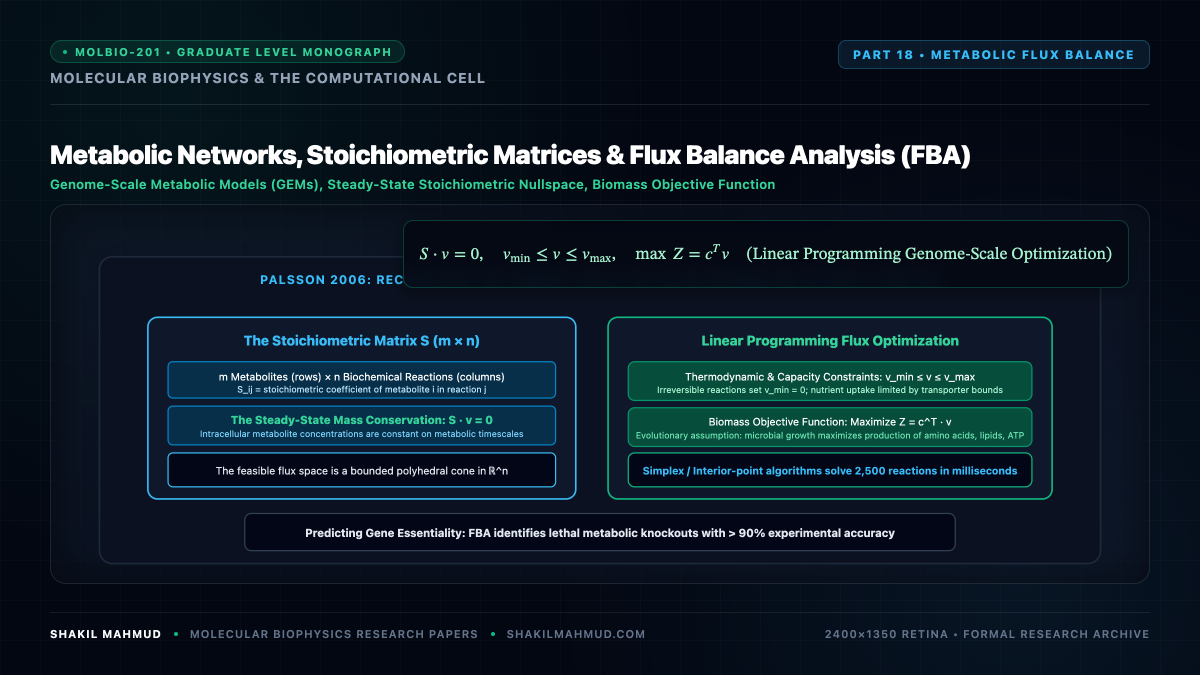
A complete cellular organism coordinates thousands of simultaneous metabolic reactions exchanging matter and energy with its environment. Because exact in vivo kinetic rate constants ($k_{text{cat}}, K_M$) remain largely unmeasured for the vast majority of enzymes, systems biologists bypass kinetic ignorance through Constraint-Based Reconstruction and Analysis (COBRA), formalizing cellular metabolism as a constrained linear programming optimization problem known as Flux Balance Analysis (FBA).
1. The Stoichiometric Matrix $S$ & The Steady-State Constraint
Consider a metabolic network composed of $m$ internal metabolites and $n$ biochemical reaction fluxes. The network architecture is completely formalized by the Stoichiometric Matrix $S in mathbb{R}^{m times n}$:
[
S_{ij} = text{stoichiometric coefficient of metabolite } i text{ in reaction } j
]
(where substrates carry negative coefficients $S_{ij} 0$, and non-participating species are zero).
The time evolution of metabolite concentration vector $mathbf{x} in mathbb{R}^m$ is governed by the matrix differential equation:
[
frac{dmathbf{x}}{dt} = S mathbf{v} – boldsymbol{mu} mathbf{x}
]
Where $mathbf{v} in mathbb{R}^n$ is the metabolic flux vector ($text{mmol} cdot text{g}_{text{DW}}^{-1} cdot text{h}^{-1}$) and $boldsymbol{mu}$ is the cell growth dilution rate. Because metabolic turnover occurs on timescales of milliseconds ($tau_{text{met}} sim 10^{-3}text{–}10^{-1} text{ s}$) while cell division requires hours ($tau_{text{growth}} sim 10^3text{–}10^4 text{ s}$), the system operates in a quasi-steady state:
[
S mathbf{v} = mathbf{0}
]
This fundamental equality constraint states that the net production of every internal metabolite must exactly balance its net consumption: no intermediate accumulates or depletes inside the cell.
2. The Linear Programming Formulation of FBA
Because metabolic networks possess more reactions than metabolites ($n > m$), the system $S mathbf{v} = mathbf{0}$ is heavily underdetermined, defining a convex polyhedral solution space of feasible fluxes—the Flux Cone.
To identify the biologically realized flux distribution within this cone, Flux Balance Analysis formulates the problem as a Linear Program (LP):
[
begin{aligned}
text{Maximize} quad & Z = mathbf{c}^T mathbf{v} \
text{subject to} quad & S mathbf{v} = mathbf{0} \
& mathbf{v}_{min} le mathbf{v} le mathbf{v}_{max}
end{aligned}
]
Where:
- $mathbf{c}$ is an objective vector. In evolutionary growth modeling, $mathbf{c}$ weights the Biomass Objective Function ($v_{text{biomass}}$), an empirical pseudo-reaction defining the exact stoichiometric proportion of amino acids, nucleotides, lipids, vitamins, and ATP required to synthesize $1 text{ gram}$ of dry cell weight.
- $mathbf{v}_{min}, mathbf{v}_{max}$ impose thermodynamic irreversibility ($v_j ge 0$ for irreversible reactions) and physical capacity constraints (e.g., maximum oxygen uptake rate, substrate transporter saturation).
Because the feasible region is convex and the objective function is linear, the global optimum $mathbf{v}^*$ can be found reliably within milliseconds using the Simplex algorithm or interior-point methods, even for genome-scale models encompassing $> 2,500$ reactions.
3. Gene Knockout Predictions & In Silico Metabolic Engineering
FBA enables systematic in silico genetic knockout screens:
- Single-Gene Deletions: Simulating the deletion of an enzyme gene sets the corresponding reaction flux bound to zero ($v_k = 0$). If the re-optimized maximum biomass flux $Z^* = 0$, the gene is computationally predicted to be essential for life.
- OptKnock: A bilevel optimization framework that designs microbial strains for industrial bioproduction. OptKnock computationally identifies gene knockouts that couple target chemical overproduction (e.g., bio-ethanol, lycopene) directly to cellular growth, forcing the evolutionary pressure of natural selection to drive high-yield chemical synthesis.
4. Flux Variability Analysis (FVA) & Shadow Prices
Often, the optimal objective value $Z^*$ can be achieved by multiple alternative internal flux pathways. Flux Variability Analysis (FVA) solves two secondary optimization problems for every reaction $j$, determining the absolute minimum and maximum permissible flux ($v_j^{min}, v_j^{max}$) that still maintains $ge 99%$ of the maximal growth rate.
Furthermore, the dual linear programming problem yields Shadow Prices ($mathbf{y} in mathbb{R}^m$):
[
y_i = frac{partial Z^*}{partial b_i}
]
The shadow price represents the marginal increase in cellular growth rate obtained by acquiring one additional unit of metabolite $i$, quantifying the biological metabolic value of individual nutrients in the external environment.