What is life? In 1944, Erwin Schrödinger asked this foundational question in his landmark lecture, proposing that living organisms survive and maintain order by continually drawing “negative entropy” ($Delta S_{text{universe}} > 0$) from their surroundings. At the culmination of molecular biophysics lies the deepest question in natural science: how did inanimate non-equilibrium organic chemistry self-organize into the first self-sustaining computational living cells?
1. Non-Equilibrium Thermodynamics: Prigogine Dissipative Structures
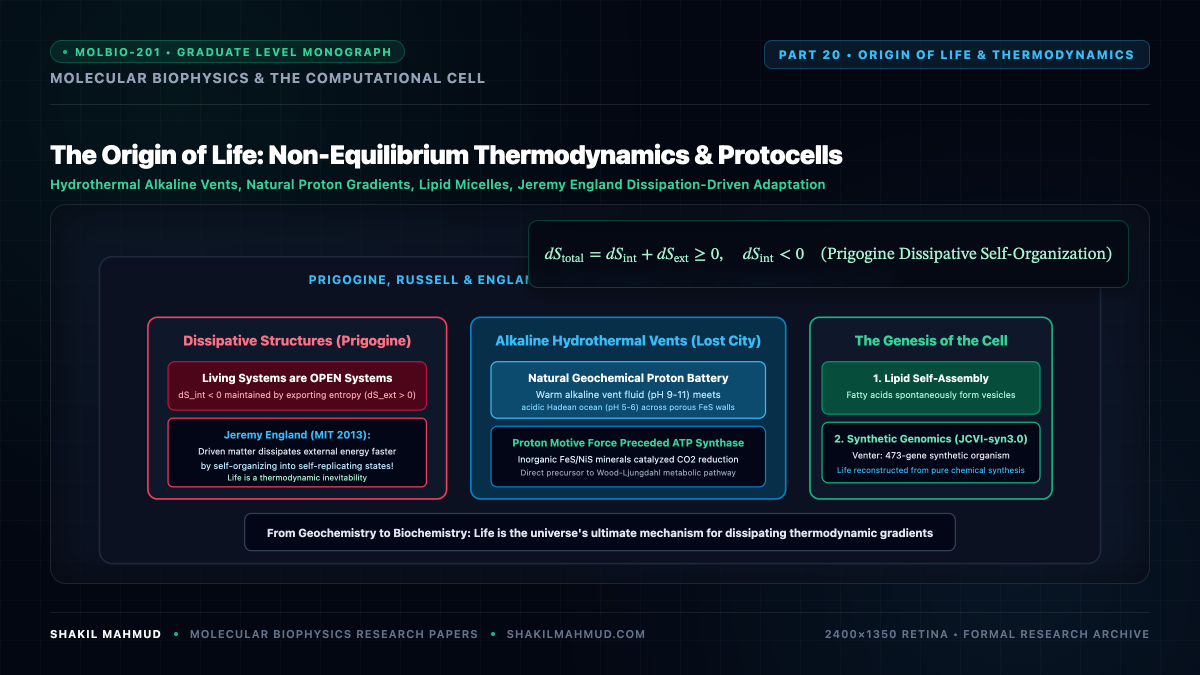
The Second Law of Thermodynamics dictates that in closed systems, entropy monotonically increases toward maximum disorder ($dS ge 0$). However, living cells are open, non-equilibrium thermodynamic systems exchanging mass, energy, and entropy with the external universe.
According to Ilya Prigogine’s theory of Dissipative Structures, when an open chemical system is driven far from thermodynamic equilibrium by sustained fluxes of matter and energy, the linear thermodynamic branch loses stability. The total entropy production rate $sigma$ is:
[
sigma = frac{d_i S}{dt} = sum_{k} J_k X_k > 0
]
Where $J_k$ represents thermodynamic fluxes (reaction rates, diffusion currents) and $X_k$ represents conjugate thermodynamic forces (chemical affinity gradients, temperature gradients). Beyond critical bifurcation points, non-linear chemical kinetics spontaneously organize into macroscopic spatiotemporal order (e.g., Turing patterns, Belousov-Zhabotinsky reaction-diffusion waves), demonstrating that self-organization is a natural, physically inevitable consequence of non-equilibrium dissipation.
2. Prebiotic Geochemical Engines: Alkaline Hydrothermal Vents
Modern origin-of-life biophysics (advocated by Michael Russell, Nick Lane, and William Martin) places the cradle of terrestrial abiogenesis at deep-sea Alkaline Hydrothermal Vents (such as the Lost City hydrothermal field):
- Serpentinization Reactions: Seawater reacting with mantle olivine generates molecular hydrogen ($text{H}_2$), methane, and alkaline fluids ($text{pH} approx 9text{–}11$) at moderate temperatures ($60text{–}90^circ text{C}$).
- Natural Proton Motive Force: The alkaline vent fluids enter an ancient Hadean ocean that was acidic ($text{pH} approx 5text{–}6$) and saturated with dissolved $text{CO}_2$ and $text{Fe}^{2+}$. Across thin, microporous inorganic mineral membranes of iron-sulfur minerals (greigite, mackinawite, $text{FeS}$), nature established a spontaneous geochemical proton gradient:
[
Delta text{pH} approx 4text{–}5 text{ units} implies Delta p approx 250text{–}300 text{ mV}
] - Inorganic Pre-Enzymes: The catalytic $text{Fe}_4text{S}_4$ cubane clusters lining these microporous rocky chimneys are structural twins of modern ferredoxin electron-transport active sites. They catalyzed the non-enzymatic reduction of $text{CO}_2$ with $text{H}_2$ via the acetyl-CoA pathway, powering the first protometabolic networks before the evolution of organic enzymes.
3. Protocell Biophysics: Fatty Acid Vesicles & Permeability
How did biological compartmentalization originate prior to complex phospholipid synthesis machinery?
Simple single-chain amphiphiles—such as decanoic acid and fatty acids found in carbonaceous chondrite meteorites (e.g., the Murchison meteorite)—spontaneously assemble into stable bilayer vesicles above their critical vesicle concentration (CVC) at $text{pH} approx text{p}K_a approx 7text{–}8$.
Unlike modern phospholipids whose hydrocarbon chains form nearly impermeable barriers, prebiotic fatty acid membranes exhibit high dynamic permeability to small charged solutes: they allow passive diffusion of ribonucleotide triphosphates (NTPs) and divalent ions ($text{Mg}^{2+}$) into the interior while retaining newly polymerized genetic polyanions (RNA), creating an autonomous physical protocell capable of non-enzymatic template replication.
4. Synthetic Life: The Venter Minimal Genome JCVI-syn3.0
In 2016, J. Craig Venter, Clyde Hutchison, and colleagues synthesized JCVI-syn3.0, a synthetic organism containing the smallest genome of any autonomously replicating cellular life form:
- Genome Size: $531,560 text{ base pairs}$ containing only $473 text{ genes}$.
- Gene Functional Breakdown:
- $149 text{ genes}$ ($31%$): Expression of genetic information (transcription, translation, tRNA processing).
- $84 text{ genes}$ ($18%$): Preservation of genomic information (replication, repair, segregation).
- $81 text{ genes}$ ($17%$): Cell membrane structure and transport.
- $84 text{ genes}$ ($18%$): Cytosolic metabolism.
- The Unsolved Frontier: $75 text{ genes}$ ($16%$) are of completely unknown biological function, yet are absolutely essential for cellular viability!
JCVI-syn3.0 stands as living proof that life is fundamentally an integrated software program executing on biological hardware. From the primordial thermodynamic dissipation of deep-sea vents to the computational cells and synthetic minimal genomes of modern science, life is the universe’s ultimate non-equilibrium informational architecture—matter organized to understand itself.