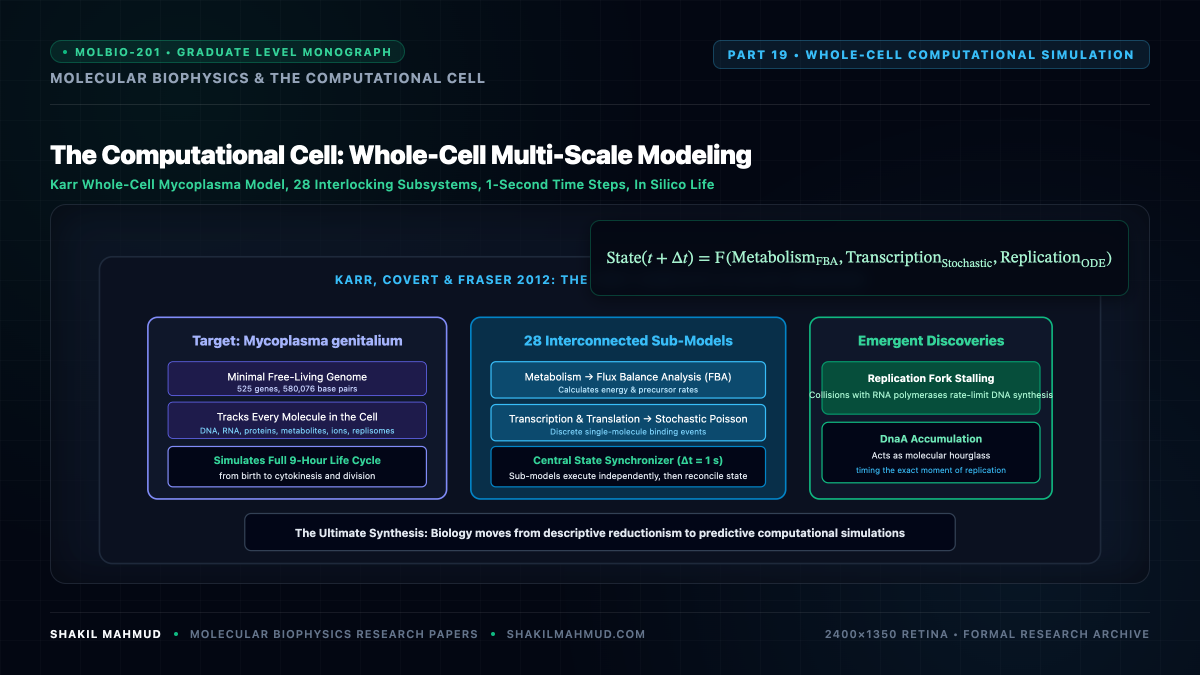
For over a century, molecular biology advanced through extreme reductionism: isolating individual genes, crystallizing single proteins, and characterizing isolated metabolic reactions. In 2012, Markus Covert and Jonathan Karr achieved the ultimate grand challenge of computational systems biology: building the first Whole-Cell Computational Model—a software simulation accounting for the functions of every annotated gene product across the entire lifecycle of a living cellular organism.
1. The Multi-Algorithmic Architecture: Integrating Incompatible Physics
Why had whole-cell modeling remained elusive for decades? The fundamental barrier is that different cellular processes operate across vast differences in spatial scale, copy number, and mathematical physics:
| Cellular Sub-System | Characteristic Timescale | Molecule Copy Number | Natural Mathematical Formalism |
|---|---|---|---|
| Central Metabolism | Milliseconds ($10^{-3} text{ s}$) | High ($> 10^5$) | Flux Balance Analysis (FBA / Linear Programming) |
| Transcription / Translation | Seconds ($10^0 text{ s}$) | Discrete, low ($0text{–}100$) | Stochastic Simulation Algorithm (Gillespie SSA) |
| Signaling & Phosphorylation | Seconds to minutes ($10^1 text{ s}$) | Intermediate ($10^2text{–}10^3$) | Ordinary Differential Equations (ODEs) |
| Chromosome Dynamics | Minutes to hours ($10^3 text{ s}$) | Polymer chain (1–2 copies) | Spatial Brownian / Langevin Dynamics |
Karr and Covert resolved this impasse not by seeking a monstrous single master equation, but by designing a Multi-Algorithmic Co-Simulation Architecture. The cellular lifecycle is partitioned into 28 sub-models, each executing within its own native mathematical formalism.
2. Orchestration & State Variable Synchronization
The simulation orchestrates these 28 sub-models through a central Cellular State Matrix ($mathbf{S}(t)$) containing the exact discrete copy numbers of all molecular species, chromosomal coordinates, and cellular volume.
The simulation advances in discrete time steps of $Delta t = 1.0 text{ second}$:
- State Allocation: At time $t$, the current state variables $mathbf{S}(t)$ are broadcast to all 28 sub-models.
- Independent Sub-Model Execution: Each sub-model computes its internal dynamics over the $1 text{ s}$ window independently (e.g., FBA computes metabolic flux, SSA computes transcriptional events, ODEs calculate protein modifications).
- State Update & Conflict Resolution: The predicted state changes $Delta mathbf{S}_k$ from all sub-models are reconciled. If two processes compete for the same scarce substrate (e.g., ATP), an allocation arbiter resolves the competition based on priority and stoichiometry, generating the synchronized state $mathbf{S}(t + Delta t)$.
3. Groundbreaking Discoveries of the *Mycoplasma* & *E. coli* Models
Applied to Mycoplasma genitalium (525 genes) and subsequently to Escherichia coli, the whole-cell model revealed emergent biological phenomena invisible to reductionist experimental biology:
- Replication Fork Dynamics: The model revealed that the total duration of the DNA replication phase is essentially constant across single cells, while the duration of the pre-replication growth phase fluctuates widely, regulated by the stochastic accumulation of DnaA initiator molecules.
- Metabolic Futile Cycles: Identified hidden energetic costs where opposing kinase/phosphatase reactions dissipate substantial ATP without functional yield.
- Unknown Gene Function Discovery: By identifying subtle mismatches between in silico growth predictions and experimental phenotypes, researchers successfully assigned biological functions to previously uncharacterized hypothetical genes.
4. The Future: Multi-Scale Spatial Digital Twins of Human Cells
Modern whole-cell modeling is transitioning from spatially homogeneous ODE/SSA networks to 3D spatial multi-scale simulations (such as the Luthey-Schulten GPU-accelerated whole-cell lattice micro-compartment models). These spatial simulations resolve macromolecular crowding, anomalous sub-diffusion, and membrane lipid domain dynamics, bringing science to the threshold of patient-specific human cell digital twins for precision pharmacology and synthetic life design.