Originating as an ancient prokaryotic RNA-guided adaptive immune system against bacteriophage predation, the CRISPR-Cas9 complex has been re-engineered into the defining biotechnology of the 21st century: a programmable macromolecular surgical knife capable of editing genomic scripts at single-nucleotide resolution.
1. Bacterial Adaptive Immunity: Adaptation, Biogenesis & Interference
CRISPR (Clustered Regularly Interspaced Short Palindromic Repeats) loci operate through three distinct biophysical stages:
- Adaptation (Spacer Acquisition): When a bacteriophage injects foreign DNA, the Cas1-Cas2 integrase complex captures a short $30text{ bp}$ fragment (protospacer) of the viral DNA and integrates it into the leader-proximal end of the host CRISPR genomic array.
- Biogenesis: The CRISPR array is transcribed into a long precursor RNA (pre-crRNA), processed by RNase III and trans-activating crRNA (tracrRNA) into mature single-spacer guide crRNAs.
- Interference: The mature crRNA guides an effector endonuclease (e.g., Cas9) to scan the cytoplasm, recognizing matching viral DNA and introducing a lethal double-strand break.
2. Cas9 Structural Biophysics: PAM Recognition & R-Loop Formation
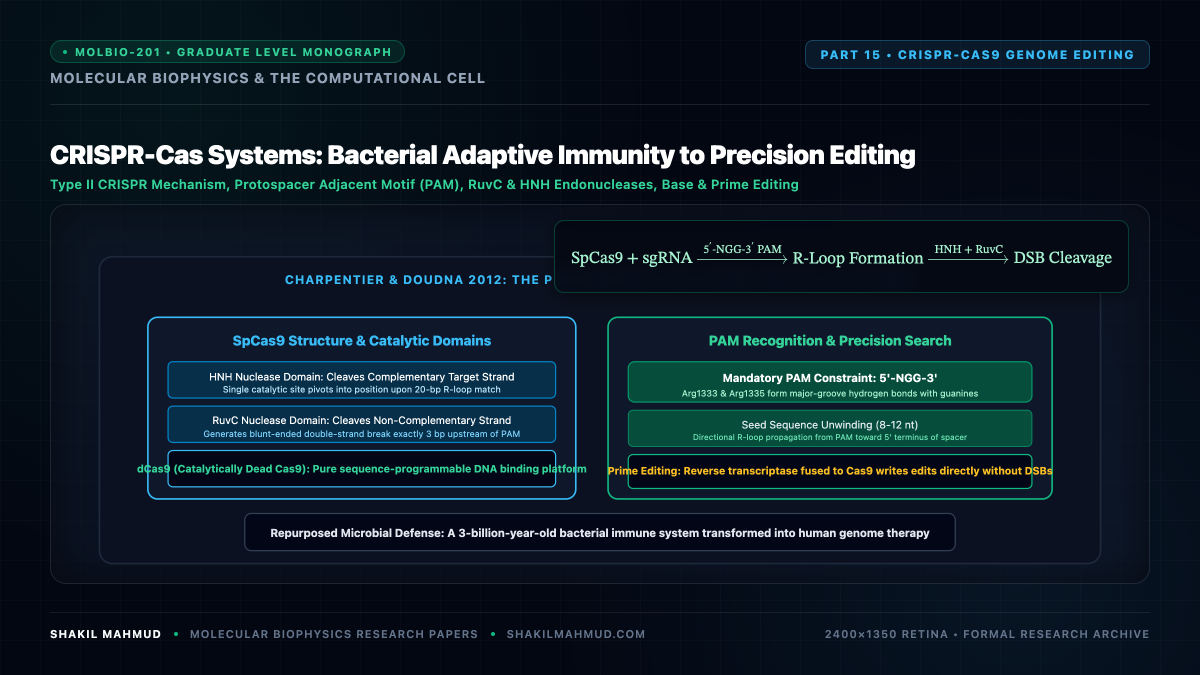
The Streptococcus pyogenes Cas9 endonuclease (SpCas9, 1,368 amino acids) comprises two major structural lobes: the Recognition (REC) lobe and the Nuclease (NUC) lobe, housing the catalytic HNH and RuvC domains.
The biophysical search mechanism proceeds through two sequential thermodynamic checkpoints:
A. Protospacer Adjacent Motif (PAM) Interrogation
Cas9 cannot unwind DNA randomly. The C-terminal PAM-Interacting (PI) domain interrogates DNA by 3D diffusion and rapid local collision, seeking the specific canonical PAM sequence: $5’text{-NGG-3′}$ on the non-target strand.
Two conserved arginine residues (Arg1333 and Arg1335) form specific bidentate hydrogen bonds with the major-groove Hoogsteen faces of the two guanine bases. This binding bends the DNA duplex by $sim 30^circ$, destabilizing the adjacent double helix.
B. Directional R-Loop Propagation
Following PAM recognition, Cas9 initiates directional strand separation at the $8text{–}10 text{ bp}$ seed region immediately adjacent to the PAM:
[
text{Duplex DNA} + text{guide RNA} rightleftharpoons text{R-Loop Intermediate} longrightarrow text{Full 20-bp R-Loop}
]
If the guide RNA matches the target strand, base-pairing free energy ($Delta G_{text{RNA-DNA}} < Delta G_{text{DNA-DNA}}$) drives the progressive unzipping of the duplex, forming an energetic R-loop where the target strand pairs with the guide RNA while the non-target strand is displaced into a single-stranded pocket.
3. Dual Nuclease Catalytic Cleavage
Full 20-bp R-loop formation triggers an allosteric swing of the HNH domain by over $180^circ$ toward the scissile phosphate of the target strand. The coordinated catalytic action is executed by two independent nuclease active sites:
- HNH Domain: Uses a single catalytic $text{Mg}^{2+}$ ion in a $betabetaalpha$-metal fold to cleave the target strand precisely 3 base pairs upstream of the PAM.
- RuvC Domain: Employs a two-metal-ion catalytic mechanism to cleave the displaced non-target strand at the same position.
The result is a clean, blunt-ended double-strand break (DSB).
4. Next-Generation Precision Editors: Base & Prime Editing
To avoid the stochastic indels generated by DSB repair, modern biotechnology deploys enzymatically altered Cas9 derivatives:
- Catalytically Dead Cas9 (dCas9): Double-mutant (D10A, H840A) lacking all cleavage activity, functioning as a sequence-specific DNA-binding delivery vehicle for transcriptional activators (CRISPRa), repressors (CRISPRi), or chromatin modifiers.
- Base Editors (CBE & ABE): A Cas9 nickase (nCas9, D10A) fused to a cytidine deaminase (e.g., APOBEC) or laboratory-evolved adenine deaminase (TadA). Base editors chemically convert $text{C}cdottext{G} to text{T}cdottext{A}$ or $text{A}cdottext{T} to text{G}cdottext{C}$ without introducing double-strand breaks.
- Prime Editing: Cas9 nickase fused to an engineered reverse transcriptase (RT) paired with an extended prime editing guide RNA (pegRNA). The pegRNA specifies both the target cut and the template sequence, enabling all 12 base-to-base conversions, insertions, and deletions with single-nucleotide surgical precision.