In macroscopic test tubes, chemical reactions appear smooth and deterministic, governed by the continuous law of mass action. Inside a microscopic single cell of volume $V sim 1 text{ fL}$, however, many critical molecular species—individual gene promoters, transcription factors, and mRNA molecules—exist in discrete numbers ranging from $0$ to a few dozen. At these low copy numbers, chemical reactions are inherently probabilistic, giving rise to Cellular Noise that drives phenotypic diversity.
1. Intrinsic vs Extrinsic Noise: The Elowitz Dual-Reporter Paradigm
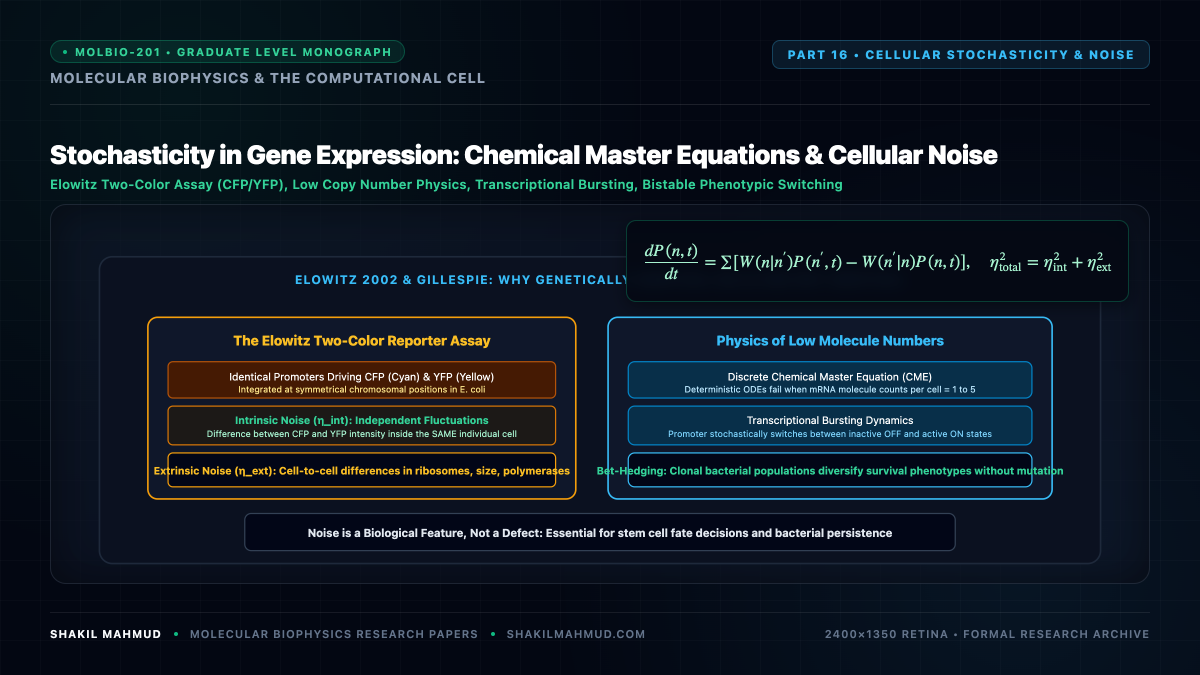
In 2002, Michael Elowitz, Arnold Levine, and colleagues performed a seminal experiment in single E. coli cells to dissect the origins of gene expression noise:
- They placed two identical promoters driving two distinct fluorescent protein reporters—Cyan Fluorescent Protein (CFP) and Yellow Fluorescent Protein (YFP)—at symmetric chromosomal loci equidistant from the replication origin.
- Intrinsic Noise ($eta_{text{int}}^2$): The inherent stochasticity of biochemical reactions at an individual gene locus (probabilistic binding of RNA polymerase, stochastic translational bursts). Because the two promoters operate independently, intrinsic noise causes the intensities of CFP and YFP to diverge within the same individual cell.
[
eta_{text{int}}^2 = frac{langle (c – y)^2 rangle}{2 langle c rangle langle y rangle}
] - Extrinsic Noise ($eta_{text{ext}}^2$): Cell-to-cell fluctuations in global cellular variables (differences in cell volume, total ribosome count, global RNA polymerase density, cell cycle phase). Extrinsic noise affects both promoters symmetrically, causing CFP and YFP intensities to fluctuate together across the population:
[
eta_{text{ext}}^2 = frac{langle c y rangle – langle c rangle langle y rangle}{langle c rangle langle y rangle}
]
The total observed variance is the orthogonal sum of both components: $eta_{text{tot}}^2 = eta_{text{int}}^2 + eta_{text{ext}}^2$.
2. The Chemical Master Equation (CME)
The rigorous mathematical description of stochastic chemical systems with discrete molecule counts $mathbf{n} = (n_1, n_2, dots, n_S) in mathbb{N}^S$ is the Chemical Master Equation:
[
frac{d P(mathbf{n}, t)}{dt} = sum_{j=1}^M left[ a_j(mathbf{n} – boldsymbol{nu}_j) P(mathbf{n} – boldsymbol{nu}_j, t) – a_j(mathbf{n}) P(mathbf{n}, t) right]
]
Where:
- $P(mathbf{n}, t)$ is the joint probability distribution of the system occupying state $mathbf{n}$ at time $t$.
- $a_j(mathbf{n})$ is the propensity function of reaction channel $j$ in state $mathbf{n}$ ($a_j(mathbf{n}) dt$ is the probability that reaction $j$ occurs in infinitesimal interval $dt$).
- $boldsymbol{nu}_j$ is the stoichiometric transition vector for reaction channel $j$.
Because the state space $mathbb{N}^S$ is infinite-dimensional, exact analytical solutions to the CME exist only for trivial linear systems. Non-linear biological networks require stochastic simulation.
3. The Gillespie Stochastic Simulation Algorithm (SSA)
In 1977, Daniel Gillespie derived an exact Monte Carlo algorithm that generates statistically rigorous trajectories from the CME without approximating the underlying physics:
- Calculate all propensity functions $a_j(mathbf{n})$ for current state $mathbf{n}$ and compute the total reaction propensity:
[
a_0(mathbf{n}) = sum_{j=1}^M a_j(mathbf{n})
] - Draw two uniform random numbers $r_1, r_2 sim mathcal{U}(0, 1)$.
- Generate the time increment $tau$ to the next reaction event as an exponentially distributed random variable:
[
tau = frac{1}{a_0(mathbf{n})} ln left( frac{1}{r_1} right)
] - Determine which reaction channel $mu$ fires by finding the integer $mu$ that satisfies:
[
sum_{j=1}^{mu-1} a_j(mathbf{n}) < r_2 a_0(mathbf{n}) le sum_{j=1}^mu a_j(mathbf{n})
] - Update time $t leftarrow t + tau$ and system state $mathbf{n} leftarrow mathbf{n} + boldsymbol{nu}_mu$, and repeat.
4. Transcriptional Bursting & Phenotypic Bifurcation
Modern single-cell mRNA counting (smFISH) reveals that transcription in both bacteria and mammals occurs not in steady Poisson streams, but in episodic Transcriptional Bursts. Promoters switch stochastically between an active state ($k_{text{on}}$) and an inactive state ($k_{text{off}}$). During the active window, polymerases fire in rapid succession, producing a geometrical burst of $b = k_{text{transcription}} / k_{text{off}}$ transcripts.
The resulting steady-state mRNA distribution deviates strongly from a Poisson distribution (where variance equals the mean, $sigma^2 = mu$). The Fano Factor $F = sigma^2 / mu$ exceeds unity ($F gg 1$), producing a negative binomial or bimodal distribution. In bacterial persister cells and embryonic stem cell differentiation, transcriptional noise serves as the creative motor that generates non-genetic phenotypic diversity, enabling bet-hedging survival in fluctuating environments.