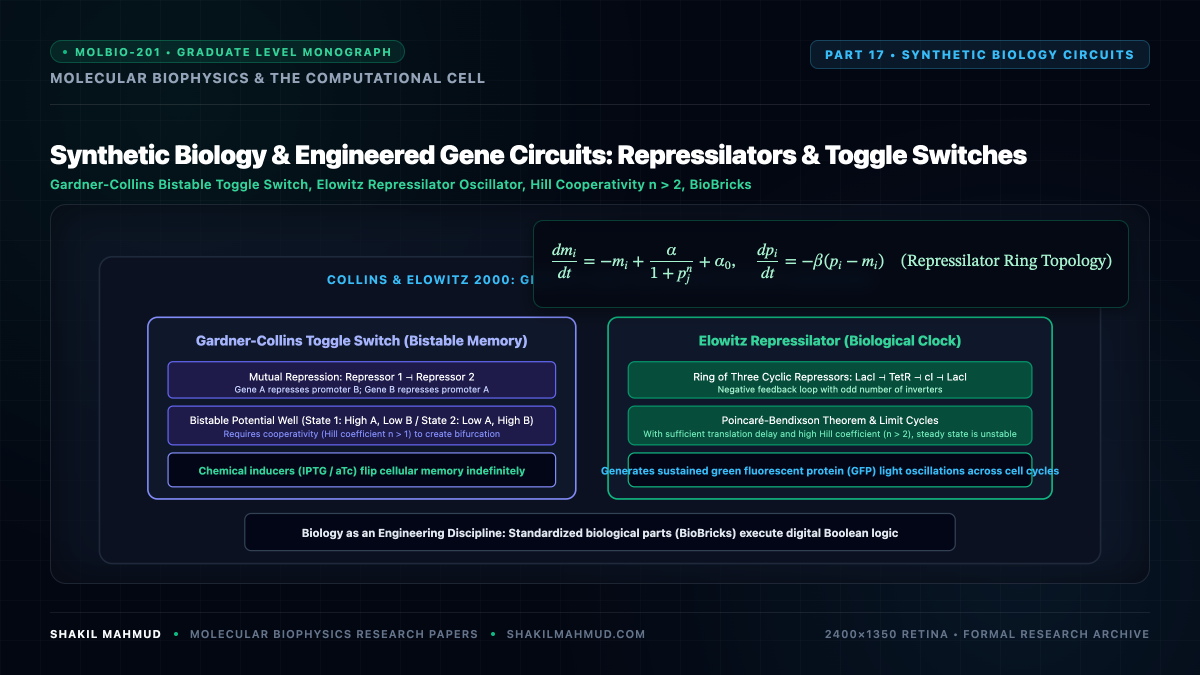
In the year 2000, molecular biology crossed a monumental threshold: the transition from descriptive observational reductionism to generative engineering synthesis. By treating genes, promoters, and repressors as modular electronic components (transistors, inverters, and logic gates), synthetic biologists constructed the first artificial gene circuits—the Bistable Toggle Switch and the Repressilator—proving that cellular computation can be rationally designed from mathematical first principles.
1. The Gardner-Cantor-Collins Genetic Toggle Switch
Constructed in Escherichia coli by Timothy Gardner, Charles Cantor, and James Collins, the genetic toggle switch consists of two mutually inhibitory transcriptional repressor genes ($u$ and $v$): Repressor 1 inhibits Promoter 2, while Repressor 2 inhibits Promoter 1.
The non-dimensional dynamical system is modeled by coupled non-linear Ordinary Differential Equations (ODEs):
[
frac{du}{dt} = frac{alpha_1}{1 + v^beta} – u
]
[
frac{dv}{dt} = frac{alpha_2}{1 + u^gamma} – v
]
Where:
- $u$ and $v$ are normalized repressor concentrations.
- $alpha_1, alpha_2$ denote effective promoter synthesis rates.
- $beta, gamma$ are the Hill coefficients characterizing cooperative multimeric repressor binding.
Phase-plane analysis reveals that when $beta, gamma > 1$ and synthesis rates exceed a critical bifurcation value, the nullclines intersect at three fixed points: two stable attractors (State 1: $[u text{ high}, v text{ low}]$; State 2: $[u text{ low}, v text{ high}]$) separated by an unstable saddle point. A transient pulse of an external chemical inducer (e.g., IPTG or thermal heat shock) flips the cell across the separatrix, creating a permanent, heritable epigenetic memory bit in the absence of ongoing stimuli.
2. The Elowitz-Leibler Repressilator: A Synthetic Genetic Oscillator
Simultaneously in 2000, Michael Elowitz and Stanislas Leibler engineered the first synthetic genetic oscillator—the Repressilator—by connecting three transcriptional repressors in a cyclic inhibitory loop: LacI represses TetR, TetR represses $lambda$ cI, and $lambda$ cI represses LacI.
The continuous cyclic dynamics are described by six symmetric differential equations for mRNA ($m_i$) and protein ($p_i$) species ($i in {1, 2, 3}$, with cyclically shifting index $j = i-1 pmod 3$):
[
frac{dm_i}{dt} = -m_i + frac{alpha}{1 + p_j^n} + alpha_0
]
[
frac{dp_i}{dt} = -beta(p_i – m_i)
]
Linear stability analysis of the unique symmetrical steady state reveals that when the repressor Hill coefficient $n > 2$ and the ratio of protein-to-mRNA lifetime is sufficiently large, the steady state undergoes a Supercritical Hopf Bifurcation. The system loses static stability and sheds a stable, macroscopic limit cycle in phase space, generating autonomous biological oscillations with periods on the order of hours, tracked in single living bacteria via green fluorescent protein.
3. Synthetic Logic Gates & Biological Computing
By engineering combinatorial promoters containing dual operator sites, synthetic biologists have constructed complete universal Boolean logic sets inside living cells:
- NOR Gates: Two repressors binding independently to occlude RNA polymerase, generating output only when both inputs are absent. Since NOR is a universal logic gate, complex circuits (NAND, XOR, Multiplexers) can be synthesized by cascading modular NOR repressors.
- AND Gates: Requiring the simultaneous presence of two distinct inputs—e.g., split transcription factor domains (a DNA-binding domain and an activation domain) that reassemble only in the presence of a heterodimerizing small molecule.
- Band-Pass Spatial Filters: Combining positive feed-forward loops to detect precise spatial concentrations of morphogens, enabling engineered bacteria to form synthetic multicellular patterns (e.g., bullseye rings) in Petri dishes.