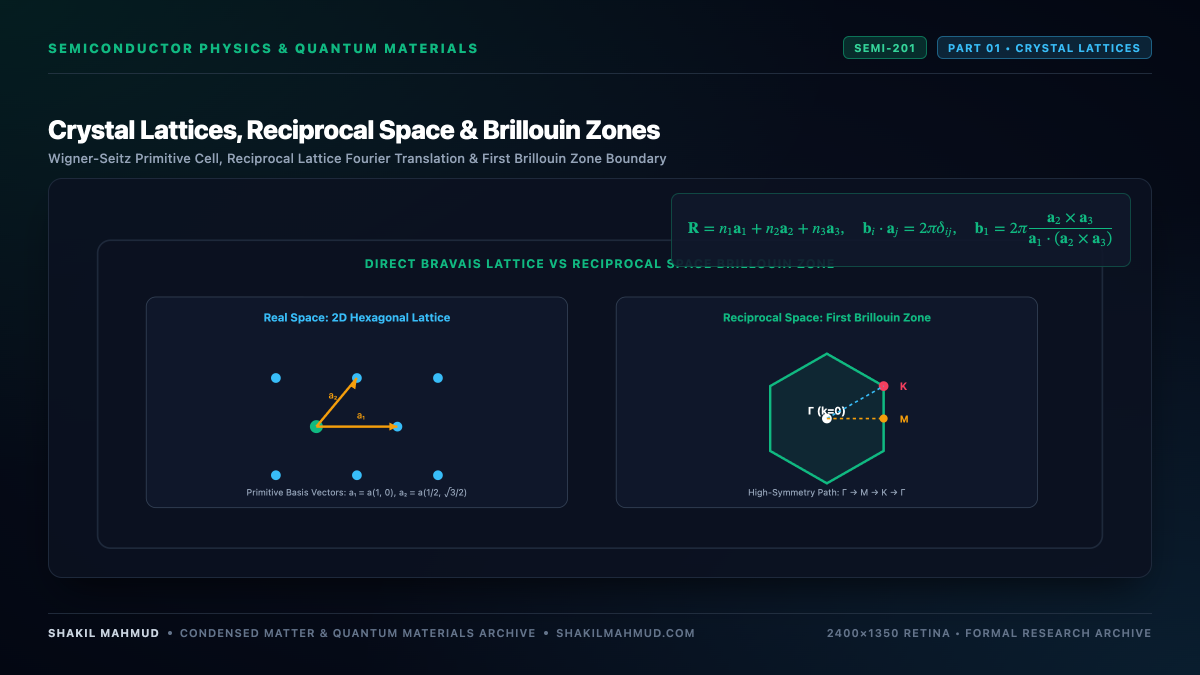
All condensed matter physics and solid-state electronics rest upon the spatial periodicity of crystalline atomic lattices. The translation symmetry of matter in real space dictates, through Fourier duality, the geometry of crystal momentum in reciprocal space—establishing the first Brillouin zone as the foundational arena for electronic band theory.
1. Direct Bravais Lattices and Primitive Translation Vectors
An ideal crystalline solid is defined mathematically as an infinite periodic array of discrete points generated by discrete translation operations. A three-dimensional direct Bravais lattice consists of all position vectors (mathbf{R}) that can be expressed as an integer linear combination of three linearly independent primitive basis vectors (mathbf{a}_1, mathbf{a}_2, mathbf{a}_3):
[
mathbf{R} = n_1 mathbf{a}_1 + n_2 mathbf{a}_2 + n_3 mathbf{a}_3, quad n_1, n_2, n_3 in mathbb{Z}
]
The primitive unit cell is a minimum-volume space that tiles the entire Euclidean space (mathbb{R}^3) without gaps or overlaps when translated by all vectors (mathbf{R}). The volume of this primitive unit cell (Omega) is given by the scalar triple product:
[
Omega = |mathbf{a}_1 cdot (mathbf{a}_2 imes mathbf{a}_3)|
]
Among all possible primitive unit cells, the Wigner-Seitz cell possesses the full point group symmetry of the lattice. It is constructed geometrically as the locus of all points in space closer to a chosen lattice point than to any other lattice site, bounded by perpendicular bisecting planes drawn between the origin and its nearest neighbors.
2. Reciprocal Space and Dual Lattice Construction
Because the microscopic potential (V(mathbf{r})) established by ionic cores possesses the full discrete translational symmetry of the Bravais lattice, (V(mathbf{r} + mathbf{R}) = V(mathbf{r})), any physical observable can be expanded as a spatial Fourier series. The dual vectors (mathbf{K}) that satisfy the plane wave invariance condition:
[
e^{i mathbf{K} cdot (mathbf{r} + mathbf{R})} = e^{i mathbf{K} cdot mathbf{r}} implies e^{i mathbf{K} cdot mathbf{R}} = 1, quad orall mathbf{R}
]
constitute the reciprocal lattice. A reciprocal lattice vector (mathbf{G}) is expanded in terms of primitive reciprocal basis vectors (mathbf{b}_1, mathbf{b}_2, mathbf{b}_3):
[
mathbf{G} = m_1 mathbf{b}_1 + m_2 mathbf{b}_2 + m_3 mathbf{b}_3, quad m_1, m_2, m_3 in mathbb{Z}
]
The orthogonality and normalization relationship between direct and reciprocal basis vectors is governed by:
[
mathbf{b}_i cdot mathbf{a}_j = 2pi delta_{ij}
]
which yields the closed-form vector definitions:
[
mathbf{b}_1 = 2pi rac{mathbf{a}_2 imes mathbf{a}_3}{mathbf{a}_1 cdot (mathbf{a}_2 imes mathbf{a}_3)}, quad mathbf{b}_2 = 2pi rac{mathbf{a}_3 imes mathbf{a}_1}{mathbf{a}_1 cdot (mathbf{a}_2 imes mathbf{a}_3)}, quad mathbf{b}_3 = 2pi rac{mathbf{a}_1 imes mathbf{a}_2}{mathbf{a}_1 cdot (mathbf{a}_2 imes mathbf{a}_3)}
]
The volume of the reciprocal primitive cell is (Omega_{mathbf{k}} = |mathbf{b}_1 cdot (mathbf{b}_2 imes mathbf{b}_3)| = rac{(2pi)^3}{Omega}).
3. The First Brillouin Zone (1BZ) and High-Symmetry Critical Points
The First Brillouin Zone (1BZ) is defined as the Wigner-Seitz primitive cell of the reciprocal lattice. Geometrically, it is bounded by the planes that perpendicularly bisect the reciprocal lattice vectors (mathbf{G}) radiating from the origin (Gamma) ((mathbf{k} = 0)). The mathematical condition defining the zone boundaries is given by the Bragg condition:
[
mathbf{k} cdot hat{mathbf{G}} = rac{1}{2} |mathbf{G}| iff 2mathbf{k} cdot mathbf{G} + |mathbf{G}|^2 = 0
]
Whenever a wavevector (mathbf{k}) terminates on a Brillouin zone boundary plane, incoming Bloch waves undergo coherent destructive interference with backscattered states, opening energy band gaps.
In cubic lattices central to semiconductor physics:
- Face-Centered Cubic (FCC) Direct Lattice (Silicon, Germanium, GaAs diamond/zincblende structures): Its reciprocal lattice is Body-Centered Cubic (BCC), and its 1BZ is a truncated octahedron with 14 faces (8 hexagons, 6 squares). Key high-symmetry points include:
- (Gamma = (0, 0, 0)): Zone center.
- (X = rac{2pi}{a}(1, 0, 0)): Center of square faces along (langle 100
angle). - (L = rac{2pi}{a}(rac{1}{2}, rac{1}{2}, rac{1}{2})): Center of hexagonal faces along (langle 111
angle). - (K = rac{2pi}{a}(rac{3}{4}, rac{3}{4}, 0)): Edge centers between adjacent hexagonal faces.
- Body-Centered Cubic (BCC) Direct Lattice: Its reciprocal lattice is FCC, and its 1BZ is a rhombic dodecahedron with 12 identical diamond-shaped faces.
4. Physical Significance: Kinematics of Crystal Momentum
Electrons in a crystal lattice do not possess true kinematic momentum (mathbf{p} = mmathbf{v}) because continuous translational symmetry is broken down to discrete translation symmetry. Instead, they possess crystal momentum (hbar mathbf{k}), which is conserved modulo an arbitrary reciprocal lattice vector (mathbf{G}):
[
mathbf{k}’ = mathbf{k} + mathbf{q} + mathbf{G}
]
Processes where (mathbf{G} = 0) are designated Normal (N) processes, whereas scattering events where (mathbf{G}
eq 0) are termed Umklapp (U) processes. Umklapp processes are indispensable for understanding thermal resistivity, electronic scattering, and high-field transport in modern nano-scale transistors.