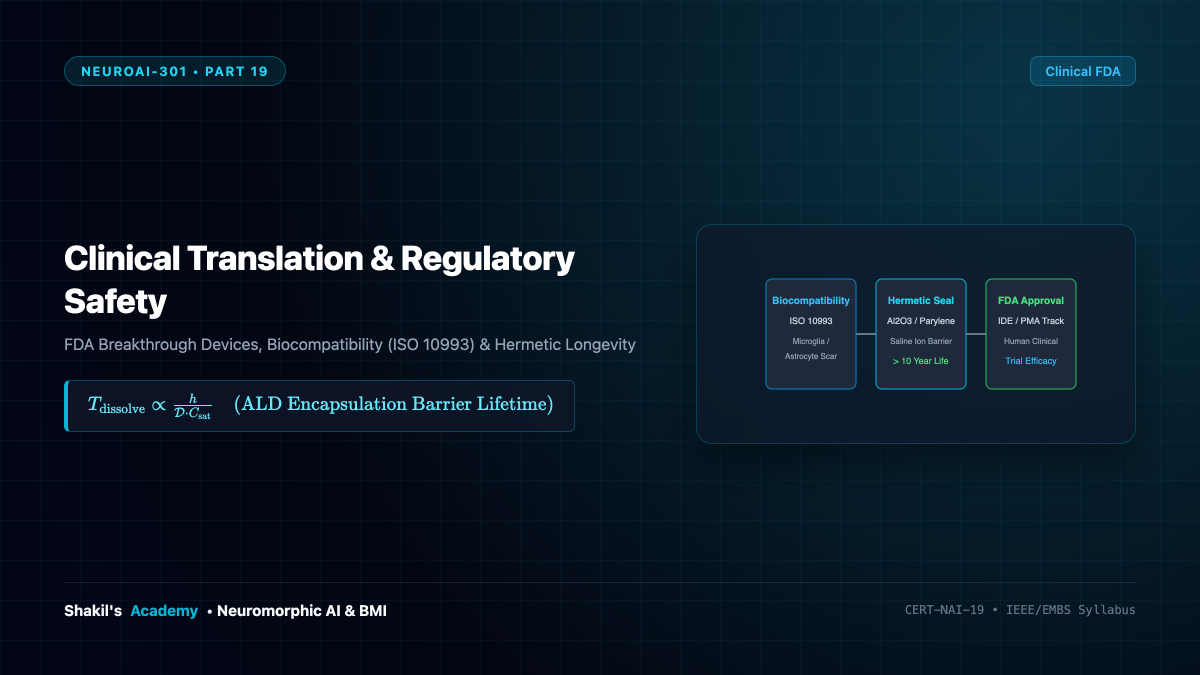
Transitioning a brain-machine interface from an academic benchtop animal proof-of-concept into a safe, commercially viable, and chronically reliable human medical implant is one of the most demanding interdisciplinary challenges in modern engineering. Implanted systems reside in the most hostile environment on Earth: warm, salty, corrosive biological fluid that relentlessly attacks electronic microchips, while the body’s immune system deploys chronic foreign-body cascades to encapsulate and reject foreign materials. This part details Clinical Translation and Regulatory Safety: FDA approval pathways, ISO 10993 testing, glial scar mitigation, and hermetic packaging.
1. The FDA Regulatory Roadmap for Medical Devices
In the United States, the Food and Drug Administration (FDA) Center for Devices and Radiological Health (CDRH) classifies medical devices into three regulatory tiers:
- Class I: Low-risk devices subject to general controls (e.g., elastic bandages).
- Class II: Moderate-risk devices subject to special controls and 510(k) premarket notification demonstrating substantial equivalence to a predicate device (e.g., clinical EEG caps).
- Class III: High-risk, life-sustaining, or permanently implanted devices that present potential unreasonable risk of illness or injury. All chronically implanted intracortical and subdural BMIs are classified as Class III devices.
Bringing a Class III BMI to market requires navigating three rigorous consecutive phases:
- FDA Breakthrough Device Designation: Expedites regulatory review and provides frequent interactive feedback with FDA review teams for novel technologies addressing irreversibly debilitating conditions.
- Investigational Device Exemption (IDE): Permits an unapproved device to be used in human clinical trials (e.g., Early Feasibility Studies and Pivotal Trials) to collect safety and effectiveness data.
- Premarket Approval (PMA): The gold-standard scientific and regulatory review. The manufacturer must prove through statistically rigorous multi-center clinical trials that the device is both safe and effective for its intended clinical indication.
2. Biocompatibility and the ISO 10993 Standard Matrix
Every material in contact with biological tissue or blood must undergo exhaustive preclinical safety characterization governed by ISO 10993 (Biological Evaluation of Medical Devices):
| Test Category | Standard | Biological Objective |
|---|---|---|
| Cytotoxicity | ISO 10993-5 | Confirms material extracts do not lyse or kill mammalian cell cultures. |
| Sensitization & Irritation | ISO 10993-10 | Evaluates immune allergic contact hypersensitivity and intracutaneous reactivity. |
| Subchronic & Chronic Toxicity | ISO 10993-11 | Evaluates systemic toxic effects over weeks to years of permanent implantation. |
| Genotoxicity & Carcinogenicity | ISO 10993-3 | Ensures materials do not induce DNA damage, gene mutations, or tumor formation. |
| Hemocompatibility | ISO 10993-4 | Evaluates hemolysis, thrombosis, and platelet activation upon contact with blood. |
| Implantation Effects | ISO 10993-6 | Histological examination of localized tissue reaction in living brain cortex. |
3. The Foreign-Body Reaction: Glial Scarring and Signal Attenuation
When a microelectrode penetrates the blood-brain barrier, it initiates an inescapable biological inflammatory cascade:
- Within minutes, plasma proteins (albumin, fibronectin) adhere to the electrode surface, attracting resident microglia.
- Activated microglia release pro-inflammatory cytokines (( ext{TNF}-alpha), ( ext{IL}-1beta)) and reactive oxygen species (ROS), causing localized neuronal apoptosis within a (50 mu ext{m}) “kill zone” around the shank.
- Surrounding astrocytes become reactive, proliferating and extending dense overlapping processes that form a tight, impermeable Glial Scar (Astrocytic Sheath) around the electrode.
The glial scar acts as an electrical and physical insulator, increasing electrode impedance by (300%) and pushing healthy surviving neurons beyond the (100 mu ext{m}) listening horizon of the electrode, causing chronic signal decay over years. Mitigations include ultra-flexible polymer threads, zwitterionic anti-fouling coatings, and local drug elution (dexamethasone).
4. Hermetic Packaging: Laser-Welded Titanium and ALD Coatings
Warm saline interstitial fluid ((37^circ ext{C}), (0.9% ext{NaCl})) is extraordinarily corrosive to microelectronics. Moisture penetration of just a few parts per million corrodes aluminum bond wires and causes electrical short-circuits. Long-term reliability (> 10 to 20 years) mandates hermetic encapsulation:
- Titanium Canisters: Medical-grade Grade 5 titanium (( ext{Ti-6Al-4V})) laser-welded under inert argon gas atmosphere to form a completely impervious enclosure.
- Ceramic & Ruby Feedthroughs: Electrical signals exit the hermetic canister through gold-brazed sapphire or high-purity alumina (( ext{Al}_2 ext{O}_3)) multi-pin feedthroughs.
- Atomic Layer Deposition (ALD): For micro-scale implants where titanium cans are too bulky, ultra-thin pinhole-free inorganic nanolaminates (alternating layers of ( ext{Al}_2 ext{O}_3) and ( ext{TiO}_2), (sim 50 ext{ nm}) thick) deposited via ALD paired with silicone or parylene-C provide decades of corrosion resistance in vivo.