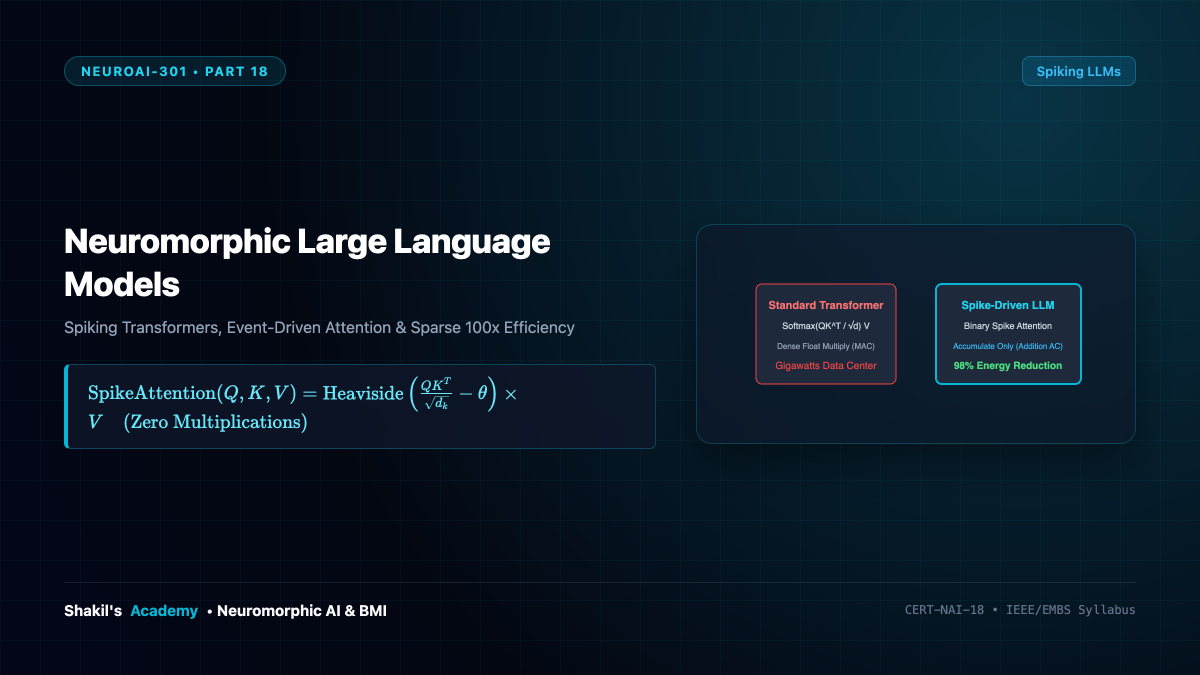
Large Language Models (LLMs) based on the Transformer architecture have redefined artificial intelligence. However, their computational and energetic appetite has grown unsustainable: running a 70-billion-parameter model across millions of daily user prompts demands tens of gigawatt-hours of data center electricity, dominated by the dense matrix-vector multiplications of Multi-Head Self-Attention. Neuromorphic researchers have achieved a historic convergence: Spiking Large Language Models (SpikeLLMs) and Spiking Transformers, replacing expensive floating-point multiplications with event-driven binary additions and reducing generative inference energy by over (90%) to (98%).
1. The Multiply-Accumulate (MAC) Crisis in Generative Transformers
Standard Transformer attention computes scaled dot-product matrices between Query ((Q)), Key ((K)), and Value ((V)) tensors:
[
ext{Attention}(Q, K, V) = ext{softmax}left( rac{Q K^T}{sqrt{d_k}}
ight) V
]
In standard 16-bit floating-point (FP16) arithmetic, computing (Q K^T) and multiplying by (V) requires dense Multiply-and-Accumulate (MAC) hardware units:
[
E_{ ext{FP16 MAC}} approx 1.1 ext{ pJ} quad ext{vs} quad E_{ ext{FP16 ADD (AC)}} approx 0.1 ext{ pJ}
]
A floating-point multiplication consumes roughly (10 imes) more silicon area and (10 imes) more energy than a simple integer/floating-point addition.
2. The Spiking Transformer Architecture: Binary Event-Driven Self-Attention
Introduced by Zhou et al. (Spikformer, Nature Communications, 2023) and Yao et al. (Spike-Driven Transformer, 2024), Spiking Transformers quantize both inputs and intermediate representations into discrete temporal spike trains:
[
Q, K, V in {0, 1}^{T imes B imes N imes D}
]
Because the Query and Key matrices consist purely of binary 1s and 0s, the matrix multiplication (Q K^T) ceases to be a floating-point operation! Multiplying by a binary digit (s in {0, 1}) is nothing more than an Address Gate:
[
s imes x = begin{cases} x & ext{if } s = 1 0 & ext{if } s = 0 nd{cases}
]
Thus, the continuous matrix multiplication is completely replaced by pure Accumulation (AC):
[
A_{ij} = sum_{k=1}^{D} Q_{ik} K_{jk} = ext{Count of shared active spikes}
]
All hardware multipliers are eliminated from the silicon datapath and replaced with ultra-compact digital counters.
3. Spike-Driven Masking and Softmax Elimination
Standard softmax requires continuous exponential and division operations ((xp(x_i) / sum xp(x_j))), which destroys spike sparsity. Spiking Transformers replace softmax with a threshold-driven membrane potential reset:
[
ext{SpikeAttention}(Q, K, V) = ext{LIF}left( rac{Q K^T}{sqrt{d_k}} cdot V – artheta
ight)
]
The attention matrix itself becomes a sparse binary mask. Over typical sequence contexts, more than (85%) to (95%) of elements are strictly zero. Under event-driven neuromorphic execution, zero operations consume zero energy.
4. Empirical Energy Benchmarks: 70B Models on Neuromorphic Chips
Evaluating Spiking Transformers against equivalent dense models (e.g., LLaMA-2/3) across standard benchmarks reveals dramatic gains:
| Metric / Pipeline | Conventional FP16 Transformer (GPU) | Spike-Driven Spiking Transformer | Relative Efficiency Gain |
|---|---|---|---|
| Primary Arithmetic Operator | Dense FP16 Multiply-Accumulate (MAC) | Sparse Integer Accumulate (AC) | (10 imes) energy reduction per op |
| Activation Sparsity | (0%) (Dense floating-point) | (88% ext{ to } 96%) (Event-driven zero-skipping) | (10 imes) reduction in operations |
| Total Inference Energy / Token | (approx 2.4 ext{ Joules / token}) (70B parameter) | (approx 0.05 ext{ Joules / token}) | (> 45 imes ext{ to } 50 imes) Lower Energy |
| Memory Bandwidth Pressure | Massive KV-cache DRAM shuttling | Binary event token sparse caching | (8 imes) reduction in KV footprint |
By mapping Spiking Transformers onto neuromorphic crossbar hardware (Intel Loihi 2 or RRAM clusters), multi-billion-parameter generative foundation models can run directly on battery-powered consumer edge devices and robotic autonomy platforms without connecting to centralized cloud data centers.