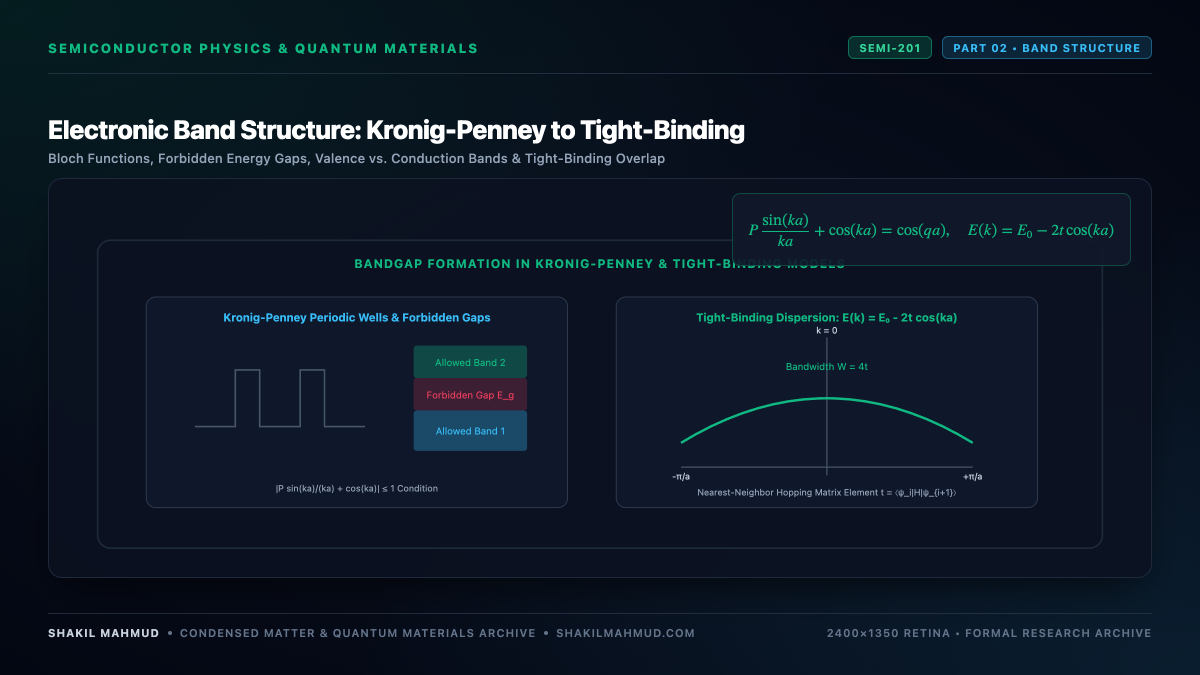
When an electron moves through a crystal, it interacts not with free space, but with a spatially periodic electrostatic potential produced by the ordered array of ionic cores. Bloch’s theorem demonstrates that the eigenstates of such a Hamiltonian are modulated plane waves, leading directly to the formation of allowed energy bands separated by forbidden bandgaps.
1. The One-Electron Hamiltonian in a Periodic Lattice
Under the independent-electron approximation, the non-relativistic stationary Schrödinger equation for an electron inside a crystal lattice is expressed as:
[
hat{H} psi(mathbf{r}) = left[ -rac{hbar^2}{2m_0}
abla^2 + V(mathbf{r})
ight] psi(mathbf{r}) = E psi(mathbf{r})
]
where the potential energy satisfies the strict translational symmetry of the Bravais lattice:
[
V(mathbf{r} + mathbf{R}) = V(mathbf{r}), quad orall mathbf{R} in ext{lattice}
]
2. Derivation of Bloch’s Theorem
To prove Bloch’s theorem, we define the translation operator (hat{T}_{mathbf{R}}) that translates spatial coordinates by a lattice vector (mathbf{R}):
[
hat{T}_{mathbf{R}} psi(mathbf{r}) = psi(mathbf{r} + mathbf{R})
]
Because the kinetic energy operator is translation-invariant and (V(mathbf{r} + mathbf{R}) = V(mathbf{r})), the translation operator commutes with the Hamiltonian:
[
[hat{H}, hat{T}_{mathbf{R}}] = 0
]
Consequently, (hat{H}) and (hat{T}_{mathbf{R}}) share a complete set of simultaneous eigenfunctions. Furthermore, two successive translations satisfy:
[
hat{T}_{mathbf{R}_1} hat{T}_{mathbf{R}_2} = hat{T}_{mathbf{R}_1 + mathbf{R}_2}
]
Let (lambda(mathbf{R})) be the eigenvalue of (hat{T}_{mathbf{R}}): (hat{T}_{mathbf{R}} psi(mathbf{r}) = lambda(mathbf{R}) psi(mathbf{r})). The composition law requires:
[
lambda(mathbf{R}_1) lambda(mathbf{R}_2) = lambda(mathbf{R}_1 + mathbf{R}_2)
]
Under Born-von Kármán periodic boundary conditions on a macroscopic crystal of (N = N_1 N_2 N_3) unit cells, the eigenvalues must lie on the unit complex circle, requiring (lambda(mathbf{R}) = e^{i mathbf{k} cdot mathbf{R}}), where (mathbf{k}) is a real wavevector in reciprocal space. Hence, the wavefunction satisfies:
[
psi_{n,mathbf{k}}(mathbf{r} + mathbf{R}) = e^{i mathbf{k} cdot mathbf{R}} psi_{n,mathbf{k}}(mathbf{r})
]
Equivalently, the wavefunction can be decomposed into the canonical Bloch form:
[
psi_{n,mathbf{k}}(mathbf{r}) = e^{i mathbf{k} cdot mathbf{r}} u_{n,mathbf{k}}(mathbf{r})
]
where (u_{n,mathbf{k}}(mathbf{r})) is a cell-periodic function possessing the full translational periodicity of the lattice: (u_{n,mathbf{k}}(mathbf{r} + mathbf{R}) = u_{n,mathbf{k}}(mathbf{r})), and (n in mathbb{N}) is the discrete band index.
3. The Central Equation in Reciprocal Space
To compute the dispersion relation (E_n(mathbf{k})), we expand both the crystal potential and the periodic amplitude (u_{n,mathbf{k}}(mathbf{r})) as Fourier series over reciprocal lattice vectors (mathbf{G}):
[
V(mathbf{r}) = sum_{mathbf{G}} V_{mathbf{G}} e^{i mathbf{G} cdot mathbf{r}}, quad psi_{mathbf{k}}(mathbf{r}) = sum_{mathbf{G}} C_{mathbf{k}-mathbf{G}} e^{i (mathbf{k} – mathbf{G}) cdot mathbf{r}}
]
Substituting these expansions into the Schrödinger equation yields the fundamental Central Equation of solid-state theory:
[
left( rac{hbar^2 (mathbf{k} – mathbf{G})^2}{2m_0} – E
ight) C_{mathbf{k}-mathbf{G}} + sum_{mathbf{G}’} V_{mathbf{G} – mathbf{G}’} C_{mathbf{k}-mathbf{G}’} = 0
]
This infinite set of algebraic equations can be truncated and diagonalized numerically, revealing energy eigenvalues that vary continuously with (mathbf{k}) within the first Brillouin zone, forming energy bands (E_n(mathbf{k})).
4. Reduced, Extended, and Periodic Zone Schemes
Because (mathbf{k}) and (mathbf{k} + mathbf{G}) describe identical physical states, band structures can be visualized in three distinct coordinate representations:
- Reduced Zone Scheme: All wavevectors are mapped back into the first Brillouin zone ((-pi/a le k le pi/a)). Every band (n) has its own branch (E_n(mathbf{k})). This is the standard scheme for semiconductor physics.
- Extended Zone Scheme: Band (n) is plotted in the (n)-th Brillouin zone, highlighting the near-parabolic free-electron behavior interrupted by bandgaps.
- Periodic Zone Scheme: Bands are repeated periodically across all Brillouin zones: (E_n(mathbf{k} + mathbf{G}) = E_n(mathbf{k})).