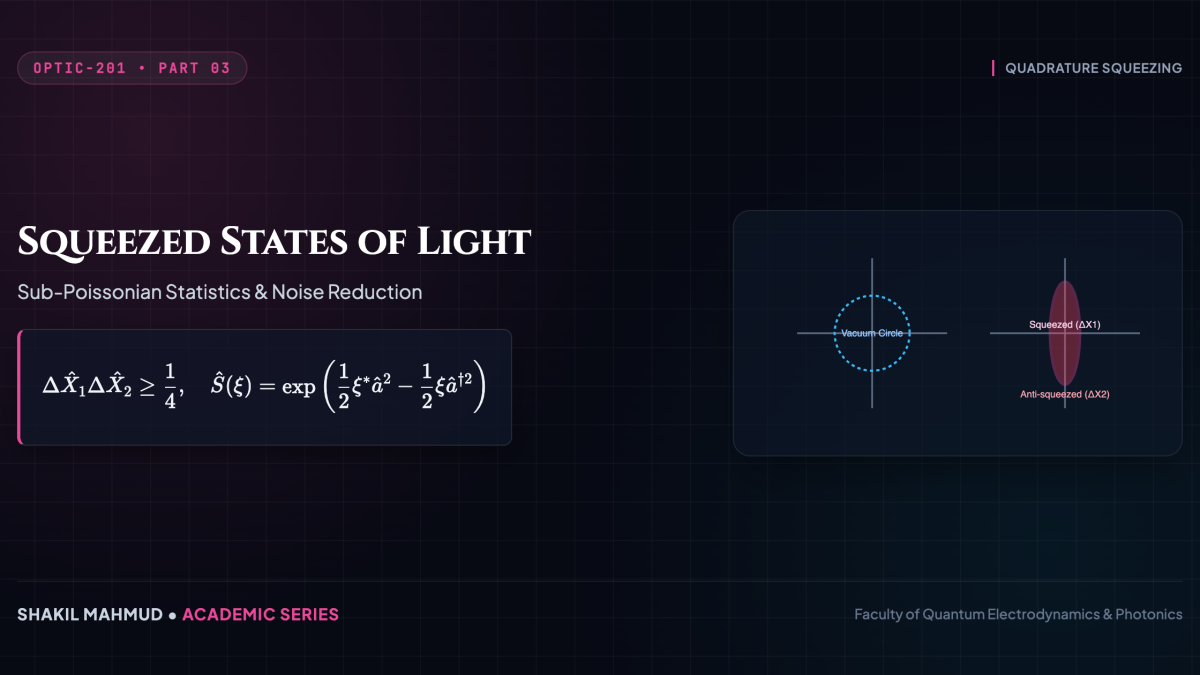
In the quantum vacuum, Heisenberg’s uncertainty principle imposes a fundamental lower bound on the simultaneous precision with which conjugate physical observables can be determined. For an optical field, the fluctuating quantum vacuum generates an irreducible noise floor known as the Standard Quantum Limit (SQL) or shot noise. However, quantum mechanics permits a remarkable loophole: by deforming the circular uncertainty contour of the vacuum state into an ellipse, squeezed states of light suppress quantum noise in one observable below the vacuum level at the expense of increased noise in the orthogonal conjugate observable.
1. Field Quadrature Operators and The Uncertainty Relation
Analogous to the dimensionless position (hat{q}) and momentum (hat{p}) operators of a mechanical harmonic oscillator, the single-mode electric field operator decomposes into two Hermitian, non-commuting dimensionless quadrature operators (hat{X}_1) (amplitude quadrature) and (hat{X}_2) (phase quadrature):
[
hat{X}_1 = rac{1}{2}(hat{a} + hat{a}^dagger), qquad hat{X}_2 = rac{1}{2i}(hat{a} – hat{a}^dagger)
]
Their commutator is purely imaginary:
[
[hat{X}_1, hat{X}_2] = rac{1}{4i} [hat{a} + hat{a}^dagger, hat{a} – hat{a}^dagger] = rac{i}{2}
]
By the Robertson-Schrödinger uncertainty formulation, the product of their variances obeys the rigid Heisenberg uncertainty lower bound:
[
Delta X_1 Delta X_2 ge rac{1}{2} |[hat{X}_1, hat{X}_2]| = rac{1}{4}
]
For the vacuum state (|0
angle) and any coherent state (|alpha
angle), noise is symmetric and isotropic: (Delta X_1 = Delta X_2 = 1/2), saturating the minimum uncertainty product (Delta X_1 Delta X_2 = 1/4). This symmetric variance defines the shot noise limit.
2. The Squeezing Operator and Squeezed Vacuum States
A squeezed state is mathematically generated by acting on the vacuum with the unitary squeezing operator (hat{S}(xi)):
[
hat{S}(xi) = xpleft[ rac{1}{2}left( xi^* hat{a}^2 – xi hat{a}^{dagger 2}
ight)
ight]
]
where (xi = r e^{i heta}) is the complex squeezing parameter, with squeezing magnitude (r ge 0) and squeezing angle ( heta). Applying the Bogoliubov transformation to the ladder operators:
[
hat{S}^dagger(xi) hat{a} hat{S}(xi) = hat{a} cosh r – hat{a}^dagger e^{i heta} sinh r
]
For a squeezed vacuum state (|xi
angle = hat{S}(xi)|0
angle) with ( heta = 0), the variances of the quadratures become:
[
(Delta X_1)^2 = rac{1}{4} e^{-2r}, qquad (Delta X_2)^2 = rac{1}{4} e^{2r}
]
While the uncertainty product strictly preserves the Heisenberg limit ((Delta X_1 Delta X_2 = rac{1}{4})), the variance in the (hat{X}_1) quadrature is exponentially suppressed by a factor of (e^{-2r}) below the vacuum shot-noise floor. In decibels, the squeezing level is quantified as:
[
V_{ ext{dB}} = -10 log_{10}left( rac{(Delta X_1)^2}{1/4}
ight) approx 8.686 , r ext{ dB}
]
3. Experimental Generation: Optical Parametric Amplification (OPA)
Because the squeezing Hamiltonian (hat{H}_{ ext{sq}} propto hat{a}^{dagger 2} – hat{a}^2) involves photon pair creation and annihilation, squeezed light is generated using second-order (chi^{(2)}) or third-order (chi^{(3)}) non-linear optical processes. In a degenerate Optical Parametric Amplifier (OPA):
- A powerful pump laser at frequency (2omega) passes through a non-linear crystal (e.g., periodically poled potassium titanyl phosphate, PPKTP) inside an optical cavity.
- Parametric down-conversion annihilates a pump photon to create pairs of identical signal photons at frequency (omega).
- Depending on the relative optical phase between the seed and pump, constructive interference amplifies one quadrature (anti-squeezing) while destructive interference de-amplifies the orthogonal quadrature, yielding up to (15 ext{ dB}) of measured quantum noise suppression.
4. Application to Gravitational Wave Detectors (LIGO & Virgo)
In giant laser interferometers such as Advanced LIGO and Virgo, kilometer-scale Fabry-Pérot arm cavities detect metric space-time strains (h = Delta L / L sim 10^{-21}) induced by colliding black holes and neutron stars. Measurement sensitivity is constrained by two quantum noise mechanisms:
- Shot Noise (High Frequencies, (f > 100 ext{ Hz})): Photon arrival phase fluctuations scaling as (1 / sqrt{P_{ ext{laser}}}).
- Radiation Pressure Noise (Low Frequencies, (f < 100 ext{ Hz})): Photon momentum recoil kicking the 40-kg mirror test masses, scaling as (sqrt{P_{ ext{laser}}}).
By injecting frequency-dependent squeezed vacuum states into the dark port of the interferometer via 300-meter audio-band filter cavities, modern gravitational wave observatories suppress both shot noise and radiation pressure noise simultaneously, expanding the observable astrophysical universe volume by more than (50%).