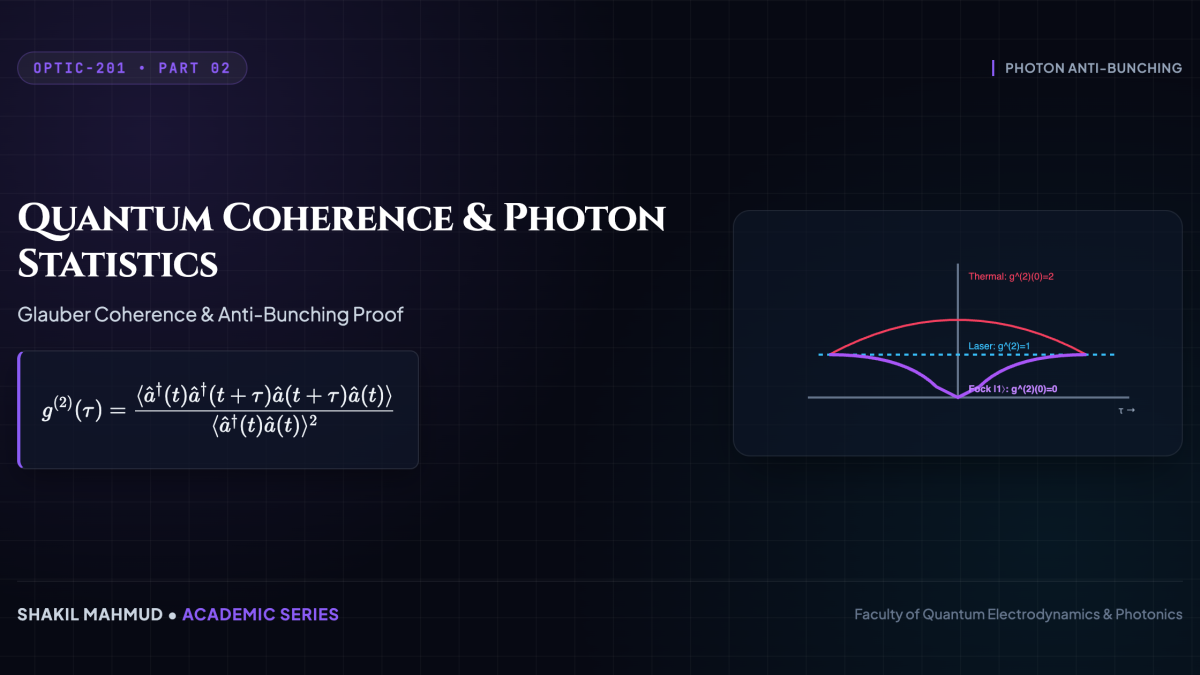
Classical optics quantifies optical coherence through fringe visibility in Young’s double-slit or Michelson interferometers. However, classical first-order coherence cannot distinguish between an ideal single-mode laser, chaotic thermal blackbody radiation, and non-classical single-photon emitters. In 1963, Roy J. Glauber formulated the complete quantum theory of optical coherence, introducing normally ordered multi-time correlation functions—most notably the second-order coherence function (g^{(2)}( au))—which earned him the 2005 Nobel Prize in Physics.
1. Glauber’s Photo-Detection Theory and Field Correlation Functions
An ideal photodetector operates via the photoelectric effect, absorbing a photon and destroying a field excitation. The detection transition probability per unit time is proportional to the normally ordered expectation value of the negative and positive frequency electric field operators (hat{mathbf{E}}^{(-)}) and (hat{mathbf{E}}^{(+)}):
[
hat{mathbf{E}}^{(+)}(mathbf{r}, t) propto hat{a} e^{-iomega t}, qquad hat{mathbf{E}}^{(-)}(mathbf{r}, t) = [hat{mathbf{E}}^{(+)}(mathbf{r}, t)]^dagger propto hat{a}^dagger e^{iomega t}
]
Glauber defined the normalized (n)-th order correlation function of an optical field. The first-order degree of temporal coherence is:
[
g^{(1)}( au) = rac{langle hat{E}^{(-)}(t) hat{E}^{(+)}(t + au)
angle}{sqrt{langle hat{E}^{(-)}(t) hat{E}^{(+)}(t)
angle langle hat{E}^{(-)}(t+ au) hat{E}^{(+)}(t+ au)
angle}}
]
By the Wiener-Khinchin theorem, the Fourier transform of (g^{(1)}( au)) yields the optical power spectral density (S(omega)), governing classical interference fringe visibility (V = |g^{(1)}( au)|).
2. Second-Order Coherence (g^{(2)}( au)) and The Hanbury Brown-Twiss Experiment
To measure intensity fluctuations and photon correlations, Robert Hanbury Brown and Richard Q. Twiss (1956) devised an intensity interferometer: splitting an optical beam with a 50:50 beam splitter onto two independent fast single-photon avalanche photodiode detectors (SPADs) separated by a relative electronic time delay ( au).
The normalized second-order temporal correlation function is defined as:
[
g^{(2)}( au) = rac{langle hat{E}^{(-)}(t) hat{E}^{(-)}(t+ au) hat{E}^{(+)}(t+ au) hat{E}^{(+)}(t)
angle}{langle hat{E}^{(-)}(t) hat{E}^{(+)}(t)
angle^2} = rac{langle hat{a}^dagger(t) hat{a}^dagger(t+ au) hat{a}(t+ au) hat{a}(t)
angle}{langle hat{a}^dagger hat{a}
angle^2}
]
Physically, (g^{(2)}( au)) is proportional to the conditional probability of detecting a second photon at time (t + au), given that a first photon was detected at time (t). At zero time delay (( au = 0)):
[
g^{(2)}(0) = rac{langle hat{a}^dagger hat{a}^dagger hat{a} hat{a}
angle}{langle hat{a}^dagger hat{a}
angle^2} = rac{langle hat{n}(hat{n} – 1)
angle}{langle hat{n}
angle^2} = 1 + rac{(Delta n)^2 – langle hat{n}
angle}{langle hat{n}
angle^2}
]
3. The Three Statistical Regimes of Light
Depending on the photon number variance ((Delta n)^2), optical fields partition into three fundamentally distinct physical regimes:
A. Thermal Chaotic Light (Photon Bunching, (g^{(2)}(0) = 2))
For thermal blackbody radiation or chaotic LED light, Gaussian field fluctuations obey Bose-Einstein statistics: ((Delta n)^2 = langle n
angle + langle n
angle^2). Substitution yields:
[
g^{(2)}_{ ext{thermal}}(0) = 1 + rac{langle n
angle^2}{langle n
angle^2} = 2
]
As ( au o infty), (g^{(2)}( au) o 1). Photons tend to arrive in clustered wave-packets, exhibiting photon bunching.
B. Coherent Laser Light (Poissonian Randomness, (g^{(2)}( au) = 1))
For a stabilized single-mode laser operating far above threshold, the field occupies a Glauber coherent state (|alpha
angle) (an eigenstate of the annihilation operator (hat{a}|alpha
angle = alpha |alpha
angle)). Because (langle hat{a}^dagger hat{a}^dagger hat{a} hat{a}
angle = |alpha|^4 = langle hat{n}
angle^2):
[
g^{(2)}_{ ext{coherent}}( au) = 1 quad orall au
]
The photon arrival times are purely uncorrelated Poissonian events (((Delta n)^2 = langle n
angle)).
C. Non-Classical Light (Photon Anti-Bunching, (g^{(2)}(0) < 1))
In classical electrodynamics, intensity (I(t)) is a non-negative real scalar. Cauchy-Schwarz inequality requires (g^{(2)}_{ ext{classical}}(0) ge 1) and (g^{(2)}(0) ge g^{(2)}( au)). Consequently, any optical field exhibiting:
[
g^{(2)}(0) < 1
]
is strictly non-classical and has no classical wave counterpart. For an ideal single-photon Fock state (|1
angle):
[
g^{(2)}_{|1
angle}(0) = rac{1(1 – 1)}{1^2} = 0
]
Once a single photon triggers detector 1, no second photon exists in the field to trigger detector 2 at ( au = 0). This photon anti-bunching is the definitive experimental hallmark of deterministic single-photon sources (e.g., semiconductor quantum dots, NV centers in diamond, single trapped atoms) enabling secure quantum key distribution.