By comparing Earth with the rocky planets, asteroids, and icy moons of the solar system, comparative planetology reveals how planetary mass, gravity, composition, and tidal forces modulate geological evolution. While Earth operates in a dynamic mobile-lid plate tectonics regime, Mercury, Mars, and the Moon operate as single-plate stagnant-lid bodies, where planetary cooling produces monstrous volcanic constructs and ancient cratered lithospheres preserved across four billion years.
1. The Planetary Lithosphere Continuum: Mobile Lid vs. Stagnant Lid
Planetary mantle convection regimes depend on the temperature-dependent viscosity contrast (Delta ta_T = ta(T_{ ext{surf}}) / ta(T_{ ext{interior}})) and yield stress (sigma_y) of the planetary lithosphere:
- Mobile-Lid Regime (Earth): The lithosphere has a yield stress low enough ((sigma_y < 100 ext{–}200 ext{ MPa})) that convective stress fractures the lid into independent plates that subduct and recycle continuously. Water plays a paramount role by lowering mantle solidus and lubricating plate shear boundaries.
- Stagnant-Lid Regime (Mars, Mercury, Moon): The cold surface lithosphere forms an unbroken, rigid outer shell. Convection is trapped beneath this immovable lid. Heat escapes strictly through conduction or localized volcanic conduits. Because the crust is stationary over underlying mantle plumes, magma continuously erupts in a single location for hundreds of millions of years.
- Episodic Regime (Venus): Extremely dry crust prevents plate subduction, accumulating internal radiogenic heat under a stagnant lid until catastrophic global volcanic resurfacing events occur every (sim 500 ext{ Myr}).
2. Mars: Low Gravity and Gargantuan Volcanism
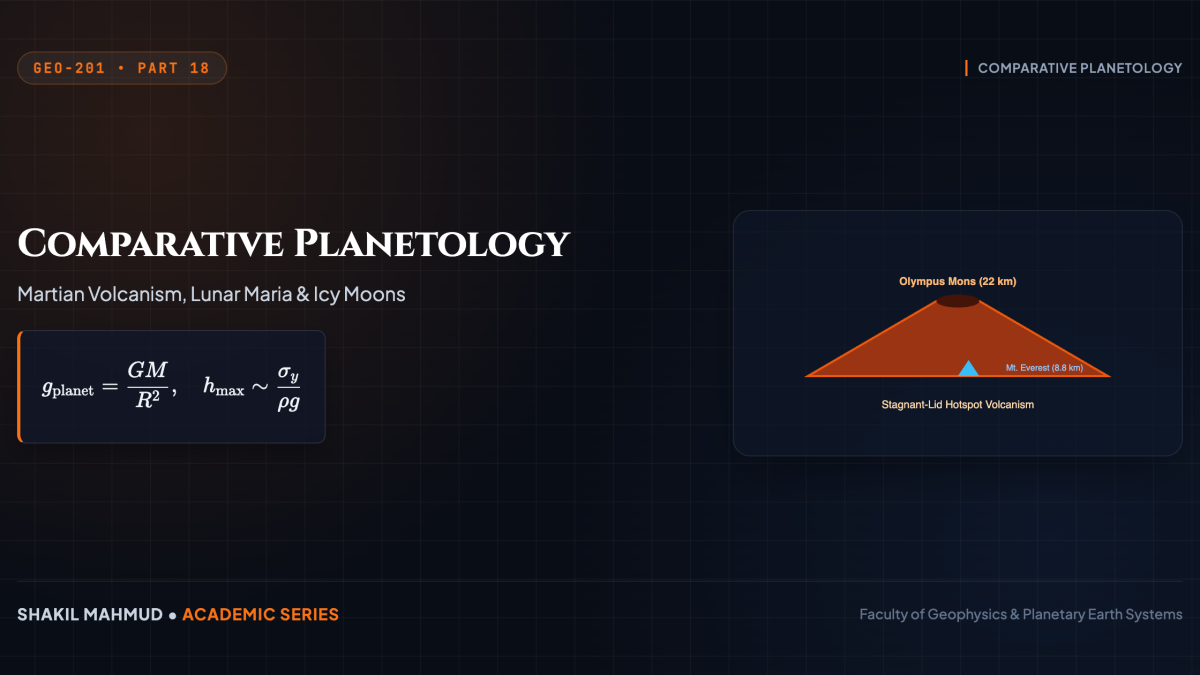
Mars hosts the largest volcanoes in the solar system, epitomized by Olympus Mons—a basaltic shield volcano rising 21.9 km above the Martian datum with a basal footprint spanning 600 km across.
The gargantuan scale of Martian topography is governed by the planetary scale height and maximum supportable mountain height (h_{ ext{max}}), derived from lithospheric shear yield strength (sigma_y):
[
h_{ ext{max}} sim rac{sigma_y}{
ho g}
]
Because Martian surface gravity is only (g_{ ext{Mars}} approx 3.72 ext{ m/s}^2) (roughly (38%) of Earth’s gravity (g_oplus approx 9.81 ext{ m/s}^2)), the same lithospheric rock strength can support a mountain roughly 2.6 times taller on Mars than on Earth. Coupled with the lack of plate tectonics, stationary mantle plumes beneath the Tharsis volcanic province constructed gargantuan volcanic constructs over billions of years.
3. The Moon: Magma Ocean Differentiation and Basaltic Maria
The petrogenesis of the Moon provides direct evidence of global planetary magma oceans:
- The Lunar Highlands (Anorthosite Crust): The pale, rugged lunar highlands are composed almost exclusively of anorthosite ((> 90%) plagioclase feldspar). When the primordial lunar magma ocean crystallized, dense mafic silicates (olivine, pyroxene) sank to form the lunar mantle, while buoyant plagioclase crystals floated to the surface, constructing an ancient flotation crust ((sim 4.45 ext{–}4.35 ext{ Ga})).
- The Lunar Maria (Flood Basalts): The dark, smooth circular basins (e.g., Mare Imbrium, Mare Tranquillitatis) are immense impact basins excavated during the Late Heavy Bombardment ((sim 3.9 ext{ Ga})). Between (3.8) and (3.0 ext{ Ga}), radiogenic heating in the lunar mantle triggered partial melting of ilmenite-rich cumulates, filling the crater basins with ultra-low-viscosity, titanium-rich flood basalts.
4. Cryovolcanism and Tidal Dissipation in Icy Ocean Worlds
In the outer solar system, geological activity is fueled not by radioactivity, but by orbital tidal dissipation. On moons such as Jupiter’s Io and Europa, and Saturn’s Enceladus, eccentric orbits forced by orbital resonances (e.g., Laplace resonance between Io, Europa, and Ganymede) induce continuous gravitational flexing:
[
dot{E}_{ ext{tidal}} approx rac{21}{2} rac{k_2 G M_{ ext{primary}}^2 R^5 e^2 Omega}{a^6 Q}
]
where (e) is orbital eccentricity, (a) is semi-major axis, (k_2) is the Love number, and (Q) is the tidal dissipation quality factor.
On Enceladus, tidal heating sustains a global liquid water ocean beneath a kilometer-thick ice shell. Pressurized hydrothermal fluids vent through fractured south polar “tiger stripe” fissures as supersonic cryovolcanic plumes, ejecting water vapor, silica nanoparticles, simple organic molecules, and molecular hydrogen directly into space—establishing Enceladus and Europa as the premier planetary candidates for extraterrestrial astrobiology.