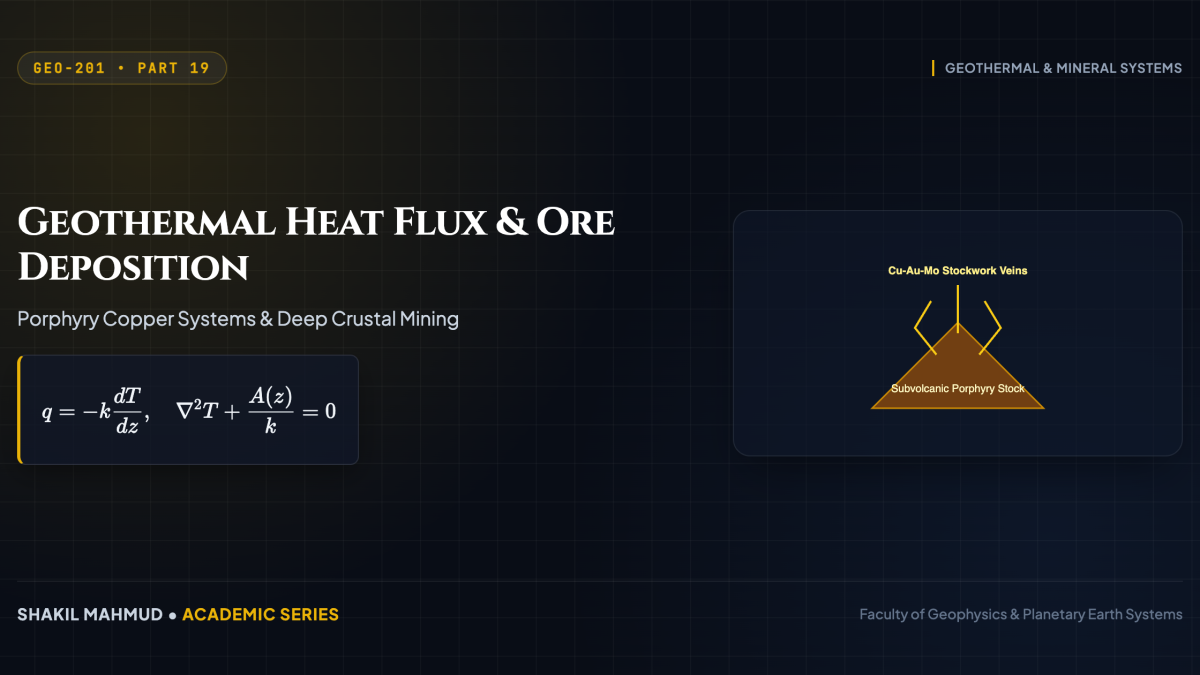
Human civilization rests entirely upon materials excavated from Earth’s crust and energy extracted from planetary heat flows. As the global economy transitions away from fossil hydrocarbons toward electrified renewable infrastructure, demand for critical metals (copper, lithium, cobalt, nickel, rare earth elements) and low-carbon baseload geothermal energy is surging exponentially. Understanding the geochemical concentrating mechanisms that forge economic ore bodies is both a profound geoscientific challenge and an industrial imperative.
1. Terrestrial Geothermal Heat Flux and Crustal Geotherms
Earth dissipates internal heat at a planetary rate of (sim 47 pm 2 ext{ TW}) (mean surface heat flux (bar{q} approx 87 ext{ mW/m}^2)). Heat conduction through the continental crust is governed by Fourier’s Law coupled with volumetric radiogenic heat production (A(z)) from the decay of ({}^{238} ext{U}), ({}^{235} ext{U}), ({}^{232} ext{Th}), and ({}^{40} ext{K}):
[
abla cdot (k
abla T) + A(z) = 0 implies rac{d^2 T}{dz^2} = -rac{A_0 e^{-z/h_r}}{k}
]
where (k approx 2.5 ext{–}3.0 ext{ W}cdot ext{m}^{-1}cdot ext{K}^{-1}) is thermal conductivity, and (h_r approx 10 ext{ km}) is the characteristic radiogenic depth scale. Integrating yields the crustal steady-state geothermal profile:
[
T(z) = T_0 + rac{q_0 – A_0 h_r}{k} z + rac{A_0 h_r^2}{k} left( 1 – e^{-z/h_r}
ight)
]
In tectonically active extensional or volcanic regions (e.g., Iceland, Basin and Range, East African Rift), shallow magmatic intrusions elevate thermal gradients to (dT/dz > 50 ext{–}100^circ ext{C/km}), powering commercial high-enthalpy geothermal power generation.
2. Enhanced Geothermal Systems (EGS) and Supercritical Fluids
Conventional hydrothermal power is geographically constrained to naturally permeable, water-bearing volcanic reservoirs. Enhanced Geothermal Systems (EGS) decouple geothermal exploitation from natural permeability by drilling deep into hot, dry crystalline basement rock ((4 ext{–}6 ext{ km}) depth, (T > 200 ext{–}300^circ ext{C})) and applying controlled hydraulic stimulation to reactivate pre-existing shear fracture networks.
At the technological frontier lies supercritical geothermal energy ((T > 374^circ ext{C}), (P > 22.1 ext{ MPa})). Supercritical water exhibits order-of-magnitude reductions in viscosity and density while maintaining high heat capacity, boosting electrical power output per well by a factor of ten compared to subcritical steam:
[
P_e = dot{m} Delta h ta_{ ext{turbine}}
]
where (Delta h) is enthalpy drop across the turbine.
3. Magmatic-Hydrothermal Ore Genesis: Porphyry Systems
More than (75%) of the world’s copper, (50%) of molybdenum, and substantial gold reserves originate in porphyry copper deposits (e.g., Escondida, Chile; Grasberg, Indonesia). These giant mineral deposits form directly above subduction zone composite batholiths through a four-stage geochemical sequence:
- Magmatic Fluid Exsolution: Water-saturated calc-alkaline dacitic/granodioritic magmas stall in the upper crust ((2 ext{–}5 ext{ km})). As crystallization progresses (second boiling), dissolved volatiles exsolve into a high-temperature supercritical aqueous brine ((T approx 600 ext{–}750^circ ext{C}), (30 ext{–}70 ext{ wt}% ext{ NaCl equiv})).
- Metal Complexation: Copper, gold, and sulfur partition strongly from the silicate melt into the saline fluid phase, transported as chloride and bisulfide complexes: ( ext{CuCl}_2^-), ( ext{Au(HS)}_2^-).
- Hydraulic Fracturing: Fluid volume expansion creates colossal fluid overpressures exceeding lithostatic confining stress plus tensile rock strength ((P_f > sigma_3 + sigma_t)), catastrophically shattering the carapace into dense, multi-directional stockwork vein networks.
- Sulfide Precipitation: As the magmatic fluids decompress, boil, and mix with cooler ambient meteoric groundwater, pH and temperature drop rapidly, destabilizing chloride complexes and precipitating massive copper-iron sulfides:
[
ext{CuCl}_2^- + ext{Fe}^{2+} + 2 ext{H}_2 ext{S} o ext{CuFeS}_2 ext{ (Chalcopyrite)}downarrow + 2 ext{H}^+ + 2 ext{Cl}^- + ext{H}_2
]
4. Critical Energy Transition Minerals and Crustal Geopolitics
The clean energy transition requires a massive scaling of mined mineral volumes. An electric vehicle requires (sim 6) times the mineral inputs of a conventional internal combustion vehicle, and an offshore wind plant requires (sim 9) times more mineral resources than a natural gas plant. Meeting global targets necessitates accessing lower-grade ores ((< 0.5% ext{ Cu})), developing deep in-situ leaching technologies, and recovering critical elements from seafloor polymetallic nodule fields in the Clarion-Clipperton Zone.