How can a dynamical system sustain continuous exponential divergence of nearby trajectories forever while remaining confined inside a strictly bounded region of phase space? The topological resolution to this profound kinematic paradox is the non-linear interplay of Stretching and Folding, first formalized by Stephen Smale in the Horseshoe Map and realized in the physical orbits of the Hénon and Rössler Attractors.
1. The Topological Mechanics of Chaos: The Smale Horseshoe
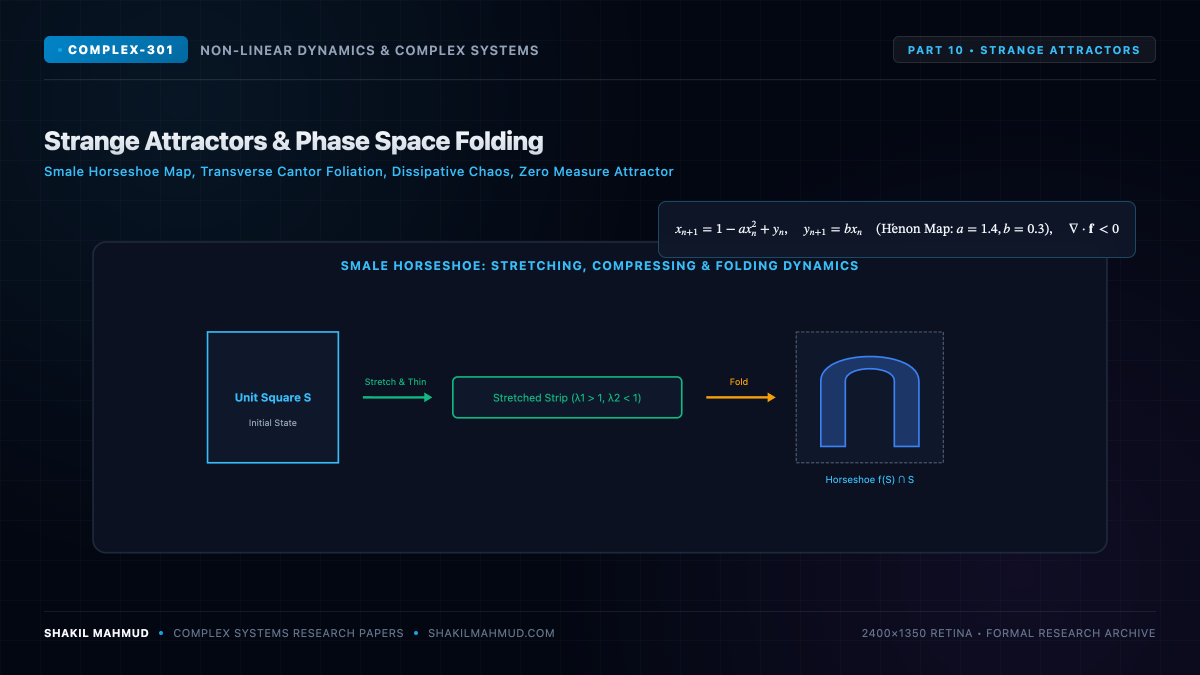
In 1967, Fields Medalist Stephen Smale introduced a simple geometric transformation of the unit square $S = [0, 1] times [0, 1] subset mathbb{R}^2$ that captured the invariant essence of chaotic motion:
- Stretching: The square is stretched linearly in the horizontal direction by factor $mu > 2$, generating sensitive dependence on initial conditions along the unstable manifold.
- Compressing (Squeezing): The square is simultaneously contracted in the vertical direction by factor $lambda < 1/2$, enforcing strong dissipation along the stable manifold.
- Folding: The elongated thin ribbon is bent into a U-shaped horseshoe and laid back over the original square, so that only two vertical strips intersect $S$.
The set of points that remain in the square for all future and past iterations ($t in mathbb{Z}$) is the invariant set:
[
Lambda = bigcap_{n=-infty}^{+infty} f^{(n)}(S)
]
Smale proved that $Lambda$ is homeomorphic to the Cartesian product of two Cantor sets (a Cantor cross-section of fractal dimension $D < 2$). Crucially, the dynamics of $f$ restricted to $Lambda$ is topologically conjugate to the Bernoulli Shift on two symbols ($Sigma_2 = {0, 1}^{mathbb{Z}}$), proving that deterministic iteration on $Lambda$ is mathematically identical to an infinite sequence of coin tosses.
2. The Hénon Attractor
In 1976, French astronomer Michel Hénon designed a simplified 2D discrete algebraic model that captured the stretch-and-fold laminar cross-section of the continuous Lorenz flow:
[
begin{aligned}
x_{n+1} &= 1 – a x_n^2 + y_n \
y_{n+1} &= b x_n
end{aligned}
]
The Hénon map decomposes into three successive geometric operations:
- Non-linear parabolic folding: $(x, y) to (x, 1 – a x^2 + y)$.
- Contraction along $x$: $(x, y) to (b x, y)$.
- Axis reflection / rotation: $(x, y) to (y, x)$.
The Jacobian determinant is a constant everywhere in phase space:
[
det(J) = det begin{pmatrix} -2ax & 1 \ b & 0 end{pmatrix} = -b
]
For Hénon’s canonical parameters ($a = 1.4, b = 0.3$), the area contraction factor is $|det(J)| = 0.3 < 1$, proving the system is dissipative. The attractor consists of a mesmerizing self-similar bundle of curves; zooming in reveals infinite nested pairs of lines separated by Cantor voids, possessing a fractal dimension of $D approx 1.26$ and Lyapunov exponents $lambda_1 approx +0.42, lambda_2 approx -1.62$.
3. The Rössler Attractor: Minimal Continuous Chaos
In 1976, Otto Rössler asked: what is the absolute simplest non-linear continuous ODE capable of generating a strange attractor? He constructed the Rössler System:
[
begin{aligned}
dot{x} &= -y – z \
dot{y} &= x + a y \
dot{z} &= b + z (x – c)
end{aligned}
]
Unlike the two-winged Lorenz butterfly, the Rössler attractor operates through a single, elegant geometric mechanism:
- In the $(x, y)$ plane, the linear spiral dynamics ($dot{x} approx -y, dot{y} approx x + ay$) cause trajectories to wind outward slowly in an expanding 2D disc.
- When $x$ exceeds threshold $c$, the non-linear $zx$ term ignites, propelling the trajectory violently upward along the $z$-axis.
- At the top, the trajectory is twisted, folded over, and reinjected back into the inner region of the $(x, y)$ spiral, creating a continuous physical realization of a Möbius strip with an infinite fractal transversal leaf structure.