In 1963, meteorologist Edward Lorenz published a paper in the Journal of the Atmospheric Sciences titled “Deterministic Nonperiodic Flow.” In twelve humble pages, Lorenz shattered the Laplacian clockwork universe by demonstrating that a simple, fully deterministic system of three coupled non-linear differential equations could generate non-periodic, infinitely complex trajectories possessing sensitive dependence on initial conditions—the foundational discovery of Deterministic Chaos.
1. Derivation from Thermal Convection
Lorenz sought a minimal mathematical model of atmospheric convection. Starting from the Navier-Stokes hydrodynamic equations coupled to the thermal heat conduction equation for a fluid layer heated from below (the Rayleigh-Bénard convection problem), Lorenz expanded the velocity streamfunction and temperature perturbation fields into Fourier spatial modes.
Truncating the infinite Fourier series down to just three dominant low-frequency spatial modes (retaining Barry Saltzman’s primary convective roll and vertical temperature distortion modes), Lorenz obtained his canonical three-variable dynamical system:
[
begin{aligned}
dot{x} &= sigma (y – x) \
dot{y} &= x (rho – z) – y \
dot{z} &= x y – beta z
end{aligned}
]
Where:
- $x(t)$ is proportional to the convective overturning circulation velocity (clockwise vs counter-clockwise).
- $y(t)$ measures the horizontal temperature gradient between ascending and descending convective fluid currents.
- $z(t)$ measures the distortion of the vertical temperature profile from strict linearity.
- $sigma = frac{nu}{kappa}$ is the dimensionless Prandtl Number (momentum diffusivity vs thermal diffusivity; Lorenz set $sigma = 10$).
- $rho = frac{text{Ra}}{text{Ra}_c}$ is the normalized Rayleigh Number measuring convective thermal driving force (Lorenz investigated the chaotic regime at $rho = 28$).
- $beta = frac{4}{1 + a^2}$ is a geometric aspect ratio parameter of the convection cell rolls (typically $beta = 8/3$).
2. Dissipation & Exponential Volume Contraction
A continuous dynamical system $dot{mathbf{x}} = mathbf{f}(mathbf{x})$ is dissipative if the divergence of its vector field is strictly negative everywhere in phase space. Calculating the divergence for the Lorenz system:
[
nabla cdot mathbf{f} = frac{partial dot{x}}{partial x} + frac{partial dot{y}}{partial y} + frac{partial dot{z}}{partial z} = -sigma – 1 – beta = -(sigma + 1 + beta)
]
For the canonical parameter values ($sigma = 10, beta = 8/3$):
[
nabla cdot mathbf{f} = -left( 10 + 1 + frac{8}{3} right) = -frac{41}{3} approx -13.67 < 0
]
By Liouville’s theorem for phase space volumes, any arbitrary initial volume $V(0) subset mathbb{R}^3$ contracts exponentially fast under the flow:
[
V(t) = V(0) expleft( – frac{41}{3} t right)
]
Within just one unit of non-dimensional time ($t = 1$), the volume contracts by a factor of $e^{-13.67} approx 1.15 times 10^{-6}$. As $t to infty$, the asymptotic volume of the attractor becomes identically zero ($V_{infty} = 0$). The trajectories are inexorably compressed onto a zero-measure set: the Strange Attractor.
3. Fixed Points & Pitchfork Bifurcations
Setting $dot{x} = dot{y} = dot{z} = 0$, we find the equilibrium states:
- The origin $O = (0, 0, 0)$ is always a fixed point, representing the static conduction state with zero convective fluid motion.
- When $rho le 1$, the origin is globally asymptotically stable.
- At $rho = 1$, the origin undergoes a pitchfork bifurcation, spawning two symmetric convection fixed points:
[
C^+ = (+sqrt{beta(rho – 1)}, +sqrt{beta(rho – 1)}, rho – 1), quad C^- = (-sqrt{beta(rho – 1)}, -sqrt{beta(rho – 1)}, rho – 1)
]
representing steady clockwise and counter-clockwise convective roll circulation. - At a critical Rayleigh number $rho_H = frac{sigma(sigma + beta + 3)}{sigma – beta – 1} approx 24.74$, both convective fixed points undergo a subcritical Hopf bifurcation, shedding their stability and creating an explosive global attractor.
4. The Butterfly Geometry & Deterministic Chaos
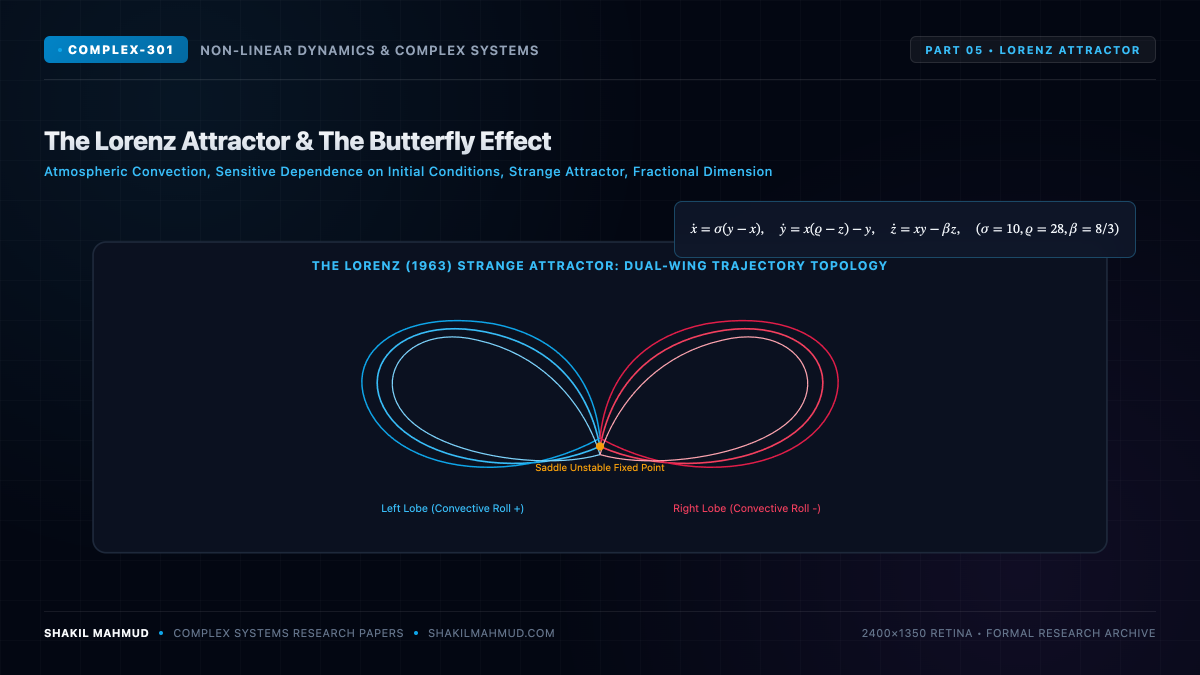
At $rho = 28$, the system possesses no stable fixed points and no stable limit cycles. Instead, trajectories orbit $C^+$ in an expanding spiral until exceeding a critical threshold, crossing through the saddle region near the origin, and entering an expanding spiral around $C^-$, alternating unpredictably between the two lobes forever without ever repeating or intersecting.
The resulting geometric structure is the iconic Butterfly Attractor. It is not a smooth 2D manifold, but an infinite book of sheets—a fractal cross-section with Hausdorff dimension $D approx 2.06$. Two initial states separated by a distance as infinitesimal as $delta_0 = 10^{-15}$ diverge exponentially fast, proving that long-term deterministic weather prediction is physically impossible—the legendary “Butterfly Effect.”