How are rhythms born out of silence? In physical systems ranging from the chemical clock of the Belousov-Zhabotinsky reaction to aeroelastic flutter in airplane wings, periodic self-sustained oscillations do not emerge from thin air; they bifurcate continuously or catastrophically from stationary equilibria via the Andronov-Hopf Bifurcation, or emerge globally through the topological collisions of Homoclinic Orbits.
1. The Spectral Physics of the Hopf Bifurcation
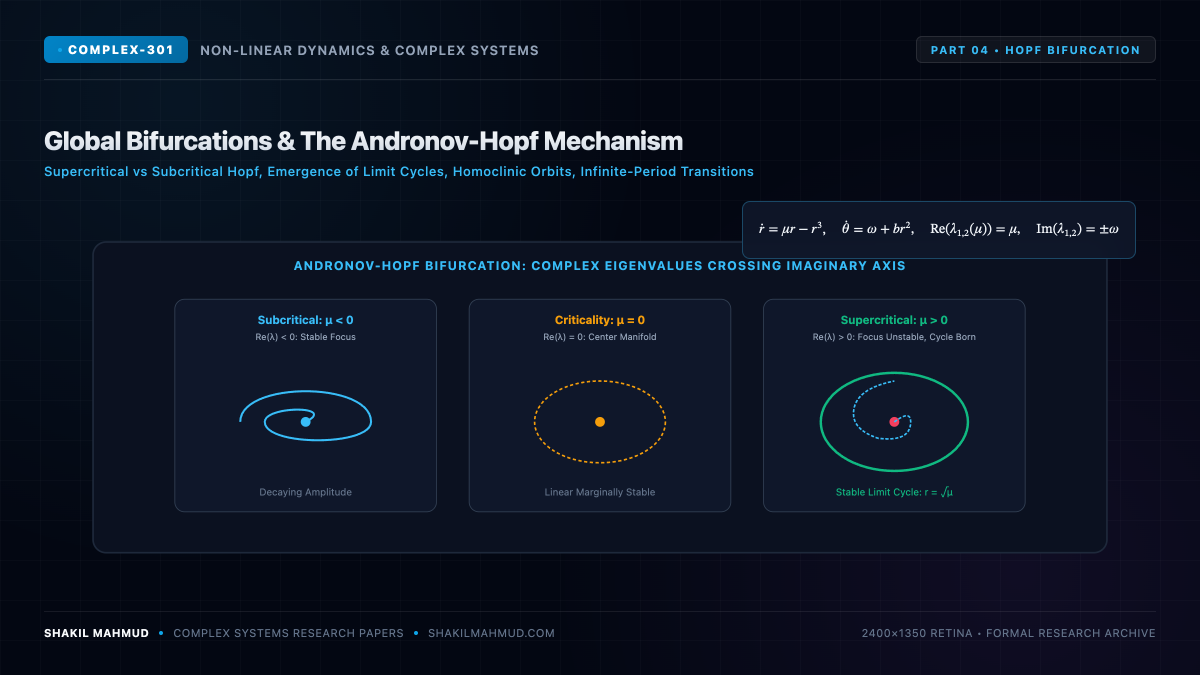
Consider an equilibrium point $mathbf{x}^*(mu)$ of a system $dot{mathbf{x}} = mathbf{f}(mathbf{x}, mu)$ whose linearized Jacobian possesses a pair of complex-conjugate eigenvalues $lambda_{1,2}(mu) = alpha(mu) pm i omega(mu)$.
An Andronov-Hopf Bifurcation occurs at $mu = mu_c$ when the real part crosses the imaginary axis with non-zero crossing velocity:
- $alpha(mu_c) = 0$ (Zero real part).
- $omega(mu_c) = omega_0 neq 0$ (Non-zero imaginary frequency).
- $left. frac{dalpha}{dmu} right|_{mu = mu_c} > 0$ (Transversality condition: non-zero crossing speed).
In polar coordinates $(r, theta)$ on the 2D center manifold, the normal form is expressed as:
[
dot{r} = mu r – a r^3, quad dot{theta} = omega + b r^2
]
2. Supercritical vs Subcritical Hopf Transitions
The qualitative character of the bifurcation is dictated by the sign of the non-linear cubic coefficient $a$:
A. Supercritical Hopf Bifurcation ($a > 0$)
When $a > 0$, the non-linear cubic term provides stabilizing non-linear saturation:
- For $mu < 0$, the origin $r = 0$ is an asymptotically stable spiral focus.
- At $mu = 0$, the origin becomes non-hyperbolic.
- For $mu > 0$, the origin loses stability and becomes an unstable focus, shedding a stable limit cycle whose radius grows continuously as:
[
r_{text{limit cycle}} = sqrt{frac{mu}{a}}
]
The oscillation begins with zero amplitude at $mu = 0$ and grows smoothly $propto sqrt{mu}$, representing a continuous, reversible “soft” onset of oscillation.
B. Subcritical Hopf Bifurcation ($a < 0$)
When $a < 0$, the cubic term is destabilizing, requiring a fifth-order stabilizing term ($dot{r} = mu r + |a| r^3 – r^5$):
- For $mu < 0$, the stable origin is surrounded by an unstable limit cycle that acts as the boundary (threshold) of the basin of attraction.
- As $mu to 0^-$, the unstable cycle shrinks and strangles the origin.
- At $mu = 0$, the origin loses stability catastrophically: trajectories are violently expelled outward to a distant, large-amplitude stable limit cycle.
When $mu$ is subsequently decreased, the system does not stop oscillating at $mu = 0$; it persists on the large cycle until a lower threshold is reached, producing severe hysteresis and explosive instabilities (e.g., aerodynamic wing flutter, neural bursting discharges).
3. Global Homoclinic & Heteroclinic Bifurcations
Unlike local bifurcations which are diagnosed purely by looking at Jacobian eigenvalues at a single point, Global Bifurcations involve large-scale topological rearrangements across phase space:
- Homoclinic Orbit: A trajectory $gamma(t)$ that originates from and returns to the same saddle equilibrium point ($lim_{t to -infty} mathbf{x}(t) = mathbf{x}^*$ and $lim_{t to +infty} mathbf{x}(t) = mathbf{x}^*$). As parameter $mu$ approaches the homoclinic threshold $mu_{text{hom}}$, a limit cycle swells until it touches the saddle point. At criticality, the period of the oscillation diverges logarithmically to infinity:
[
T(mu) sim -frac{1}{lambda_u} ln |mu – mu_{text{hom}}| longrightarrow infty
]
This is an Infinite-Period Bifurcation: the frequency vanishes while the amplitude remains finite. - Heteroclinic Cycle: A closed chain of trajectories linking two or more distinct saddle fixed points ($mathbf{x}_1^* to mathbf{x}_2^* to dots to mathbf{x}_1^*$), forming global topological barriers that organize multi-stability in ecology and competitive game dynamics.