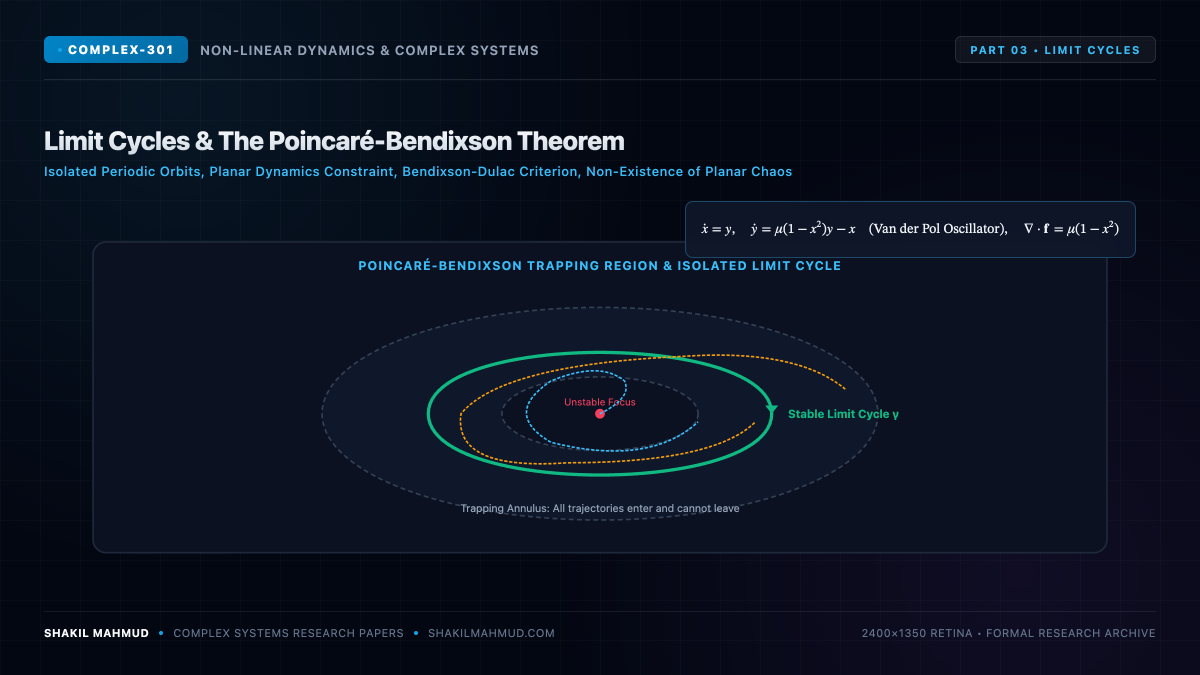
Linear systems can oscillate, but their periodic orbits form continuous neutral families whose amplitude depends entirely on initial conditions (like a frictionless harmonic pendulum). Non-linear systems, by contrast, exhibit a fundamentally new phenomenon: Limit Cycles—isolated periodic closed orbits that pull neighboring trajectories into a robust, self-sustained rhythm regardless of initial perturbations.
1. The Geometry of Limit Cycles
A closed trajectory $gamma$ corresponding to a periodic solution $mathbf{x}(t + T) = mathbf{x}(t)$ (with minimal period $T > 0$) is a Limit Cycle if it is isolated: no other closed orbits exist in its immediate topological neighborhood.
- Stable Limit Cycle (Attractor): All neighboring trajectories spiral into $gamma$ as $t to +infty$. A stable limit cycle acts as a non-linear temporal clock (e.g., heartbeat pacemaker cells, circadian rhythm biochemical oscillators).
- Unstable Limit Cycle (Repeller): Neighboring trajectories diverge away from $gamma$ as $t to +infty$ (and spiral into it as $t to -infty$).
- Semi-Stable Limit Cycle: Attracting from the interior, repelling from the exterior (or vice-versa).
2. The Poincaré-Bendixson Theorem: The Planar Constraint
One of the most celebrated structural theorems in dynamical systems is the Poincaré-Bendixson Theorem (formulated by Henri Poincaré in 1881 and completed by Ivar Bendixson in 1901):
Let $mathcal{D} subset mathbb{R}^2$ be a closed, bounded (compact) subset of the plane. Suppose $dot{mathbf{x}} = mathbf{f}(mathbf{x})$ is a continuously differentiable vector field on $mathcal{D}$, and let $T subset mathcal{D}$ be a trapping region—a forward-invariant set such that any trajectory starting in $T$ remains in $T$ for all future times ($t ge 0$). If $T$ contains no fixed points, then every trajectory in $T$ must asymptotically approach a closed periodic orbit (a limit cycle) as $t to infty$.
The mathematical proof relies fundamentally on the Jordan Curve Theorem: a simple closed curve in the plane separates $mathbb{R}^2$ into an “inside” and an “outside”. Because trajectories cannot cross themselves (by Picard-Lindelöf uniqueness), a bounded trajectory trapped in a compact planar domain with no equilibria is topologically forced to wind asymptotically onto a closed loop.
The Profound Implication: Deterministic chaos is mathematically impossible in continuous 2D autonomous systems ($mathbb{R}^2$). To exhibit chaotic wandering without self-intersection, continuous phase space requires at least three independent degrees of freedom ($n ge 3$).
3. Criteria for Ruling Out Limit Cycles: Bendixson & Dulac
Before hunting for limit cycles, we often prove they cannot exist. Bendixson’s Negative Criterion states that if $mathcal{D} subseteq mathbb{R}^2$ is a simply connected domain, and the divergence of the vector field:
[
nabla cdot mathbf{f} = frac{partial f_1}{partial x} + frac{partial f_2}{partial y}
]
is strictly non-zero and does not change sign throughout $mathcal{D}$, then there are no periodic orbits lying entirely in $mathcal{D}$.
This was generalized by Henri Dulac through the introduction of a smooth weighting function $rho(x, y) > 0$. If there exists a $mathcal{C}^1$ function $rho$ such that:
[
nabla cdot (rho mathbf{f}) = frac{partial (rho f_1)}{partial x} + frac{partial (rho f_2)}{partial y}
]
does not change sign in $mathcal{D}$, then $mathcal{D}$ contains no closed orbits. The proof follows directly from Green’s Theorem: the line integral around any proposed closed orbit $oint_gamma rho (f_1 dy – f_2 dx) = 0$ contradicts the non-zero surface integral $iint_{text{int}(gamma)} nabla cdot (rho mathbf{f}) , dA neq 0$.
4. The Van der Pol Relaxation Oscillator
The classical paradigm of a self-excited limit cycle is the Van der Pol Oscillator, originally developed to model triode vacuum-tube circuits in 1920s electronics:
[
ddot{x} – mu (1 – x^2) dot{x} + x = 0
]
Here, the non-linear damping term $mu (1 – x^2)$ acts as a dynamic energy regulator:
- When $|x| < 1$, the damping is negative ($-mu$), actively injecting energy and pumping the amplitude outward.
- When $|x| > 1$, the damping is positive ($+mu$), dissipating energy and braking the amplitude inward.
For large $mu gg 1$, the system exhibits relaxation oscillations: long periods of slow stress accumulation alternating with sudden, explosive kinematic discharges—the physical prototype of neuronal action potentials, seismic stick-slip fault ruptures, and intermittent geysers.