“Clouds are not spheres, mountains are not cones, coastlines are not circles, and bark is not smooth, nor does lightning travel in a straight line.” With these words in 1977, Benoît Mandelbrot inaugurated Fractal Geometry—the mathematical language of nature’s rugged, scale-invariant forms, revealing how strange attractors in chaotic phase space possess fractional non-integer dimensions.
1. The Failure of Euclidean Geometry in Nature
In standard Euclidean geometry, dimension is an integer: a point has dimension $0$, a line has dimension $1$, a plane has dimension $2$, and a solid volume has dimension $3$. If we scale a $1$-dimensional line by a linear magnification factor $s = 3$, it yields $N = 3^1 = 3$ self-similar copies. Scaling a $2$-dimensional square by $s = 3$ yields $N = 3^2 = 9$ copies. In general, for an integer-dimensional Euclidean object:
[
N(s) = s^D implies D = frac{ln N(s)}{ln s}
]
In nature, however, physical boundaries—such as the coastline of Britain (Richardson’s coast measurement paradox)—exhibit statistical self-similarity across decades of magnification: the measured length $L(epsilon) sim epsilon^{1 – D}$ diverges to infinity as the ruler length $epsilon to 0$.
2. The Hausdorff-Besicovitch & Box-Counting Dimensions
To quantify scale-invariant roughness mathematically, Felix Hausdorff (1918) and Abram Besicovitch generalized the notion of measure and dimension.
A. The Box-Counting (Minkowski-Bouligand) Dimension
Cover a bounded geometric subset $F subset mathbb{R}^n$ with a grid of $n$-dimensional hypercubes of side length $epsilon$. Let $N(epsilon)$ be the minimum number of boxes required to cover $F$. The Box-Counting Dimension is defined by the logarithmic scaling slope:
[
D_{text{box}} = lim_{epsilon to 0} frac{ln N(epsilon)}{ln(1/epsilon)} = -lim_{epsilon to 0} frac{ln N(epsilon)}{ln epsilon}
]
B. The Hausdorff Measure & Dimension
The rigorous topological foundation is the $d$-dimensional Hausdorff measure $mathcal{H}^d(F) = lim_{delta to 0} inf_{{U_i}} sum_{i} (text{diam } U_i)^d$. There exists a unique critical threshold $D_H$ such that:
[
mathcal{H}^d(F) = begin{cases} infty & text{if } d D_H end{cases}
]
This jump discontinuity defines the Hausdorff Dimension $D_H$. A Fractal is formally defined by Mandelbrot as any set whose Hausdorff dimension strictly exceeds its topological (Lebesgue covering) dimension:
[
D_H > D_T
]
3. Canonical Exactly Self-Similar Fractals
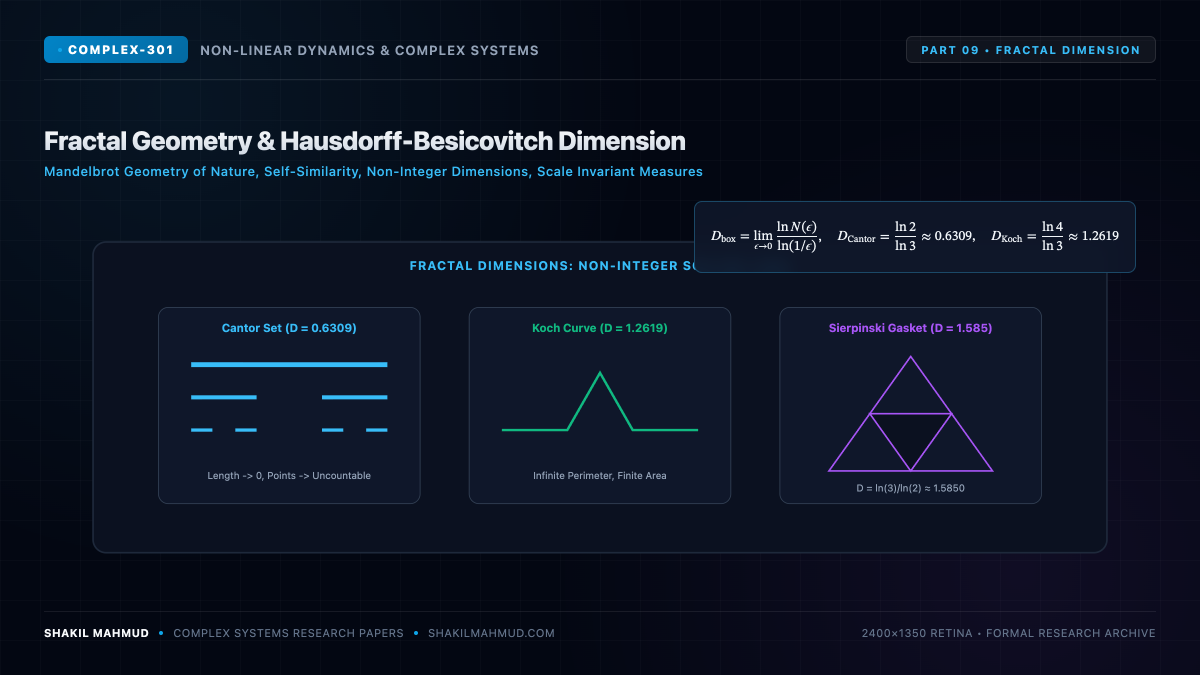
- The Middle-Third Cantor Set: Begin with the unit interval $[0, 1]$ ($D_T = 1$) and recursively delete the open middle third. At iteration $k$, there are $N_k = 2^k$ segments of length $epsilon_k = (1/3)^k$. Its fractal dimension is:
[
D_{text{Cantor}} = frac{ln 2}{ln 3} approx 0.6309297dots
]
It has total Lebesgue measure zero, contains an uncountably infinite number of points, is totally disconnected, and has topological dimension $0$, yet possesses non-zero fractional Hausdorff dimension. - The Koch Snowflake: Replace the middle third of each line segment with an equilateral triangle without base. At each step, $N$ quadruples ($N = 4$) while size scales by $s = 3$:
[
D_{text{Koch}} = frac{ln 4}{ln 3} = frac{2 ln 2}{ln 3} approx 1.2618595dots
]
Its perimeter is infinite ($lim_{ktoinfty} (4/3)^k = infty$), yet it bounds a strictly finite planar area. - The Sierpiński Gasket: Removing the central inverted triangle from an equilateral triangle ($N = 3, s = 2$):
[
D_{text{Sierpinski}} = frac{ln 3}{ln 2} approx 1.5849625dots
]
4. The Mandelbrot Set: The Boundary of Complex Dynamics
In discrete complex dynamics, iterating the quadratic polynomial $z_{n+1} = z_n^2 + c$ for complex parameter $c in mathbb{C}$ starting from critical point $z_0 = 0$ generates the iconic Mandelbrot Set $mathcal{M}$:
[
mathcal{M} = { c in mathbb{C} mid lim_{n to infty} |z_n| le 2 }
]
In 1998, Mitsuhiro Shishikura proved a monumental conjecture: the topological boundary of the Mandelbrot set $partial mathcal{M}$ has Hausdorff dimension identically equal to two: $D_H(partial mathcal{M}) = 2$. The boundary is an infinitely convoluted fractal curve that fills the plane, embodying the supreme aesthetic and computational bridge between pure complex analysis and non-linear dynamics.