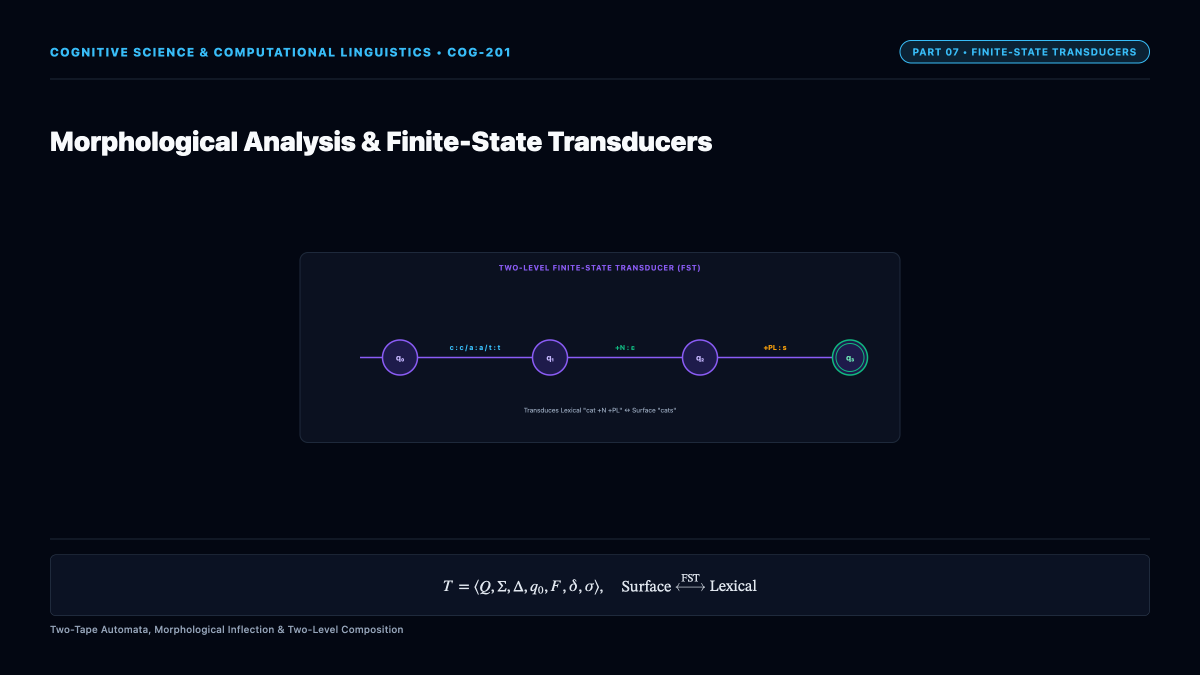
Words are not indivisible atoms of language. They are structured composite objects assembled from minimal meaning-bearing units called morphemes. In computational linguistics, the parsing and generation of complex word forms is formalized with mathematical elegance using Finite-State Transducers (FSTs), linking surface spellings with abstract lexical representations.
1. Linguistic Morphology: Morphemes and Allomorphy
A morpheme is the minimal structural unit of grammatical or lexical significance. Morphology divides into two fundamental domains:
- Inflectional Morphology: Adapts a word to its syntactic context (tense, person, number, case, aspect) without altering its fundamental lexical category or core semantic concept (e.g., walk ( o) walks, walking, walked).
- Derivational Morphology: Creates an entirely new lexical item, frequently shifting syntactic category (e.g., compute ([V]) ( o) computer ([N]) ( o) computerize ([V]) ( o) computerization ([N])).
When morphemes combine, phonological and orthographic adjustments generate allomorphs. For instance, the English plural morpheme ({ -s }) manifests as ([-s]) after voiceless consonants (cats), ([-z]) after voiced sounds (dogs), and ([-partial z]) after sibilants (kisses). Orthographically, rules dictate changes such as (y o ie) (fly ( o) flies) or consonant gemination (stop ( o) stopped).
2. Finite-State Transducers (FSTs)
While a standard Finite-State Automaton (FSA) recognizes or generates a single set of strings, a Finite-State Transducer (FST) is a two-tape automaton that reads an input string on one tape and outputs a corresponding string on another tape. Formally, an FST (T) is defined as a 7-tuple:
[
T = langle Q, Sigma, Delta, q_0, F, delta, sigma
angle
]
where:
- (Q) is a finite set of states.
- (Sigma) is a finite input alphabet.
- (Delta) is a finite output alphabet.
- (q_0 in Q) is the initial state.
- (F subseteq Q) is the set of final (accepting) states.
- (delta: Q imes (Sigma cup { psilon }) o 2^Q) is the state transition function.
- (sigma: Q imes (Sigma cup { psilon }) o 2^{Delta^*}) is the output transition function.
Each transition arc in an FST is labeled with an input/output pair (a : b), where (a in Sigma cup { psilon }) and (b in Delta cup { psilon }). When (a) is read, (b) is emitted. If (b = psilon), the symbol is deleted; if (a = psilon), a symbol is inserted.
3. Bidirectional Processing: Analysis versus Generation
A crucial computational virtue of FSTs is their strict mathematical reversibility:
- Morphological Analysis: The surface string (e.g., “cats”) is fed as input, and the FST transduces it into the abstract lexical analysis (“cat +N +PL”).
- Morphological Generation: Inverting the transducer arcs ((a : b o b : a)) allows the identical automaton to take lexical morphemes (“cat +N +PL”) and synthesize the surface string (“cats”).
4. Kimmo Koskenniemi’s Two-Level Morphology and Transducer Composition
In 1983, Kimmo Koskenniemi revolutionized computational morphology by introducing Two-Level Morphology. Rather than applying a cascaded sequence of intermediate rule transitions that destroy morphological boundaries, two-level morphology maintains direct, parallel correspondence between two distinct structural tapes:
- Lexical Tape: The canonical underlying sequence of lexical stems and grammatical inflectional tags (e.g.,
c a t +N +PL). - Surface Tape: The orthographic or phonetic output string (e.g.,
c a t s).
In modern industrial implementations (such as the Xerox FST toolkit, Foma, and OpenFst), complex morphological systems are constructed by modular compilation and the algebraic composition operator ((circ)):
[
T_{ ext{total}} = T_{ ext{lexicon}} circ T_{ ext{rule}_1} circ T_{ ext{rule}_2} circ dots circ T_{ ext{rule}_n}
]
Because finite-state transducers are closed under composition, intersection, and inversion, an entire multi-layered natural language lexicon containing hundreds of thousands of complex irregular and agglutinative word forms compiles into a single deterministic, minimal FST that executes in linear time (mathcal{O}(m)), where (m) is the length of the word string.