While phonetics studies the continuous acoustic and articulatory physics of speech sounds, phonology investigates the discrete, unconscious mental grammar that organizes speech into symbolic phonemic contrasts. The historical transition from rule-based rewrite derivations to constraint-based Optimality Theory exemplifies one of the most elegant paradigms in cognitive computational linguistics.
1. Phonemes, Allophones, and Distinctive Features
In any spoken language, continuous acoustic waveforms are perceived by the human auditory cortex as categorical sequences of discrete mental symbols called phonemes. A phoneme is the minimal structural unit capable of distinguishing word meanings (demonstrated by minimal pairs such as /pæt/ vs /bæt/ in English, or /kʰal/ vs /gal/ in Bengali).
Physical surface realizations of a phoneme conditioned by neighboring acoustic environments are termed allophones (e.g., the aspirated ([p^h]) in “pin” versus the unaspirated ([p]) in “spin”). In 1952, Roman Jakobson, Gunnar Fant, and Morris Halle demonstrated that phonemes are not atomic primitives; rather, they decompose into a universal matrix of binary distinctive features ([pm ext{feature}]):
- Major Class Features: ([pm ext{consonantal}]), ([pm ext{sonorant}]), ([pm ext{syllabic}]).
- Laryngeal Features: ([pm ext{voice}]), ([pm ext{spread glottis}]), ([pm ext{constricted glottis}]).
- Place Features: ([ ext{LABIAL}]), ([ ext{CORONAL} (pm ext{anterior}, pm ext{distributed})]), ([ ext{DORSAL} (pm ext{high}, pm ext{low}, pm ext{back})]).
- Manner Features: ([pm ext{continuant}]), ([pm ext{nasal}]), ([pm ext{strident}]).
2. Rule-Based Generative Phonology (SPE)
In their classic 1968 treatise The Sound Pattern of English (SPE), Noam Chomsky and Morris Halle formalized phonological competence as an ordered sequence of algorithmic rewrite rules transforming abstract underlying representations (UR) into concrete surface representations (SR):
[
A o B / C underline{quad} D
]
reading: “Segment A becomes B in the phonetic environment between C and D.” For instance, word-final obstruent devoicing in German, Russian, or Dutch is expressed as:
[
[+ ext{consonantal}, – ext{sonorant}] o [- ext{voice}] / underline{quad} #
]
While SPE successfully modeled isolated processes, sequential rule pipelines suffered from severe theoretical flaws: the “Duplication Problem” (where separate dynamic rules redundantly enforced identical static morpheme structure constraints) and conspiratorial rule clustering.
3. Optimality Theory (OT): Prince and Smolensky’s Revolution
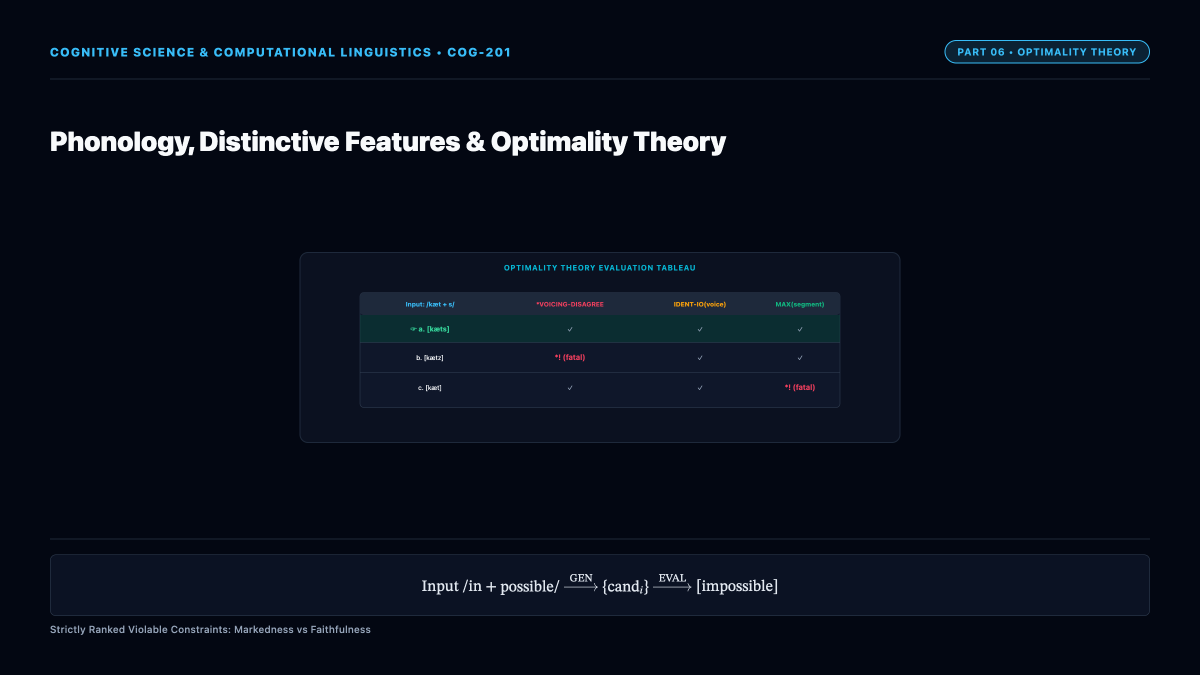
In 1993, Alan Prince and Paul Smolensky introduced Optimality Theory (OT), abandoning serial rewrite derivations in favor of parallel constraint satisfaction. In OT:
- Phonological constraints are universal (present in the cognitive grammar of all human languages).
- Constraints are intrinsically violable (no surface form can satisfy all constraints simultaneously).
- Cross-linguistic variation (typology) is determined entirely by language-specific strict ranking hierarchies among these constraints: (mathcal{C}_1 gg mathcal{C}_2 gg mathcal{C}_3).
The computational architecture of OT operates through two formal functional components:
- GEN (Generator): Takes an underlying input form (/ ext{input}/) and generates an infinite set of candidate surface phonetic outputs: ({ ext{cand}_1, ext{cand}_2, ext{cand}_3, dots }).
- EVAL (Evaluator): Evaluates all candidates in parallel against the language’s ranked constraint hierarchy, iteratively eliminating sub-optimal candidates until a single optimal surface form survives.
4. The Conflict Between Faithfulness and Markedness
Universal phonological constraints fall into two mutually antagonistic families:
- Faithfulness Constraints: Demand that the surface output match the underlying input identically:
- ( ext{MAX-IO}): Every segment in the input must have a correspondent in the output (forbids deletion).
- ( ext{DEP-IO}): Every segment in the output must have a correspondent in the input (forbids epenthesis/insertion).
- ( ext{IDENT-IO}( ext{feature})): Corresponding segments must have identical values for ([ ext{feature}]).
- Markedness Constraints: Demand that the surface output avoid acoustically difficult, un-aerodynamic, or structurally complex phonetic structures:
- ( ext{NO-CODA}): Syllables must not have consonants in the coda ((*C_sigma)).
- ( ext{ONSET}): Syllables must begin with a consonant consonant onset.
- (* ext{VOICED-CODA}): Obstruents in the coda must not be voiced.
When markedness outranks faithfulness (( ext{Markedness} gg ext{Faithfulness})), phonological alternation occurs (e.g., insertion of vowels or deletion of consonants to achieve optimal CV syllables). When faithfulness outranks markedness, underlying contrasts are faithfully preserved. OT provides a computationally elegant, constraint-based architecture for human phonological cognition.