Zero-Knowledge Succinct Non-Interactive Arguments of Knowledge (zk-SNARKs) represent the pinnacle of verifiable computation: allowing a prover to demonstrate correct execution of an arbitrary arbitrary computation involving millions of operations through a microscopic 128-byte proof that verifies in less than 3 milliseconds. In this foundational treatise, we trace the full compilation pipeline: converting high-level code to Arithmetic Circuits, flattening to Rank-1 Constraint Systems (R1CS), translating via Lagrange interpolation into a Quadratic Arithmetic Program (QAP), and executing Jens Groth’s legendary Groth16 protocol.
1. The Compilation Pipeline: From Code to R1CS
Computations in zk-SNARKs are not evaluated on CPUs; they are executed as an Arithmetic Circuit over a large finite scalar field (mathbb{F}_p), composed entirely of addition and multiplication gates. Any program can be flattened into a system of quadratic constraints known as Rank-1 Constraint Systems (R1CS).
An R1CS consists of three matrices (A, B, C in mathbb{F}_p^{m imes n}) and a witness vector (w = (1, x_1, dots, x_l, w_1, dots, w_{n-l-1}) in mathbb{F}_p^n) satisfying (m) constraint equations:
[
(A w) circ (B w) = (C w)
]
where (circ) denotes the Hadamard (entry-wise) vector product. Each row represents a single multiplication gate: ((sum A_i w_i) cdot (sum B_i w_i) = (sum C_i w_i)).
2. Quadratic Arithmetic Programs (QAP)
Checking (m) distinct vector constraints in R1CS would require the verifier to perform (mathcal{O}(m)) work. To achieve succinctness (verifying in constant time), Rosario Gennaro, Craig Gentry, Bryan Parno, and Mariana Raykova (GGPR, 2013) invented Quadratic Arithmetic Programs (QAP): bundling all (m) matrix rows into continuous polynomials using Lagrange interpolation over evaluation domain ({r_1, dots, r_m}).
We interpolate polynomials (A_i(X), B_i(X), C_i(X)) such that (A_i(r_j) = A_{j, i}). Defining the target vanishing polynomial:
[
T(X) = prod_{j=1}^m (X – r_j)
]
The vector equation ((A w) circ (B w) = C w) holds across all gates if and only if the polynomial:
[
P(X) = left( sum_{i=0}^{n-1} w_i A_i(X)
ight) cdot left( sum_{i=0}^{n-1} w_i B_i(X)
ight) – left( sum_{i=0}^{n-1} w_i C_i(X)
ight)
]
vanishes at every root (r_j in {r_1, dots, r_m}). By basic polynomial algebra, this is equivalent to stating that (T(X)) divides (P(X)) without remainder:
[
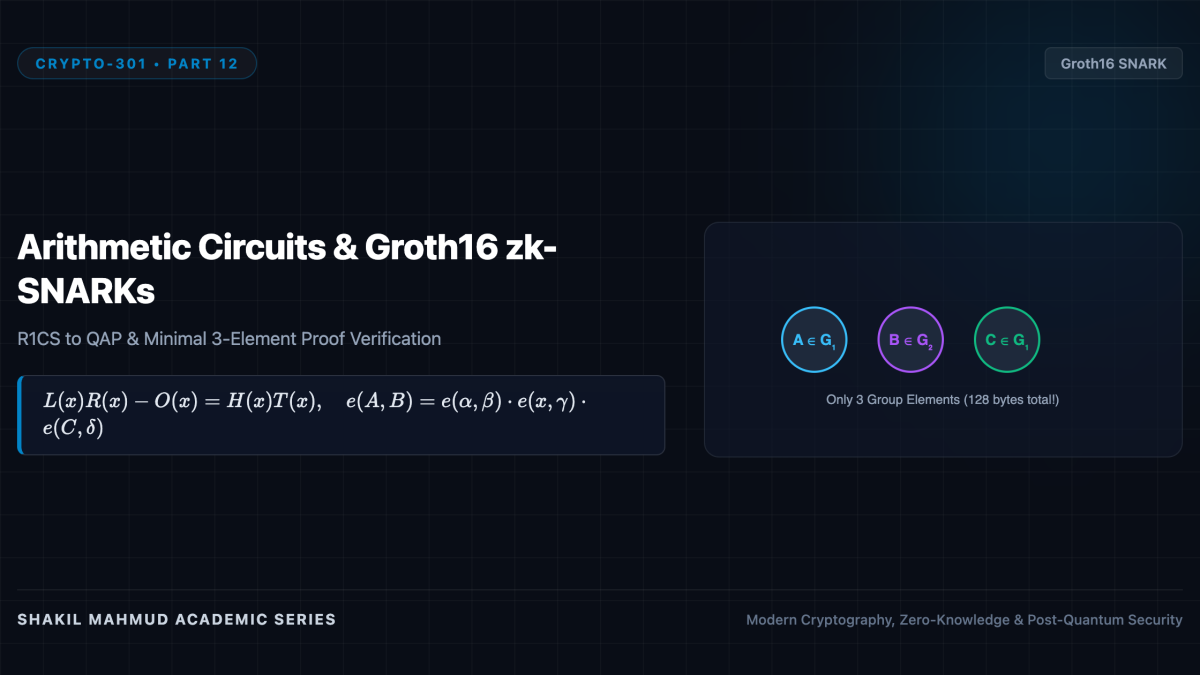
xists H(X) in mathbb{F}_p[X] quad ext{such that} quad L(X) R(X) – O(X) = H(X) cdot T(X)
]
By Schwartz-Zippel, checking this identity at a single random secret point ( au) guarantees with overwhelming probability that the equation holds everywhere.
3. The Groth16 zk-SNARK Protocol
Published in 2016 by Jens Groth, Groth16 remains the undisputed gold standard for minimal proof size and blinding verification speed across production zero-knowledge systems:
- Trusted Setup: Sample secret toxic waste ((alpha, beta, gamma, delta, au) leftarrow mathbb{F}_p^*). Compute proving key and verification key consisting of encrypted powers of ( au) shifted by (alpha, beta, gamma, delta) in groups (G_1) and (G_2).
- Proof Generation: To prove knowledge of witness (w) satisfying the QAP, the prover samples random blinding scalars (r, s leftarrow mathbb{F}_p) and constructs exactly three group elements:
[
A in G_1, quad B in G_2, quad C in G_1
]
where (A = [alpha + sum w_i A_i( au) + r delta]_1), (B = [beta + sum w_i B_i( au) + s delta]_2), and (C) absorbs cross-terms, quotient (H( au)T( au)/delta), and blinding factors. - Succinct Verification: The verifier checks public inputs (x) via a single pairing equation:
[
e(A, B) stackrel{?}{=} e(alpha, beta) cdot eleft( sum_{i=0}^l x_i left[ rac{beta A_i( au) + alpha B_i( au) + C_i( au)}{gamma}
ight]_1, [gamma]_2
ight) cdot e(C, [delta]_2)
]
Groth16 achieves the absolute theoretical minimum for pairing-based SNARKs: the proof is strictly 3 group elements (2 in (G_1), 1 in (G_2) = 128 bytes), and verification requires only 3 pairing computations, taking ~1.5 milliseconds. The trade-off is that Groth16 requires a circuit-specific trusted setup ceremony.