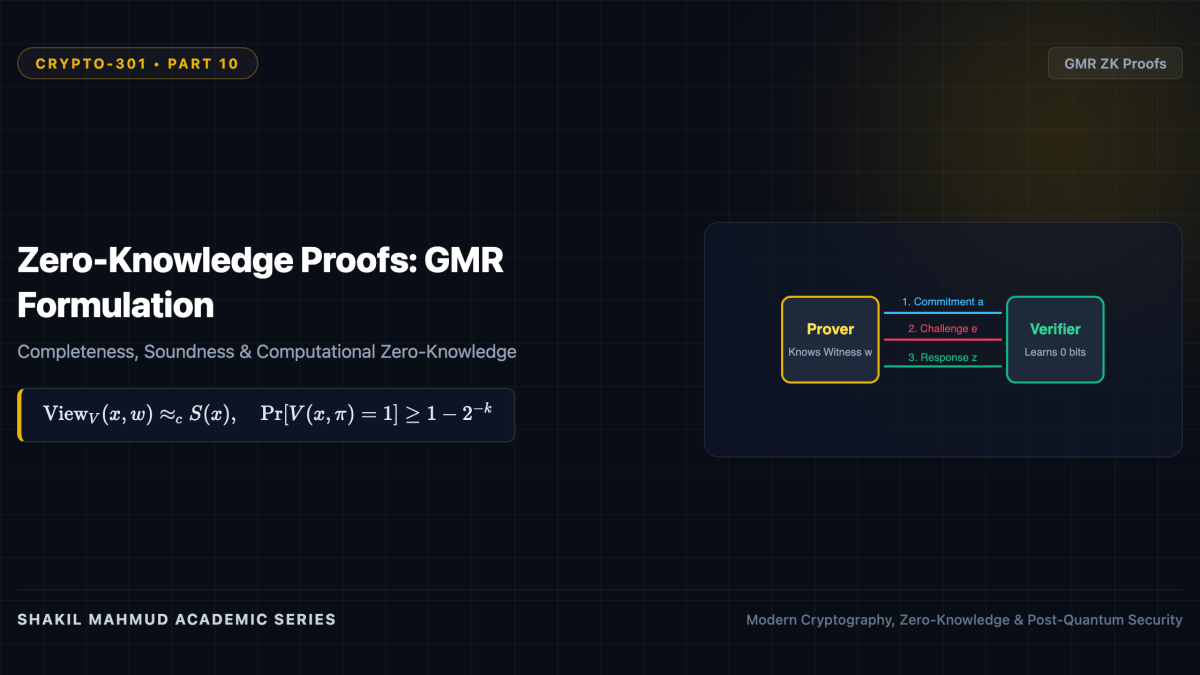
In 1985, Shafi Goldwasser, Silvio Micali, and Charles Rackoff published a paper that shattered the classical definition of a mathematical proof: “The Knowledge Complexity of Interactive Proof-Systems.” For thousands of years, a proof was a static sequence of deductive assertions. GMR redefined proof as an interactive dynamic conversation between an all-powerful Prover and a probabilistic polynomial-time Verifier, proving that a statement can be demonstrated beyond a shadow of a doubt while revealing exactly zero knowledge beyond its truth.
1. The Interactive Proof System (IP) and Complexity Theory
An Interactive Proof (IP) for language (L) consists of an interactive protocol (langle P, V
angle) between prover (P) and PPT verifier (V). The protocol must satisfy two core axioms:
- Completeness: If (x in L), an honest prover convinces the honest verifier with overwhelming probability:
[
Pr[langle P, V
angle(x) = 1] ge 1 – 2^{-n}
] - Soundness: If (x
otin L), no malicious cheating prover (P^*) (even with infinite computational power) can convince the verifier, except with negligible probability:
[
orall P^*, quad Pr[langle P^*, V
angle(x) = 1] le ext{negl}(n)
]
In 1992, Adi Shamir proved the momentous complexity equality (mathbf{IP} = mathbf{PSPACE}): interactive proof systems allow a polynomial-time verifier to verify computations that would otherwise require exponential time, using polynomial space.
2. Formalizing Zero-Knowledge: The Simulation Paradigm
How do we mathematically prove that an interaction conveys “zero knowledge”? GMR introduced the Simulation Paradigm.
Let ( ext{View}_V^{langle P, V
angle}(x)) denote the random variable representing the verifier’s entire transcript of the interaction: the public input (x), the verifier’s random coin tosses (r), and all messages exchanged ((m_1, m_2, dots)). An interactive proof is defined as Zero-Knowledge if:
There exists a probabilistic polynomial-time algorithm (S) (the Simulator) that, given ONLY the statement (x) and NO access to the secret witness (w) or the prover, outputs a simulated transcript (S(x)) whose probability distribution is computationally indistinguishable from the real view ( ext{View}_V^{langle P, V
angle}(x)).
[
S(x) approx_c ext{View}_V^{langle P, V
angle}(x)
]
The philosophical and mathematical implication is profound: if a verifier could have generated an identical transcript completely on their own in polynomial time using a desktop computer without knowing the secret, then the real conversation with the prover could not possibly have leaked even a single bit of knowledge about the witness.
3. Canonical Example: Zero-Knowledge Graph 3-Coloring
Goldreich, Micali, and Wigderson (GMW, 1991) proved that every language in NP possesses a computational zero-knowledge proof by reducing NP-complete Graph 3-Coloring to an interactive protocol:
- Graph Setup: Prover has graph (G = (V, E)) and secret valid 3-coloring (phi: V o {1, 2, 3}) such that ((u, v) in E implies phi(u)
eq phi(v)). - Prover Permutation & Commitment: Prover samples random permutation (pi in S_3) of the color palette ({R, G, B}), recoloring every vertex as (phi'(v) = pi(phi(v))). Prover commits to each vertex color using a hiding commitment: (C_v = ext{Commit}(phi'(v); r_v)) for all (v in V), sending all commitments to Verifier.
- Verifier Random Challenge: Verifier picks a single random edge (e = (u, v) in E) and asks the prover to open it.
- Prover Response: Prover reveals only the openings for the endpoints (u) and (v): (big( phi'(u), r_u, phi'(v), r_v big)).
- Verifier Check: Verifier verifies commitments and checks that (phi'(u)
eq phi'(v)).
If the graph is not 3-colorable, at least one edge has conflicting endpoints, catching a cheater with probability at least (1/|E|). Repeating this protocol (|E| cdot k) times reduces the cheating probability to ((1 – 1/|E|)^{|E|k} le e^{-k}), achieving arbitrary soundness. Crucially, because the colors are uniformly randomized in every round, the verifier only sees two randomly distinct colors on one edge, which reveals zero global structure about the 3-coloring.