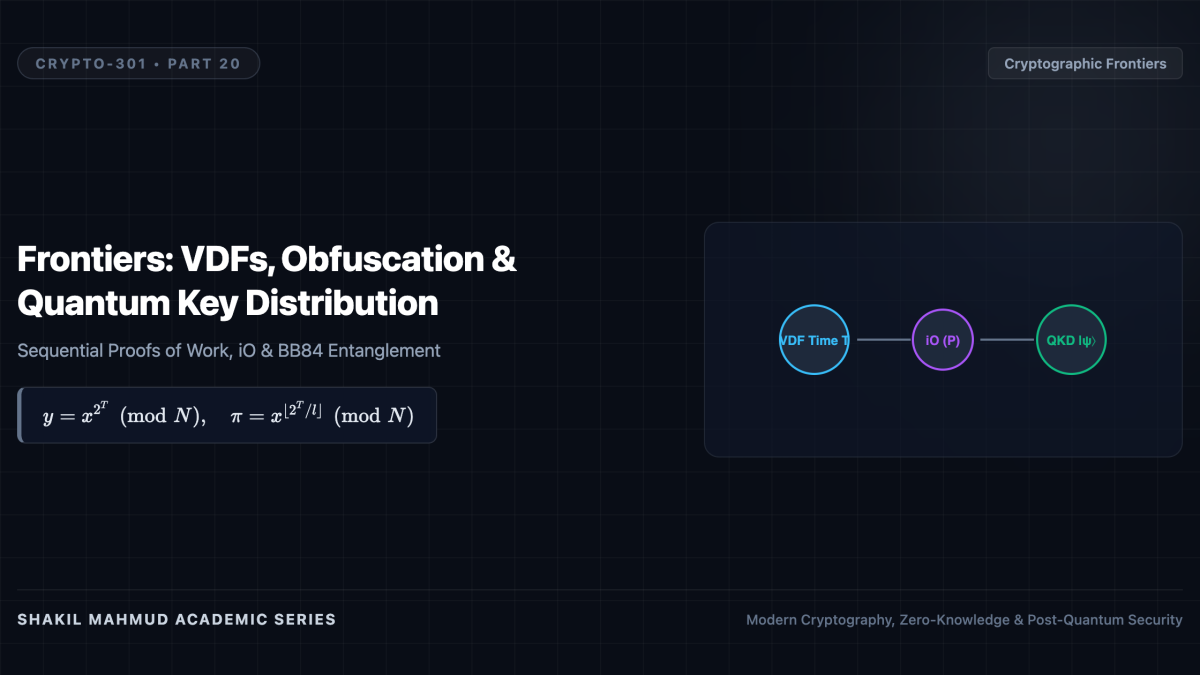
As we cross into the mid-21st century, cryptography has transcended message confidentiality to become the architectural foundation of decentralized trust, algorithmic fairness, and quantum-physical guarantees. At the outer perimeter of this intellectual frontier lie three revolutionary technologies: Verifiable Delay Functions (VDFs) that turn physical time into a cryptographic primitive, Indistinguishability Obfuscation (iO)—the “master tool” capable of generating every known cryptographic primitive—and Quantum Key Distribution (QKD) grounded in the Heisenberg uncertainty principle.
1. Verifiable Delay Functions (VDF)
In distributed consensus and randomness beacons, standard cryptographic puzzles can be solved instantly by an adversary possessing massive parallel computing power. In 2018, Dan Boneh, Joseph Bonneau, Benedikt Bünz, and Ben Fisch defined the Verifiable Delay Function (VDF): a function (f: X o Y) that requires an exact prescribed number of strictly sequential computation steps (Delta) (enforcing wall-clock physical time), yet produces an output (y) with a succinct proof (pi) that can be verified in (mathcal{O}(log Delta)) steps.
The premier construction is Wesolowski’s VDF over an RSA group (mathbb{Z}_N^*) (or class group of imaginary quadratic fields) of unknown order:
- Evaluation: Compute repeated modular squaring (T = 2^Delta) times:
[
y = x^{2^Delta} pmod N
]
Because factoring (N) is unknown and each squaring strictly depends on the output of the prior squaring, parallelization provides zero acceleration. - Succinct Proof Generation: Let (ll = H(x parallel y)) be a random prime. The prover computes the quotient (q = lfloor 2^Delta / ll
floor) and sends proof:
[
pi = x^q pmod N
] - Instant Verification: The verifier computes remainder (r = 2^Delta bmod ll) via modular exponentiation, and checks:
[
pi^ll cdot x^r stackrel{?}{=} y pmod N
]
Verification requires only two short modular exponentiations, taking under 2 milliseconds on a single CPU core!
2. Indistinguishability Obfuscation (iO): The “Master Tool”
Program obfuscation aims to scramble software source code into an unrecognizable binary blob that executes faithfully while revealing zero internal secrets (e.g., hiding a private key inside an executable). While Barak et al. (2001) proved that Virtual Black Box (VBB) obfuscation is impossible for general programs, Indistinguishability Obfuscation (iO) provides the relaxed, achievable gold standard.
An obfuscator (imathcal{O}) guarantees that for any two circuits (C_1, C_2) that compute the identical function ((orall x, C_1(x) = C_2(x))) and have identical size, their obfuscations are computationally indistinguishable:
[
imathcal{O}(C_1) approx_c imathcal{O}(C_2)
]
In 2020, Aayush Jain, Huijia Lin, and Amit Sahai achieved the monumental breakthrough of constructing iO based purely on standard polynomial hardness assumptions (LWE, Learning Parity with Noise, and PRGs in ( ext{NC}^0)). With iO, cryptographers can theoretically synthesize almost every cryptographic primitive known to science—from public-key encryption and functional encryption to non-interactive zero-knowledge—establishing iO as the universal crown jewel of theoretical computer science.
3. Quantum Key Distribution (QKD): The BB84 Protocol
While post-quantum cryptography relies on computational hardness against quantum Turing machines, Quantum Key Distribution (QKD) abandons computational assumptions entirely, grounding security in the physical laws of quantum mechanics.
Invented in 1984 by Charles Bennett and Gilles Brassard, the BB84 Protocol transmits single photons polarized across two conjugate, mutually unbiased bases: rectilinear (+) ((0^circ, 90^circ)) and diagonal ( imes) ((45^circ, 135^circ)):
- Alice prepares single photons with random bits encoded in randomly chosen bases ((+) or ( imes)) and sends them to Bob over an optical fiber.
- Bob measures each arriving photon in an independently chosen basis ((+) or ( imes)).
- Over a public authenticated radio channel, Alice and Bob announce the bases used for each photon, discarding all instances where their bases disagreed (Sifting).
By the No-Cloning Theorem and Heisenberg’s Uncertainty Principle, an eavesdropper (Eve) cannot measure a photon without irreversibly perturbing its quantum state. If Eve intercepts the photons, she introduces an unavoidable Quantum Bit Error Rate (QBER) exceeding (25%). If the measured error rate is below threshold ((approx 11%)), Alice and Bob execute error correction and privacy amplification to distill an unconditionally secure, information-theoretically secret one-time pad key.