Modern cryptography is distinct from historical heuristics and code-making: it is a rigorous branch of computational complexity theory and discrete mathematics. Rather than hoping an ad-hoc cipher resists cryptanalysis, modern cryptography builds schemes whose security is mathematically reducible to fundamental computational hardness assumptions. At the bedrock of this entire edifice lies the concept of One-Way Functions (OWFs), the existence of which directly implies (P
eq NP).
1. The Mathematical Definition of One-Way Functions
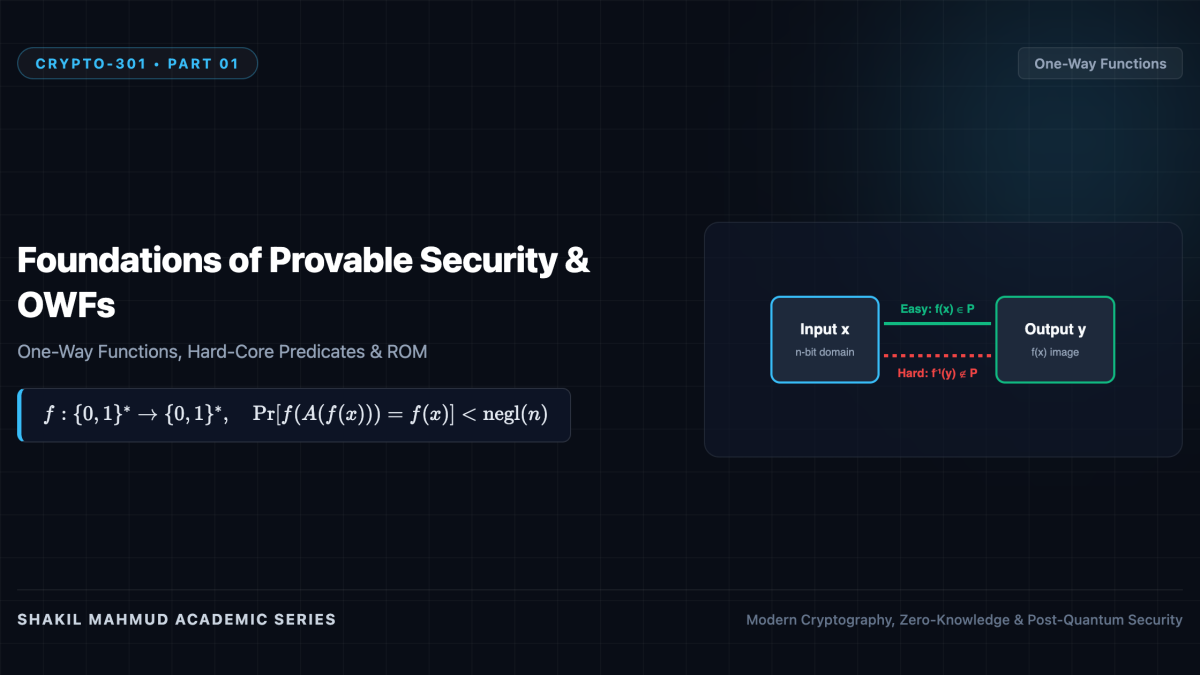
A function (f: {0,1}^* o {0,1}^*) is defined as a Strong One-Way Function if two conditions hold simultaneously:
- Easy to compute: There exists a deterministic polynomial-time algorithm (M) such that for all (x in {0,1}^*), (M(x) = f(x)).
- Hard to invert: For every probabilistic polynomial-time (PPT) adversary (mathcal{A}), every positive polynomial (p(n)), and all sufficiently large security parameters (n):
[
Pr_{x leftarrow {0,1}^n} left[ mathcal{A}(1^n, f(x)) in f^{-1}(f(x))
ight] le rac{1}{p(n)} = ext{negl}(n)
]
where the probability is taken over the uniform choice of (x in {0,1}^n) and the internal randomness of (mathcal{A}).
Notice that if (P = NP), any polynomial-time computable relation (R(x, y) = 1 iff f(x) = y) can be decided and inverted in polynomial time via non-deterministic witness search, proving that OWFs cannot exist if (P = NP). Conversely, proving the unconditional existence of one-way functions would immediately resolve the million-dollar (P ext{ vs } NP) Millennium Prize Problem.
2. Hard-Core Predicates and the Goldreich-Levin Theorem
While an adversary cannot invert (f(x)) completely, (f(x)) might nevertheless leak significant partial information about (x) (e.g., the parity or most significant bits). To extract pure, unpredictable cryptographic randomness from a one-way function, we construct a Hard-Core Predicate.
A polynomial-time computable predicate (B: {0,1}^* o {0,1}) is a hard-core predicate for (f) if guessing (B(x)) from (f(x)) is computationally indistinguishable from a random coin toss:
[
Pr_{x leftarrow {0,1}^n} left[ mathcal{A}(1^n, f(x)) = B(x)
ight] le rac{1}{2} + ext{negl}(n)
]
In 1989, Oded Goldreich and Leonid Levin proved that every one-way function can be transformed into a function with a generic hard-core predicate. Let (g(x, r) = (f(x), r)) where (|x| = |r| = n). The inner product modulo 2:
[
B(x, r) = langle x, r
angle = bigoplus_{i=1}^n x_i r_i pmod 2
]
is a hard-core predicate for (g). The proof is a tour de force of algorithmic Fourier analysis and Hadamard-Walsh decoding, showing that any adversary guessing the parity (langle x, r
angle) with advantage (psilon) can be transformed via list decoding into an algorithm that recovers (x) completely in time (mathcal{O}(n^2 psilon^{-2})).
3. Pseudorandom Generators (PRG) & The Håstad-Impagliazzo-Levin-Luby Theorem
From a one-way function and its hard-core bit, one can construct a Pseudorandom Generator (PRG): an efficient deterministic function (G: {0,1}^n o {0,1}^{n + ll(n)}) that expands a short random seed (s) into a longer string whose distribution is computationally indistinguishable from the uniform distribution (U_{n+ll(n)}):
[
left| Pr_{s leftarrow U_n} [D(G(s)) = 1] – Pr_{y leftarrow U_{n+ll}} [D(y) = 1]
ight| le ext{negl}(n)
]
The landmark HILL Theorem (1999) established that pseudorandom generators exist if and only if one-way functions exist. From PRGs, Goldreich, Goldwasser, and Micali (GGM) proved that one can construct Pseudorandom Functions (PRFs) using binary tree evaluations, forming the mathematical basis for block ciphers, MACs, and symmetric encryption.
4. The Random Oracle Model (ROM) vs. Standard Model
In theoretical cryptography, schemes are evaluated under two primary proof paradigms:
- The Standard Model: Adversaries are bounded solely by polynomial time and polynomial memory. Hardness reductions depend strictly on complexity conjectures (e.g., LWE, CDH, Factoring).
- The Random Oracle Model (ROM): Idealized by Bellare and Rogaway (1993), cryptographic hash functions are modeled as an omniscient, publicly accessible black box (mathcal{H}: {0,1}^* o {0,1}^m) that outputs fresh, uniformly distributed random bits for every novel query, while returning identical outputs for repeated queries.
While Canetti, Goldreich, and Halevi proved in 1998 that there exist uninstantiable counterexample schemes secure in the ROM but insecure for any real hash function, the ROM remains the industry standard for designing ultra-efficient practical protocols, including Fiat-Shamir transformations, RSA-OAEP, and modern zk-SNARKs.