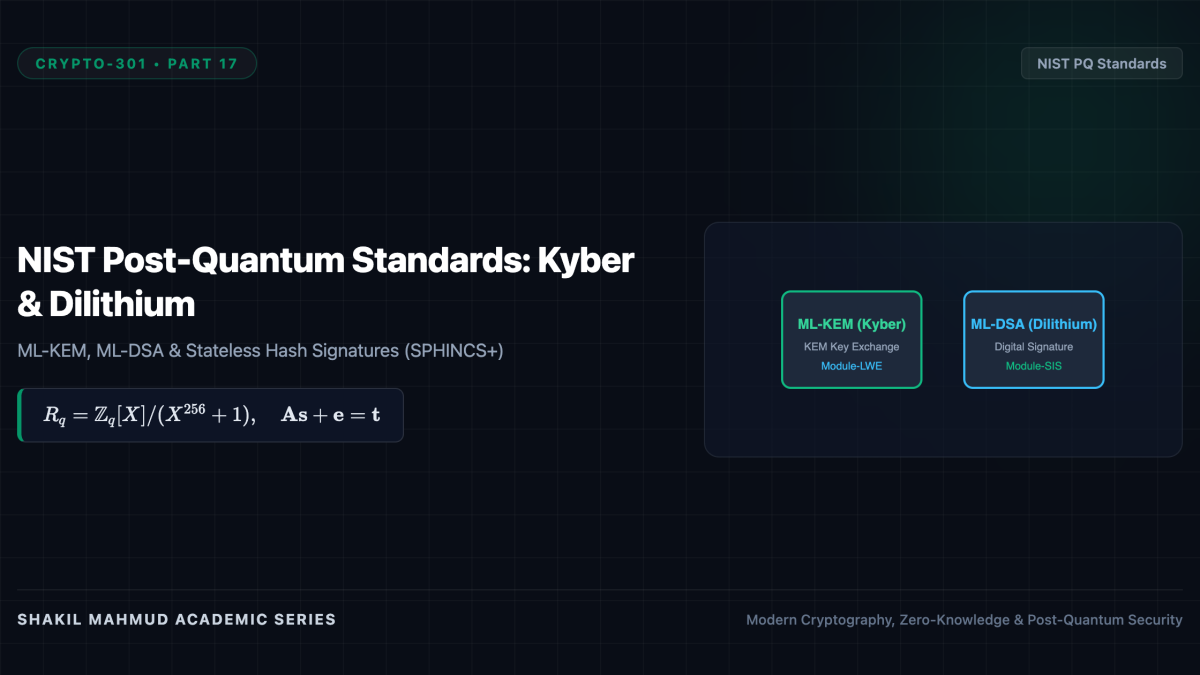
Following an intensive six-year global competition evaluating dozens of candidates, the National Institute of Standards and Technology (NIST) finalized the primary post-quantum cryptographic standards in 2024: ML-KEM (FIPS 203, formerly CRYSTALS-Kyber) for general encryption and key encapsulation, ML-DSA (FIPS 204, formerly CRYSTALS-Dilithium) for primary digital signatures, and SLH-DSA (FIPS 205, formerly SPHINCS+) as a stateless hash-based fail-safe. In this treatise, we explore the algebraic architecture of module lattices and the mathematical mechanics of these foundational standards.
1. The Algebraic Power of Module Lattices: R_q
Standard LWE offers ironclad security but requires massive matrix sizes ((sim ext{megabytes})). Ring-LWE compresses matrices into single polynomials over cyclotomic rings, but introduces potential algebraic vulnerability. Module Lattices strike the ideal compromise: vectors of dimension (k) whose entries are polynomials in the cyclotomic ring:
[
R_q = mathbb{Z}_q[X] / (X^{256} + 1)
]
where (q = 3329) (for Kyber). Multiplication of polynomials modulo (X^{256} + 1) is evaluated in (mathcal{O}(n log n)) using the Number Theoretic Transform (NTT), an integer analogue of the FFT that computes polynomial multiplication in hardware in microseconds.
2. ML-KEM (CRYSTALS-Kyber): Mechanics of Key Encapsulation
ML-KEM implements an IND-CCA2 secure Key Encapsulation Mechanism (KEM) based on Module-LWE:
- KeyGen: Sample uniform matrix (mathbf{A} leftarrow R_q^{k imes k}) from a seed using SHAKE-128. Sample small secret vector (mathbf{s}) and error vector (mathbf{e}) from a centered binomial distribution (beta_ta). The public key is:
[
mathbf{t} = mathbf{A} mathbf{s} + mathbf{e} in R_q^k
] - Encapsulation: The sender samples small ephemeral vectors (mathbf{r}, mathbf{e}_1, e_2). For message (m in {0,1}^{256}) encoded into the upper bits of polynomial (mu = ext{Decompress}(m)):
[
mathbf{u} = mathbf{A}^T mathbf{r} + mathbf{e}_1, quad v = mathbf{t}^T mathbf{r} + e_2 + mu in R_q
]
Ciphertext is (c = (mathbf{u}, v)). - Decapsulation: The recipient computes:
[
v – mathbf{s}^T mathbf{u} = (mathbf{t}^T mathbf{r} + e_2 + mu) – mathbf{s}^T (mathbf{A}^T mathbf{r} + mathbf{e}_1) = mu + left( mathbf{e}^T mathbf{r} + e_2 – mathbf{s}^T mathbf{e}_1
ight)
]
Because the error term (|mathbf{e}^T mathbf{r} + e_2 – mathbf{s}^T mathbf{e}_1|_infty < q/4), threshold rounding recovers (m) with decryption failure probability below (2^{-140}). The Fujisaki-Okamoto (FO) transform re-encrypts the recovered message to guarantee IND-CCA2 security against chosen-ciphertext attackers.
3. ML-DSA (CRYSTALS-Dilithium) & “Fiat-Shamir with Aborts”
Constructing digital signatures from lattices cannot use standard Fiat-Shamir directly: the response vector (mathbf{z} = mathbf{y} + c mathbf{s}) leaks the secret key (mathbf{s}) through correlation with the error distribution. Vadim Lyubashevsky solved this via Rejection Sampling (Fiat-Shamir with Aborts):
- Sample masking vector (mathbf{y} leftarrow [-gamma_1, gamma_1]^l). Compute (mathbf{w}_1 = ext{HighBits}(mathbf{A} mathbf{y})).
- Compute challenge hash (c = H(m parallel mathbf{w}_1)).
- Compute candidate response (mathbf{z} = mathbf{y} + c mathbf{s}).
- Rejection Step: If (|mathbf{z}|_infty ge gamma_1 – beta), abort and restart with fresh (mathbf{y}).
Rejection sampling guarantees that accepted signatures (mathbf{z}) follow a distribution completely independent of secret key (mathbf{s}), providing tight security reductions based on Module Short Integer Solution (M-SIS).
4. SLH-DSA (SPHINCS+): Stateless Hash-Based Signatures
As a hedge against unforeseen structural breakthroughs in lattice mathematics, NIST standardized SLH-DSA. Relying solely on the collision resistance of cryptographic hashes (SHA-256 or SHAKE-256), SLH-DSA builds a multi-level hyper-tree of Winternitz One-Time Signatures (WOTS+) and Few-Time Signatures (FORS). While public keys and signatures are larger ((sim 8) to (49) KB), SLH-DSA provides the most conservative, mathematically unassailable security foundation in existence.