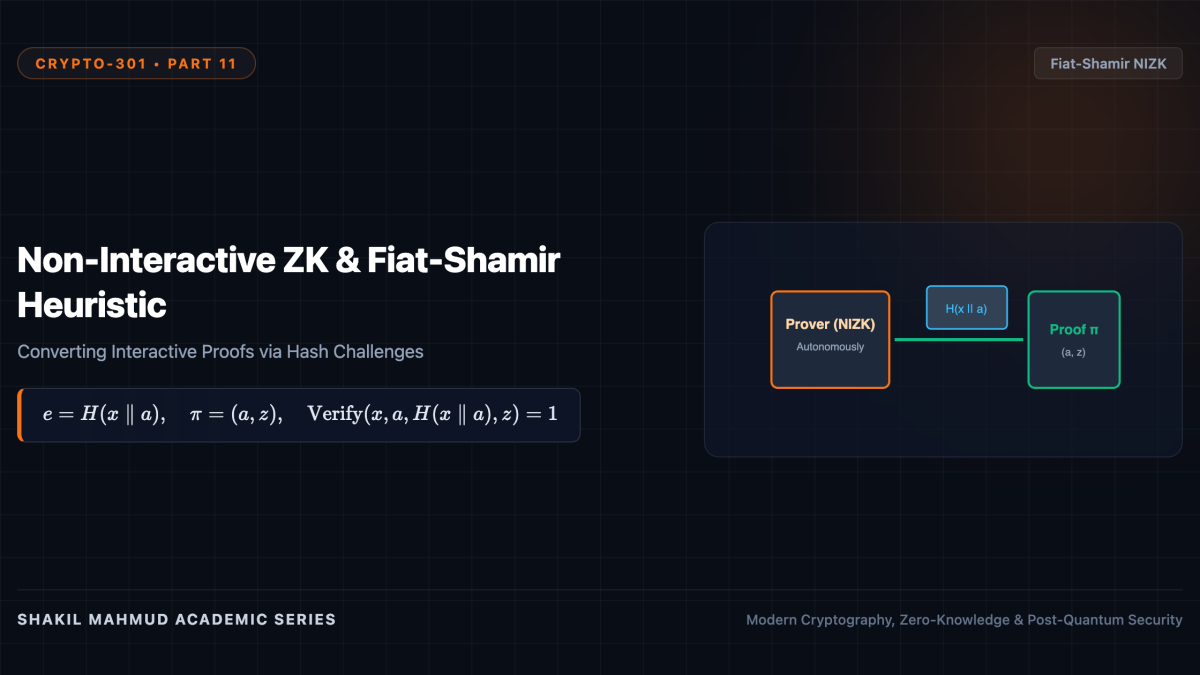
Interactive zero-knowledge proofs are fundamentally conversational: the verifier must generate random challenges in real-time, preventing the proof from being published on a public blockchain ledger, verified asynchronously, or broadcast to millions of observers simultaneously. In 1986, Amos Fiat and Adi Shamir solved this dilemma by introducing the Fiat-Shamir Heuristic: replacing the interactive verifier with a cryptographic hash function evaluated on the statement and the prover’s initial commitments, transforming multi-round public-coin proofs into autonomous Non-Interactive Zero-Knowledge (NIZK) arguments.
1. Sigma Protocols ((Sigma)-Protocols)
A 3-round interactive proof for a relation (R = {(x, w)}) is called a (Sigma)-Protocol if it follows a canonical three-step structure:
- Commitment (Message (a)): Prover samples random ephemeral coins (r) and sends initial commitment (a = P_1(x, w; r)).
- Challenge (Message (e)): Verifier samples a uniform random challenge (e leftarrow {0,1}^t) from a public challenge space (public-coin).
- Response (Message (z)): Prover computes response (z = P_2(x, w, r, e)) and sends (z) to Verifier.
- Verification: Verifier evaluates deterministic predicate (phi(x, a, e, z) in {0, 1}).
A valid (Sigma)-protocol satisfies Special Soundness: given two accepting transcripts ((a, e, z)) and ((a, e’, z’)) with identical commitments (a) but distinct challenges (e
eq e’), the secret witness (w) can be extracted in polynomial time via simple algebraic division or subtraction.
2. The Fiat-Shamir Transformation
The Fiat-Shamir transformation converts any public-coin (Sigma)-protocol into a non-interactive argument in the Random Oracle Model (ROM) by removing the interactive verifier. The prover computes the challenge autonomously by evaluating a cryptographic hash function (mathcal{H}):
[
e = mathcal{H}(x parallel a)
]
The complete non-interactive proof is the compact pair (pi = (a, z)). To verify (pi), anyone possessing public input (x) independently evaluates:
[
e’ = mathcal{H}(x parallel a), quad ext{and checks } phi(x, a, e’, z) stackrel{?}{=} 1
]
Soundness in the ROM is rock-solid: because a cryptographic hash function behaves as a random oracle, the prover cannot predict (e) before choosing commitment (a). Any attempt to bias or forge the response (z) requires inverting the random oracle or finding collisions, bounding the forging probability by (mathcal{O}(Q_{mathcal{H}} / 2^t)) where (Q_{mathcal{H}}) is the number of hash queries.
3. Adaptive Soundness & The Fiat-Shamir Trap
While elegant, naive implementations of Fiat-Shamir often suffer from catastrophic vulnerabilities if the public statement (x) is omitted from the hash input: (e = mathcal{H}(a)). In 2019, security audits revealed that multiple production ZK systems (including Bulletproofs implementations) failed to bind (x) into the challenge:
The Frozen Heart Vulnerability: If (e = mathcal{H}(a)), a malicious prover can generate commitment (a), compute challenge (e), compute response (z), and afterwards find a false statement (x^*) for which the verification equation holds! Always enforce: (e = mathcal{H}( ext{protocol_tag} parallel x parallel a)).
4. Generalized NIZKs and Common Reference Strings (CRS)
In the Standard Model (without random oracles), non-interactive zero-knowledge requires a Common Reference String (CRS): a trusted public parameter string (sigma) accessible to both parties. Feige, Lapidot, and Shamir proved that under standard hardness assumptions (e.g., existence of trapdoor permutations), CRS-based NIZKs exist for all NP languages, providing the conceptual bridge from (Sigma)-protocols to modern universal SNARKs.