Symmetric-key cryptography underpins the confidential transmission of petabytes of planetary data every second. While classical ciphers relied on fragile permutations, modern block ciphers transform plaintexts through iterated Substitution-Permutation Networks (SPN) or Feistel structures. In this treatise, we explore the algebraic foundations of the Advanced Encryption Standard (AES), the mathematics of finite field inversion in ( ext{GF}(2^8)), and provable security bounds against differential and linear cryptanalysis.
1. Feistel Networks and the Luby-Rackoff Theorem
In a classical Feistel Network, a (2n)-bit block is split into left and right halves ((L_i, R_i)). At round (i in {1, dots, r}), the cipher evaluates an arbitrary round function (F_i: {0,1}^n o {0,1}^n) governed by subkey (K_i):
[
L_{i+1} = R_i, quad R_{i+1} = L_i oplus F_i(R_i)
]
The cardinal structural brilliance of the Feistel design is that decryption is mathematically identical to encryption: running the rounds in reverse with keys (K_r, dots, K_1) recovers the plaintext regardless of whether the round function (F) is invertible or not.
In 1988, Michael Luby and Charles Rackoff proved the foundational Luby-Rackoff Theorem: if round functions (F_1, dots, F_4) are chosen independently from a secure family of pseudorandom functions (PRFs), then a 4-round Feistel network is a Strong Pseudorandom Permutation (SPRP), meaning no polynomial-time adversary with adaptive chosen-plaintext and chosen-ciphertext queries can distinguish the cipher from a truly uniform permutation with advantage exceeding (mathcal{O}(q^2 / 2^n)).
2. The Architecture of AES (Rijndael) and GF(2⁸) Inversion
Unlike DES, the Advanced Encryption Standard (AES) is a pure Substitution-Permutation Network (SPN) operating on a (4 imes 4) array of bytes known as the State. Each of the 10, 12, or 14 rounds (for 128, 192, and 256-bit keys) executes four distinct algebraic layers:
- SubBytes: Non-linear byte substitution via the AES S-box.
- ShiftRows: Cyclically shifting row (r) left by (r) bytes ((r in {0,1,2,3})), providing inter-column diffusion.
- MixColumns: Matrix multiplication in ( ext{GF}(2^8)) over the irreducible polynomial (m(x) = x^8 + x^4 + x^3 + x + 1).
- AddRoundKey: XORing the state with the round subkey: (S leftarrow S oplus K_i).
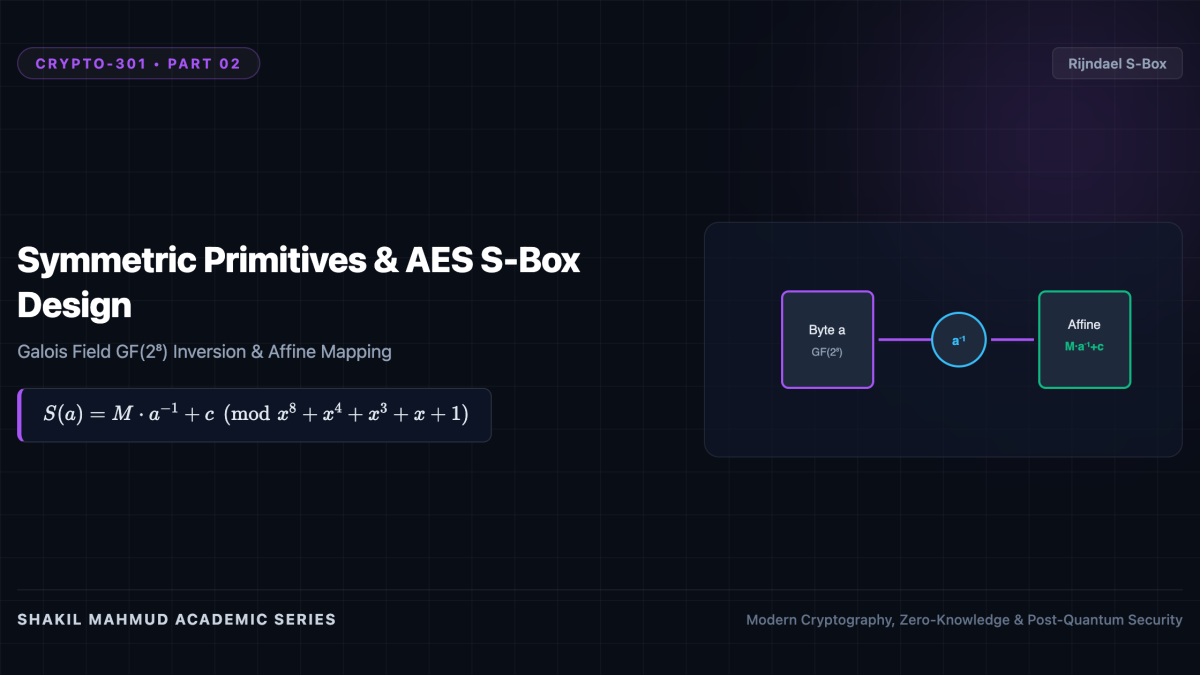
The heart of AES resistance against mathematical attack is the S-Box. An input byte (a in ext{GF}(2^8)) undergoes two consecutive mappings:
- Multiplicative Inversion: Compute (a^{-1}) in the finite field ( ext{GF}(2^8) cong mathbb{F}_2[x] / (x^8 + x^4 + x^3 + x + 1)), with the convention that (0^{-1} = 0).
- Affine Transformation: Multiply by an invertible binary matrix (M in mathbb{F}_2^{8 imes 8}) and add constant vector (c = 0 ext{x}63):
[
s_i = a’_i oplus a’_{(i+4) bmod 8} oplus a’_{(i+5) bmod 8} oplus a’_{(i+6) bmod 8} oplus a’_{(i+7) bmod 8} oplus c_i
]
Field inversion (x mapsto x^{254}) provides maximum non-linearity and optimal differential branch resistance, while the affine transformation breaks simple algebraic symmetries in the field that could otherwise be exploited by polynomial interpolation attacks.
3. Differential and Linear Cryptanalysis
Modern symmetric primitives are engineered specifically to minimize two canonical attack vectors:
- Differential Cryptanalysis (Biham & Shamir): Tracks the propagation of input differences (Delta x = x oplus x^*) through rounds to observe output differences (Delta y = y oplus y^*). The Difference Distribution Table (DDT) of the AES S-box has a maximum entry of 4 (differential uniformity (delta = 4/256 = 2^{-6})), ensuring that any 4-round differential characteristic has probability bounded well below (2^{-128}).
- Linear Cryptanalysis (Matsui): Finds linear approximations between plaintext bits, ciphertext bits, and key bits: (alpha cdot P oplus beta cdot C = gamma cdot K). The maximum linear probability bias for the AES S-box is (2^{-3}). Over four rounds, the Wide Trail Strategy guarantees at least 25 active S-boxes, yielding a compound correlation bias below (2^{-75}), far below the threshold of feasibility.