Every public-key protocol governing planetary financial ledgers, encrypted messaging, and state secrets (RSA, ECDSA, Diffie-Hellman) shares a fatal vulnerability: it relies on integer factoring or discrete logarithms in Abelian groups. In 1994, Peter Shor demonstrated that a fault-tolerant quantum computer running the Quantum Fourier Transform (QFT) solves both problems in polynomial time (mathcal{O}(n^3)), extinguishing classical public-key cryptography. In response, modern cryptography transitioned to Lattice-Based Cryptography: grounded in high-dimensional geometric hardness that resists both classical and quantum algorithms.
1. Shor’s Algorithm & The Hidden Subgroup Problem
Shor’s breakthrough exploits the fact that both factoring and discrete logarithms are manifestations of the Abelian Hidden Subgroup Problem (HSP). Given group (G) and function (f) constant and distinct on cosets of subgroup (H le G), finding (H) on a classical computer requires exponential queries.
Shor proved that quantum superposition combined with the Quantum Fourier Transform isolates the period (r) of (f(x) = a^x pmod N) in polynomial time:
[
|psi
angle = rac{1}{sqrt{Q}} sum_{x=0}^{Q-1} |x
angle |a^x bmod N
angle xrightarrow{ ext{QFT}} ext{destructive interference leaves only states near } rac{k}{r}
]
Measuring the state yields (r) via continued fractions. If (r) is even, (gcd(a^{r/2} pm 1, N)) yields non-trivial prime factors of (N). A quantum computer with (sim 4000) logical qubits would factor a 2048-bit RSA key in hours.
2. Lattices & Geometric Hardness: SVP and CVP
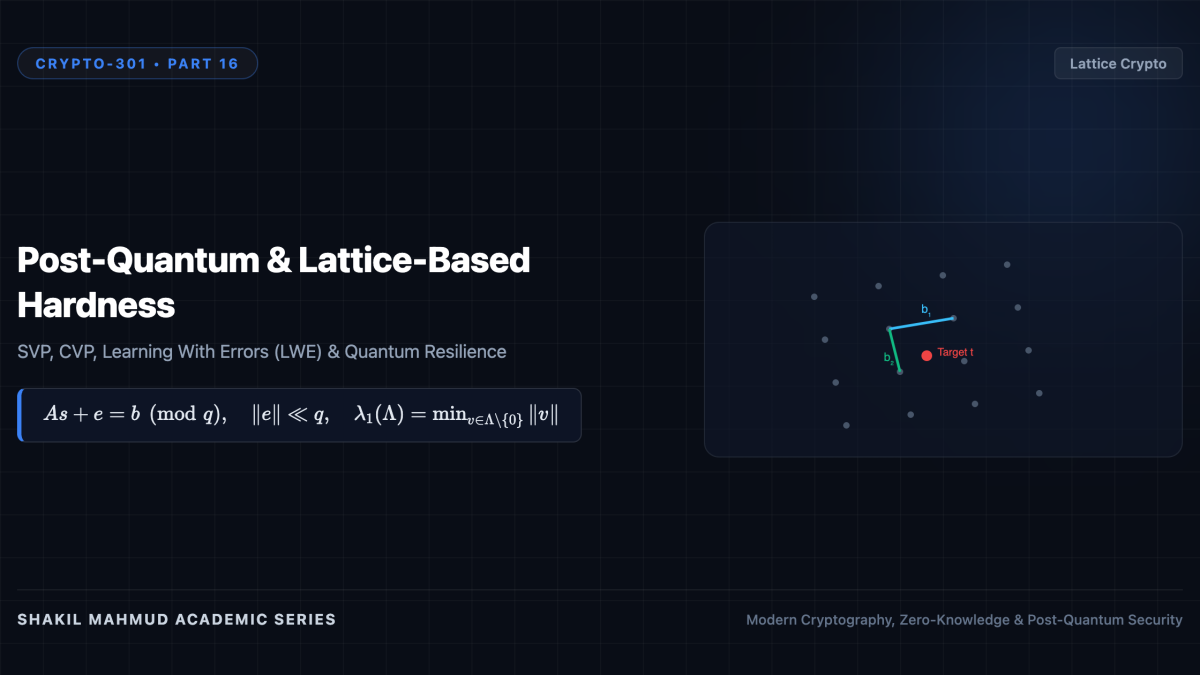
A Lattice (Lambda subset mathbb{R}^n) is the discrete set of all integral linear combinations of (n) linearly independent basis vectors (mathbf{b}_1, dots, mathbf{b}_n in mathbb{R}^n):
[
Lambda = mathcal{L}(mathbf{B}) = left{ sum_{i=1}^n z_i mathbf{b}_i middle| z_i in mathbb{Z}
ight} = mathbf{B} mathbb{Z}^n
]
The fundamental parallelotope has determinant (det(Lambda) = sqrt{det(mathbf{B}^T mathbf{B})}). Lattices host problems proven to be NP-hard or classically/quantually intractable in high dimensions ((n ge 500)):
- Shortest Vector Problem (( ext{SVP}_gamma)): Find a non-zero vector (mathbf{v} in Lambda setminus {mathbf{0}}) such that (|mathbf{v}| le gamma lambda_1(Lambda)), where (lambda_1(Lambda)) is the length of the shortest non-zero lattice vector. Minkowski’s theorem guarantees (lambda_1(Lambda) le sqrt{n} det(Lambda)^{1/n}).
- Closest Vector Problem (( ext{CVP}_gamma)): Given target (mathbf{t} in mathbb{R}^n), find (mathbf{v} in Lambda) minimizing (|mathbf{t} – mathbf{v}|).
Lattice problems lack the periodic Abelian symmetry of discrete logs: no polynomial-time quantum algorithm is known. The best known algorithms (BKZ lattice reduction) require time (approx 2^{0.292 k}) where (k) is the block size.
3. Learning With Errors (LWE) & Regev’s Reduction
In 2005, Oded Regev introduced the Learning With Errors (LWE) problem, providing the foundational engine for post-quantum encryption and Fully Homomorphic Encryption.
Let (n, q) be integers and (chi) an error distribution over (mathbb{Z}_q) (typically a discrete Gaussian with standard deviation (sigma = alpha q)). Let (mathbf{s} leftarrow mathbb{Z}_q^n) be a secret vector. The adversary receives samples of the form:
[
(mathbf{a}_i, b_i = mathbf{a}_i cdot mathbf{s} + e_i bmod q), quad ext{where } mathbf{a}_i leftarrow mathbb{Z}_q^n, e_i leftarrow chi
]
In matrix form: (mathbf{A} mathbf{s} + mathbf{e} = mathbf{b} pmod q). Without the error term (mathbf{e}), recovering (mathbf{s}) is trivial via Gaussian elimination in (mathcal{O}(n^3)). With tiny random perturbations (e_i), the system becomes computationally intractable.
Regev’s Theorem: If there exists an efficient algorithm to solve LWE, then there exists a quantum algorithm that solves the worst-case Shortest Independent Vectors Problem (SIVP) on any (n)-dimensional lattice. This worst-case to average-case reduction provides unprecedented security guarantees: breaking LWE for random keys breaks lattice problems for their hardest possible configurations.