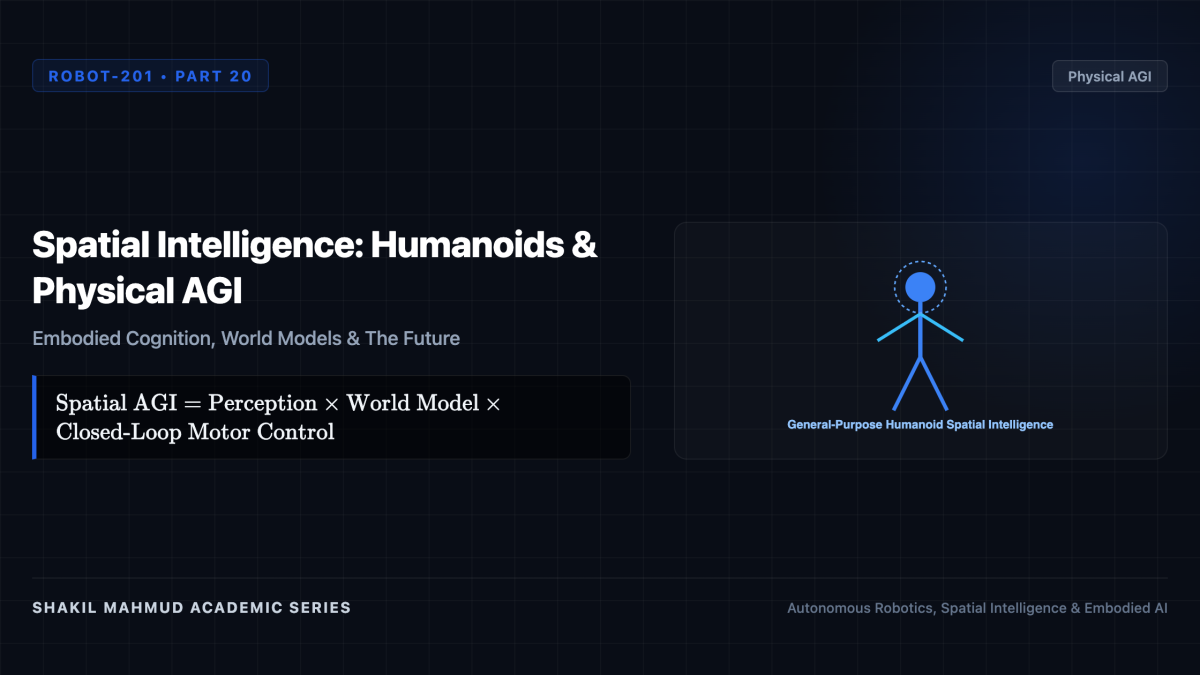
The ultimate frontier of artificial intelligence is not manipulating abstract pixels or text strings on internet servers, but acting purposefully within the unconstrained, unforgiving physical universe. Spatial Intelligence unites 3D geometric perception, dynamic physics simulation, dexterous manipulation, and embodied foundation models. As bipedal humanoids transition from research laboratories to automotive assembly lines and domestic households, robotics stands at the threshold of Physical Artificial General Intelligence (Physical AGI).
1. Why the Humanoid Form Factor?
Decades of debate questioned whether robots should resemble humans. Today, the industrial consensus has decisively converged on the bipedal humanoid morphology (e.g., Tesla Optimus, Figure 02, Boston Dynamics Atlas, Sanctuary AI Phoenix):
- Anthropomorphic Built Environment: The entire human world—door handles, staircases, factory shelves, vehicle pedals, hand drills, and surgical suites—was engineered exclusively for a bipedal creature standing (1.7 ext{ meters}) tall with two arms and opposable thumbs.
- Data Synergy: First-person egocentric video datasets (millions of hours of humans cooking, assembling machinery, and performing surgery) can be mapped directly into humanoid kinematic skeletons via retargeting without complex morphological re-mapping.
- Universal Flexibility: A wheeled specialized arm can only perform one narrow task in one room. A general-purpose humanoid can unload trucks in the morning, assemble transmissions in the afternoon, and prepare meals in the evening.
2. The Triad of Physical AGI
True embodied physical general intelligence requires the integration of three computational pillars:
[
ext{Physical AGI} = ext{Spatial World Model} imes ext{Embodied Foundation Model} imes ext{High-Frequency Motor Control}
]
- Spatial World Models: Generative 4D neural physics engines (e.g., dynamic 3D Gaussian Splatting, NeRFs, video world simulators) that predict the geometric and physical consequences of actions (“If I push this stack of plates, how will they slide and tip?”) before applying motor torque.
- Embodied Foundation Models (VLA): Multimodal transformers bridging open-vocabulary human language instructions, semantic visual reasoning, and continuous action tokens.
- Whole-Body Reactive Control (1 kHz): Millisecond-level feedback loops running whole-body MPC and impedance control, dynamically absorbing shocks, preventing falls, and regulating contact forces.
3. Techno-Economics of Industrial Humanoids
The economic inflection point for physical robotics is governed by the capital cost amortized over service life:
[
ext{Operational Cost per Hour} = rac{ ext{CAPEX} + ext{Maintenance Lifetime}}{ ext{Operating Hours}} approx rac{$25,000 + $15,000}{20,000 ext{ hours}} approx $2.00/ ext{hour}
]
At ($2 ext{–}$4) per hour operating cost, humanoids operating 24/7 without fatigue, shift changes, or injuries will fundamentally restructure global manufacturing, logistics, elderly healthcare, and construction, liberating humanity from dangerous, repetitive, and debilitating physical labor.
4. The Grand Horizon: From Earth to the Stars
From the kinematic foundations of Lie groups and the PoE formula to deep reinforcement learning, SLAM, and embodied foundation models, robotics has unified classical mechanics with modern artificial intelligence. Empowered with spatial intelligence, autonomous robots will build planetary infrastructure, construct orbital solar arrays, explore deep ocean trenches, and establish self-sustaining human settlements across the Solar System.