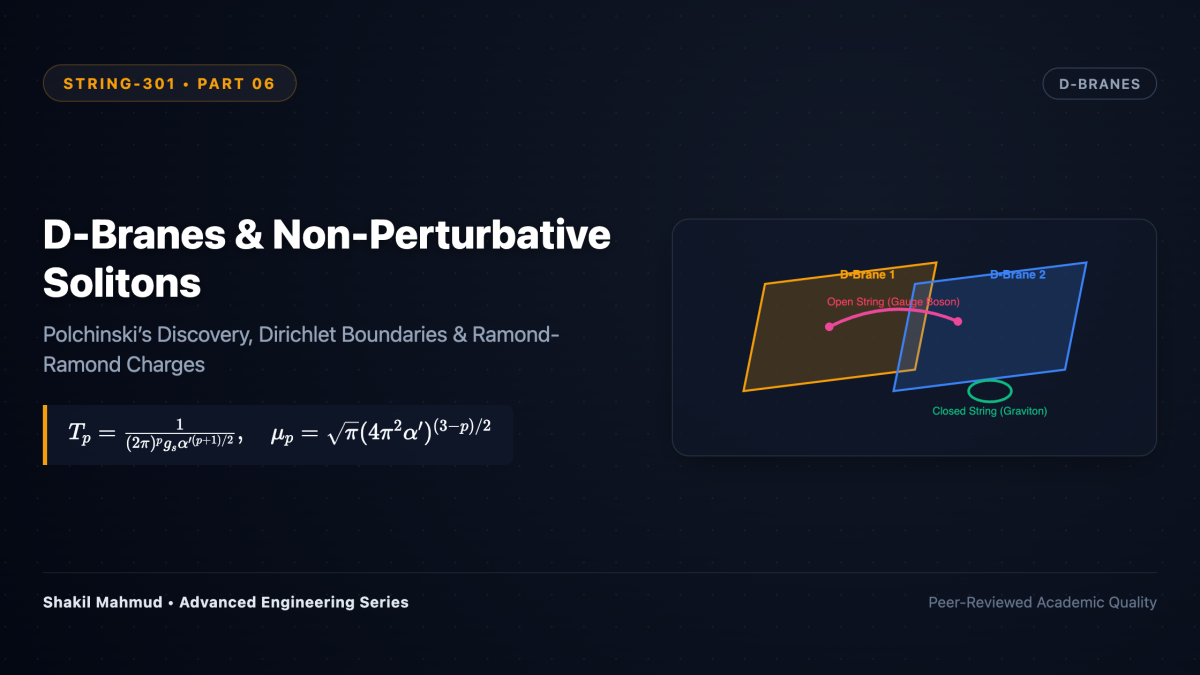
For the first twenty-five years of string theory, physicists believed that strings were the only fundamental objects in the universe. Open strings had boundaries: endpoints freely sliding at the speed of light under Neumann boundary conditions. In 1995, Joseph Polchinski made one of the most transformative breakthroughs in theoretical physics: demonstrating that Dirichlet boundary conditions—where open string endpoints are anchored to a hyper-surface—are not mathematical contrivances, but describe massive, dynamical non-perturbative solitons carrying conserved Ramond-Ramond charges. These dynamical hypersurfaces are Dirichlet-Branes (D-Branes).
1. Neumann vs. Dirichlet Boundary Conditions
Varying the open string action produces the boundary variation term (int d au left[ partial_sigma X^mu delta X_mu
ight]_{sigma=0}^{sigma=pi} = 0). For each spacetime coordinate (mu in {0, dots, D-1}), two boundary conditions satisfy this vanishing:
- Neumann Boundary Condition: (partial_sigma X^mu = 0) at (sigma in {0, pi}). Momentum is conserved across the endpoint, allowing the string endpoint to slide freely in spacetime.
- Dirichlet Boundary Condition: (delta X^mu = 0 implies X^mu( au, sigma=0) = c_0^mu) and (X^mu( au, sigma=pi) = c_pi^mu). The string endpoints are rigidly locked onto a fixed sub-manifold of spacetime.
If (p+1) coordinates satisfy Neumann conditions ((mu = 0, dots, p)) and (D – (p+1)) coordinates satisfy Dirichlet conditions ((mu = p+1, dots, D-1)), the open string endpoints are constrained to move along a ((p+1))-dimensional hypersurface. This hypersurface is a ( ext{D}p)-Brane (a ( ext{D}0)-brane is a point-like particle, a ( ext{D}1)-brane is a string, a ( ext{D}2)-brane is a membrane, a ( ext{D}3)-brane is a 3-dimensional spatial volume).
2. Polchinski’s Discovery: D-Branes Carry Ramond-Ramond Charges
In Type II superstring theories, the Ramond-Ramond sector contains antisymmetric tensor gauge potentials (C_{p+1}). In ordinary perturbative string theory, fundamental strings (F1) carry electric charge under the NS-NS 2-form (B_2), but zero charge under any R-R field: (int_{S^1} C_{p+1} = 0). For decades, physicists were perplexed: if superstring theory has R-R gauge fields, what charged objects act as their sources?
In his landmark 1995 paper, Polchinski proved that ( ext{D}p)-branes are the exact non-perturbative sources carrying unit Dirac electric and magnetic charge under the ((p+1))-form R-R potentials:
[
mu_p = sqrt{pi} (4pi^2 alpha’)^{(3-p)/2}
]
Furthermore, D-branes are BPS (Bogomol’nyi-Prasad-Sommerfield) States: they preserve half of spacetime supersymmetry ((16) supercharges), and their tension is exactly saturated by their central charge:
[
T_p = rac{mu_p}{g_s} = rac{1}{(2pi)^p g_s alpha’^{(p+1)/2}} propto rac{1}{g_s}
]
Because the tension scales as (1/g_s) (rather than (1/g_s^2) like field theory solitons), D-branes are non-perturbative states that become extraordinarily heavy at weak coupling ((g_s ll 1)), acting as stable gravitational and gauge anchors in spacetime.
3. Non-Abelian Gauge Symmetry on Coincident D-Branes
Consider a single ( ext{D}p)-brane. The lowest-lying open string mode with both endpoints anchored on the brane is a massless vector field (A_mu) living on the brane worldvolume: a ( ext{U}(1)) Maxwell gauge field (photons).
Now consider a stack of (N) coincident parallel ( ext{D}p)-branes. Open strings can begin on brane (i) and end on brane (j) ((i, j in {1, dots, N})). These strings carry Chan-Paton matrix indices (|i, j
angle). As the branes coincide, the mass of the stretched strings vanishes:
[
M_{ij}^2 = rac{|mathbf{x}_i – mathbf{x}_j|^2}{(2pialpha’)^2} xrightarrow{mathbf{x}_i o mathbf{x}_j} 0
]
The (N^2) massless vector bosons transform in the adjoint representation of the non-Abelian Lie algebra (mathfrak{u}(N)). A stack of (N) coincident D-branes naturally synthesizes ( ext{U}(N)) Yang-Mills Gauge Theory!
The low-energy dynamics of the D-brane are governed by the Dirac-Born-Infeld (DBI) Action coupled to the Wess-Zumino topological charge term:
[
S_{ ext{D}p} = -T_p int d^{p+1}sigma , e^{-Phi} sqrt{-det(P[g + B]_{ab} + 2pialpha’ F_{ab})} + mu_p int sum_n P[C_n] wedge e^{2pialpha’ F + B}
]
Through Polchinski’s D-branes, gauge theories, gravity, and spacetime geometry were unified into a single coherent non-perturbative framework, setting the stage for the holographic revolution.