In March 1995, at the University of Southern California Strings ’95 conference, Edward Witten stepped up to the podium and delivered an address that permanently altered the landscape of theoretical physics, igniting the Second Superstring Revolution. For a decade, physicists had wrestled with five disparate, competing 10-dimensional superstring theories. Witten demonstrated that these five theories, along with 11-dimensional supergravity, are merely perturbatively distinct asymptotic corners of a single, majestic, non-perturbative 11-dimensional master theory: M-Theory.
1. The Expanding Eleventh Dimension
Consider 10-dimensional Type IIA superstring theory at string coupling constant (g_s = e^{langle Phi
angle}). In the Type IIA spectrum, the D0-brane is a point-like particle carrying unit R-R 1-form gauge charge with mass:
[
M_{ ext{D}0} = rac{1}{g_s ll_s}
]
For bound states of (n) D0-branes, the mass spectrum is precisely integer-spaced:
[
M_n = rac{n}{g_s ll_s}
]
Witten made a breathtaking observation: this formula is structurally identical to the Kaluza-Klein Tower of momentum modes for a massless field compactified on a circle of radius (R_{11}):
[
M_{ ext{KK}} = rac{n}{R_{11}}
]
Comparing the two formulas reveals the profound relation:
[
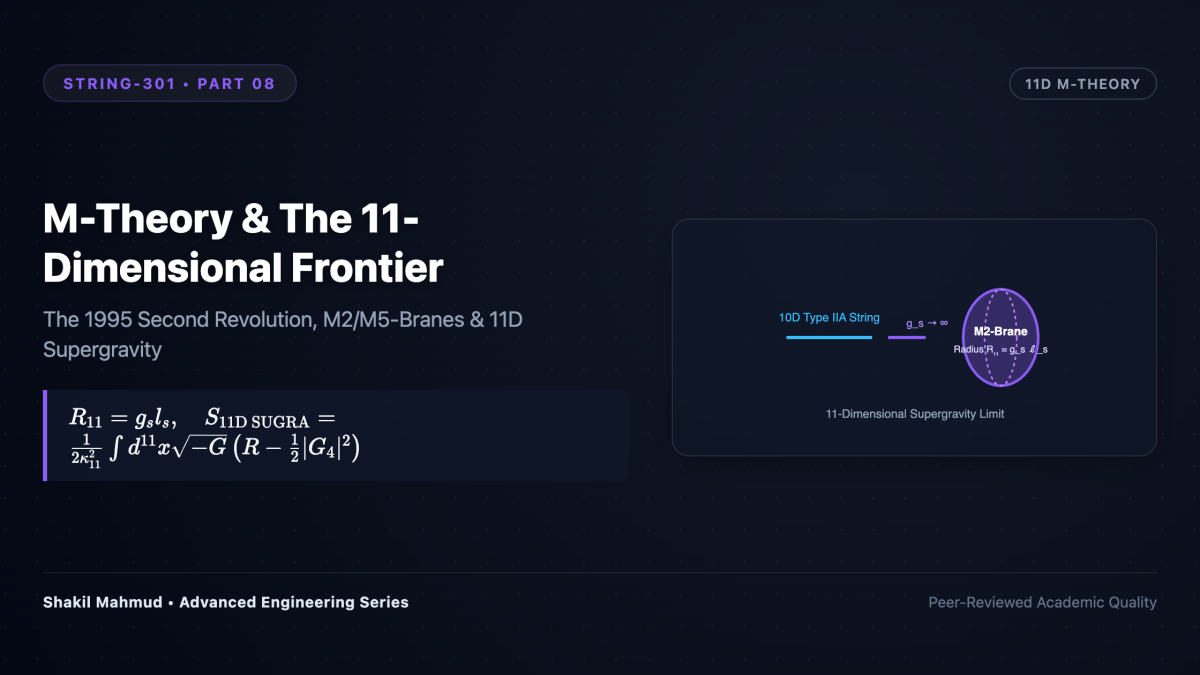
R_{11} = g_s ll_s = g_s sqrt{alpha’}
]
At weak coupling ((g_s o 0)), the radius (R_{11} o 0): the 11th dimension shrinks away, making spacetime appear purely 10-dimensional. But as the string coupling is tuned to strong coupling ((g_s o infty)), an entire eleventh spatial dimension decompresses and opens up into macroscopic spacetime! The fundamental 10D Type IIA string is revealed to be a two-dimensional membrane wrapped around this 11th circular dimension.
2. The Low-Energy Limit: 11-Dimensional Supergravity
In 1978, Eugène Cremmer, Bernard Julia, and Joël Scherk proved that supersymmetry cannot exist in dimensions greater than eleven without introducing particles of spin greater than 2. The maximum possible supersymmetric field theory is 11D Supergravity (11D SUGRA) with (mathcal{N}=1) supersymmetry ((32) real supercharges).
Its field content is uniquely sparse and elegant, consisting of only three fields totaling 128 bosonic and 128 fermionic degrees of freedom:
- Vielbein / Metric ((e_M^A / G_{MN})): 44 physical degrees of freedom.
- 3-Form Gauge Field ((C_3 = C_{MNP} dx^M wedge dx^N wedge dx^P)): 84 physical degrees of freedom.
- Gravitino ((Psi_M)): 128 fermionic physical degrees of freedom.
The 11D supergravity action is:
[
S_{ ext{11D}} = rac{1}{2kappa_{11}^2} int d^{11}x , sqrt{-G} left( R – rac{1}{2}|G_4|^2
ight) – rac{1}{12kappa_{11}^2} int C_3 wedge G_4 wedge G_4 + S_{ ext{fermionic}}
]
where (G_4 = d C_3) is the 4-form field strength, and the Chern-Simons topological term (C_3 wedge G_4 wedge G_4) is required for local supersymmetry. Eleven-dimensional supergravity is the low-energy effective field theory of M-theory.
3. The Fundamental Objects of M-Theory: M2 and M5-Branes
M-theory contains no fundamental 1D strings. Instead, the 3-form potential (C_3) and its dual 6-form potential ( ilde{C}_6) couple naturally to two fundamental extended supersymmetric objects:
- The M2-Brane (Membrane): An electrically charged 2-dimensional spatial membrane with worldvolume action:
[
S_{ ext{M2}} = -T_{ ext{M2}} int d^3xi sqrt{-det(g_{ij})} + mu_{ ext{M2}} int P[C_3]
]
When an M2-brane wraps around the compact 11th circle (S^1(R_{11})), it appears in 10 dimensions as the fundamental Type IIA string (( ext{F}1)). When unwrapped, it descends to the ( ext{D}2)-brane. - The M5-Brane (Fivebrane): The magnetic dual of the M2-brane, wrapping a 5-dimensional spatial volume. In 10 dimensions, wrapped M5-branes become D4-branes, while unwrapped M5-branes become NS5-branes.
4. The Web of Dualities and Horava-Witten Compactification
Witten and Petr Horava showed that compactifying M-theory not on a circle (S^1), but on an orbifold interval (S^1/mathbb{Z}_2) (a line segment bounded by two 10D boundary planes) yields Heterotic (E_8 imes E_8). Each 10D boundary world carries an (E_8) Yang-Mills gauge theory, providing the first concrete realization of “Brane-World” cosmology.
With M-theory at the apex, all five superstring theories—Type I, Type IIA, Type IIB, Heterotic ( ext{SO}(32)), and Heterotic (E_8 imes E_8)—were unified into a singular non-perturbative web connected by S, T, and M-dualities. The five “theories” are simply asymptotic limits of one master framework: M-Theory.